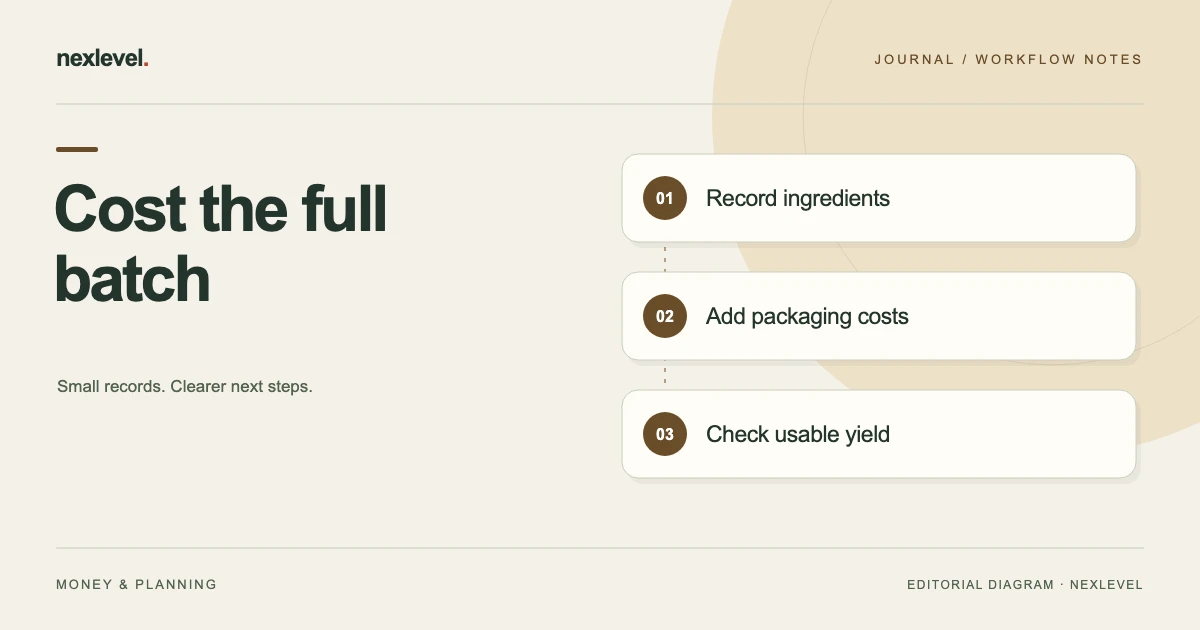
A candle batch costing sheet should explain how supplier packs become consumed material costs, how shared work is allocated, and how actual yield changes the cost per unit. A recipe can be repeatable while its cost record remains incomplete if vessels, packaging, labor, or unusable output are omitted.
This template organizes costing around an existing tested recipe and a recorded batch. It includes fictional pack prices and a worked cost example. It does not recommend a formula, fragrance load, wick, process temperature, test schedule, or selling price, and a cost calculation does not establish that a candle is ready for sale.
Separate the recipe, cost basis, and batch
The recipe defines the formulation being used. The cost basis identifies the supplier prices and other planning assumptions. The batch records a particular production event, including actual consumption and yield. Keep these related records distinct.
Give the recipe a version and the batch a separate identifier. If a recipe changes, preserve which version produced the earlier batch. If supplier prices change, a new estimate can use the new cost basis without rewriting the historical batch.
Record the intended cost boundary. You may be calculating consumed materials only, production cost including labor and overhead, or a channel-specific pricing scenario. A number labeled “unit cost” is ambiguous unless the included items are clear.
Use quantities from the appropriate recipe and production records. The costing sheet should not invent a formulation to make the arithmetic convenient. Technical suitability and safety testing belong in their own evidence and review process.
Copy this candle costing template
Use a material library for pack costs, a batch sheet for consumption, and a pricing scenario for channel assumptions. These fields keep the relationships readable:
- Identity: recipe version, batch reference, date, planned quantity, and cost-model version.
- Material: supplier item, pack price, pack quantity, unit, and cost per unit.
- Consumption: planned or actual batch usage, source record, and calculated line cost.
- Staged items: vessels, wicks, labels, packaging, and other relevant items.
- Work: active labor time, internal rate, and separately defined overhead.
- Yield: planned output, actual recorded output, excluded units, and denominator used.
- Scenario: retail or wholesale scope, modeled selling price, fees, and other included costs.
- Review: assumptions, missing information, actual-versus-plan differences, and next action.
Keep currency and units visible. A material priced by kilogram cannot be multiplied directly by a consumption value in grams without conversion. Count-based items need their own pack basis.
Convert supplier packs into usable unit costs
Divide the relevant pack cost by its quantity in the unit used for consumption. A fictional wax pack costing 60 for 5,000 g has a basis of 0.012 per gram. A fictional fragrance pack costing 24 for 500 g has a basis of 0.048 per gram.
For count-based items, a pack of 12 vessels costing 24 has a basis of 2 per vessel. A pack of 100 wicks costing 12 has a basis of 0.12 each. These examples explain costing units, not which material or component is appropriate for a candle.
State whether freight, discounts, or other acquisition costs are included in the pack basis or recorded separately. Do not include the same cost in both places. Use the business’s appropriate method consistently rather than switching bases without a note.
Keep the supplier record and date. A historical batch may use its historical cost basis, while a new planning scenario may use current replacement prices. Both can be useful if the distinction is explicit.
Capture every staged material once
List the items consumed or assigned to the batch, including relevant vessels, wicks, labels, and packaging. A formulation’s raw material total may not include these staged items, so a recipe cost alone can understate the modeled production cost.
Keep item identity readable. Similar-looking vessels or packaging can have different pack prices. A short internal code should be accompanied by enough description to distinguish the material used.
Record consumption on a consistent basis. If actual usage already includes a recorded loss, do not add the same loss again as a separate waste percentage. If you use a planning allowance instead, label it as an assumption rather than actual measured waste.
Distinguish consumed items from purchased stock. Buying a pack does not mean the entire pack was used in one batch. The sheet should connect the relevant consumption to its unit cost rather than charging every purchase wholesale to the first batch.
A fictional worked batch cost
Suppose Batch C-012 is planned for 10 units from an existing recipe. The consumption entries come from that recipe’s separate record. The example shows calculated costs without supplying a candle formula or operating instructions.
| Cost line | Batch amount |
|---|---|
| Wax consumption | 18.00 |
| Fragrance consumption | 8.00 |
| Vessels | 20.00 |
| Wicks | 1.20 |
| Packaging | 9.00 |
| Material subtotal | 56.20 |
| Labor: 0.5 hours × 18 | 9.00 |
| Defined overhead allocation | 4.80 |
| Modeled production total | 70.00 |
Dividing the modeled total by the planned 10 units gives 7.00 per planned unit. That is an estimate under the stated boundary. It is not the supplier purchase total, an established selling price, or proof that all future production costs are known.
The total excludes selling fees and any other channel costs not listed. Those belong in the pricing scenario if relevant. Stating this boundary prevents a production subtotal from being mistaken for complete profit analysis.
Use actual yield as a separate recorded fact
Suppose the recorded usable output for the same cost example is nine units rather than the planned 10, while the modeled total remains 70.00. Dividing by nine gives approximately 7.78 per recorded usable unit. The change comes from the denominator, not a new supplier price.
Define what the denominator means. Produced units, acceptable units under the maker’s process, retained test samples, and units available for a particular channel can differ. Keep their treatment explicit rather than selecting whichever count gives the most appealing cost.
A unit labeled usable for internal costing is not automatically approved for sale. Keep quality and safety decisions connected to their own records. The cost sheet should not substitute a financial calculation for a technical release decision.
When losses or retained samples matter to the model, record them once and explain the allocation. Avoid both omitting their cost and charging them twice through overlapping consumption and allowance entries.
Keep labor and overhead assumptions visible
Separate active labor from elapsed waiting time. Preparation, handling, labeling, and packing can consume human time even when another part of the process includes waiting. Record the tasks included in the chosen labor estimate.
Use an explicit internal hourly rate and time basis. The fictional half hour at 18 produces 9.00 in modeled labor. That rate is an illustrative input, not a wage recommendation or claim about what a business should charge.
Define overhead allocation separately. A per-batch amount, an hourly basis, or another method can produce different results. State the chosen method so a later comparison uses the same boundary.
Check for double counting. If an internal rate already includes a particular overhead component, adding it again elsewhere inflates the estimate. A clear model explains included components instead of hiding them behind a single impressive total.
Compare retail and wholesale scenarios on the same basis
A retail scenario and a wholesale scenario may have different packaging, quantities, fees, handling, or fulfillment requirements. Record those differences before comparing their totals. A lower selling price alone does not describe the whole channel.
Using the fictional planned cost of 7.00, a selling price of 12.00 leaves 5.00 before unlisted selling costs. A price of 9.00 leaves 2.00 on the same limited basis. These are arithmetic examples, not suggested market prices or complete net-profit figures.
Margin and markup use different denominators. The 5.00 difference divided by the 12.00 price is about 41.67% before unlisted costs; divided by the 7.00 modeled cost, it is about 71.43% markup. Label the calculation rather than using the words interchangeably.
For fees charged as a percentage of price, include the actual fee basis in the scenario. Our job cost estimate example demonstrates a general price-and-fee equation using fictional inputs. Adapt the arithmetic only after defining the real scenario’s scope.
Preserve the batch snapshot and its later observations
Save the recipe version, cost basis, planned quantity, and calculation at the time of the batch. Later supplier updates should not silently change the historical estimate. A snapshot makes actual-versus-plan review possible.
Keep production notes and later test observations linked to the batch. The dates of preparation, observation, and review describe different events. Do not replace one with another simply to keep a single date field filled.
If you correct a transcription error, identify the correction and its effect. A changed pack quantity can alter several calculations. Preserve the reason rather than making the old total disappear without explanation.
When a recipe changes, create a distinguishable successor. A similar product name should not conceal a different formula, material source, or component configuration in the historical record.
Review actual differences before changing defaults
Compare planned and actual consumption, labor, output, and included costs. Make sure both sides use the same currency and scope. A difference caused by missing packaging entries is not yet evidence that the production process became cheaper.
Separate one-off events from recurring patterns. A small batch with an unusual interruption may need a note rather than a permanent new overhead assumption. Use the available history without inventing statistical certainty.
Identify the next useful improvement: verify a pack quantity, measure active time, clarify yield categories, or update a supplier cost. A focused action improves the model more than repeatedly adjusting a target price until the result looks attractive.
Keep the underlying documents available so another person can understand the calculation. The unit total is useful only when the path from supplier pack to batch and output remains traceable.
Update supplier prices without changing historical batches
Suppose a new planning version increases one consumed material line from 18.00 to 20.00 while every other input stays the same. The modeled batch total rises from 70.00 to 72.00. For the same planned 10-unit denominator, the modeled unit cost rises from 7.00 to 7.20. This is a price-basis comparison, not evidence that consumption or yield changed.
Keep the earlier batch attached to its earlier cost basis. A historical report should not change merely because the material library now contains a different supplier price. The new estimate can identify the updated source and date while preserving the original production record.
If the pack size also changes, recalculate the unit basis before comparing prices. A more expensive pack may contain more material, so comparing pack totals alone can be misleading. Keep currency, quantity, and unit together.
Before a handoff, ask another person to reconstruct one line from supplier pack through consumption to the batch total. Then ask which yield denominator produced the unit figure. If those answers require a private explanation, improve the labels. A readable cost trail makes later adjustments more dependable without requiring the recipient to trust an unexplained total.
Use Wickometry for formulas, batches, and cost scenarios
Wickometry connects material libraries, recipe scaling, batch snapshots, yield, cost controls, and retail or wholesale scenarios. Its official listing also describes recorded test observations, local reminders, optional private iCloud synchronization, and Pro exports. It does not certify a candle formula or replace testing and supplier guidance.
View Wickometry on the App Store for current features and access. Keep technical suitability, recorded production, and financial assumptions distinguishable. A useful costing sheet explains the number and the evidence behind it.
Sources and example scope
Product features were checked against the official Wickometry listing and product page. Batch C-012 and every price, cost, quantity, and rate are fictional. The guide supplies original costing arithmetic rather than candle-making parameters, safety approval, tax treatment, or pricing advice.