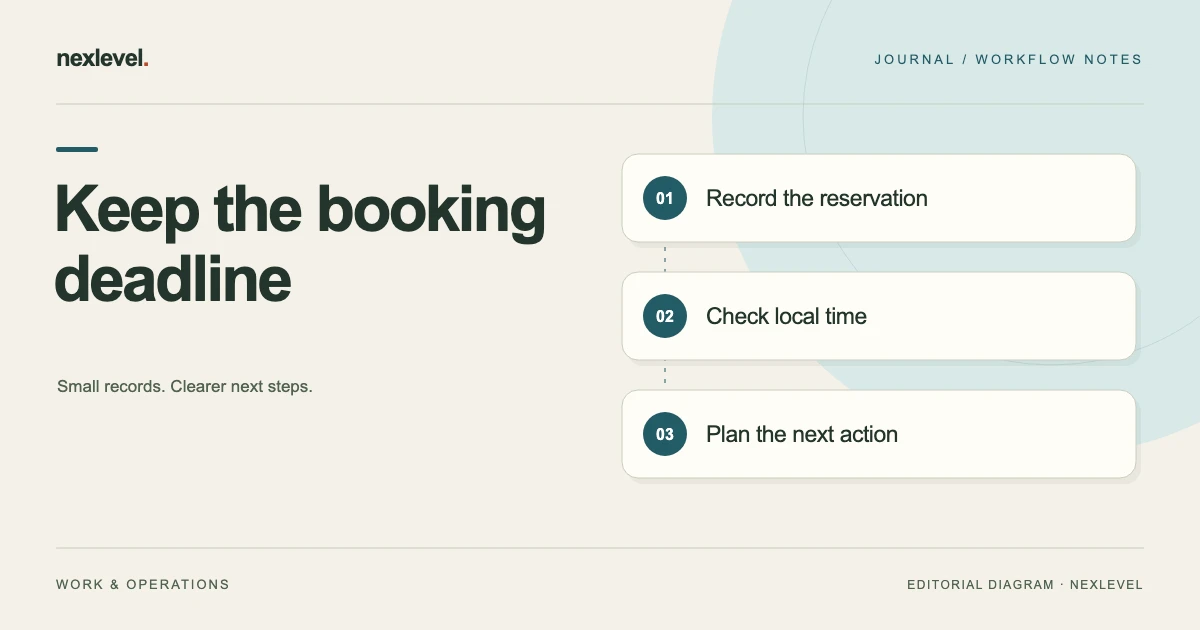
A travel reservation deadline tracker should tell you which decision is due next, whose clock defines the deadline, and what action still needs to happen. A note saying “pay Friday” can become unreliable when the provider uses another time zone, the hold has a specific cutoff, or two people each assume the other will book.
This template organizes fare holds and other reservation deadlines using information you verify with the provider. It includes a fictional example, a time-zone checking method, and a decision history. It does not establish travel-provider rules, extend a hold, or complete a booking.
Separate the reservation from the deadline
Give each hold or reservation a readable name, provider, confirmation reference, and travel context. A flight hold, hotel payment request, and car-rental deadline can belong to the same trip while requiring different decisions.
Record the event the deadline concerns. It might be a payment cutoff, a hold expiry, or a response requested by a provider. Do not label every date “cancellation deadline,” because different events may have different consequences.
Keep the travel date separate. A reservation can require action long before departure, and an itinerary date does not tell you when a held price or reservation expires. The tracker should support the next decision rather than merely reproduce the calendar of the trip.
Preserve the source message or account reference. A short note is easier to use when you can reopen the actual terms and confirm whether the entered deadline still applies.
Copy this reservation deadline template
Use one entry per distinct provider event. If a reservation has several important deadlines, identify them separately instead of repeatedly replacing a single date.
- Identity: trip, provider, reservation type, and confirmation reference.
- Deadline event: what must happen, the exact date and time, and provider time zone.
- Local view: the corresponding time where the decision owner will be.
- Source: provider message or account page, captured date, and any uncertainty.
- Decision owner: who will act and who must provide input.
- Review plan: personal decision time, reminders, and any required preparation.
- Current state: active, action in progress, booked, released, expired, or another clearly defined state.
- Outcome: action taken, confirmation evidence, final price and currency if relevant.
Keep sensitive references out of lock-screen reminder text and broadly shared notes. The private record can identify the reservation while a notification simply tells you which decision to review.
Record the provider’s time before converting it
Copy the provider’s stated deadline faithfully, including its time-zone information. If the wording is incomplete, record the uncertainty and ask the provider to clarify. Do not silently choose your device’s time zone because the date otherwise looks inconvenient to enter.
Use a named time zone when your workflow supports it, and verify the date-specific conversion with an appropriate calendar or time-zone tool. Some locations change their offset during the year. A remembered offset from a previous trip may not apply to this deadline.
Keep the provider time visible alongside the local time. That gives you a useful cross-check when your device changes zones during travel. A local display is a convenience, while the provider’s actual stated deadline remains the source to verify.
Do not substitute an unexplained abbreviation for a known source. Short labels can be ambiguous. Preserve the original wording and resolve unclear timing before relying on a countdown.
A fictional example: two holds on one trip
Imagine Morgan is organizing a trip with a companion. A fictional flight provider states a hold deadline of 18:00 on 22 October in a zone explicitly using UTC+1 on that date. Morgan’s location uses UTC−3 for this example, so the corresponding local time is 14:00 on the same date.
The tracker preserves both times and labels the offsets as example assumptions. Morgan sets a personal review earlier than the actual cutoff, because the companion still needs to confirm the travel date. Morgan is the decision owner, and the companion is an input owner.
A separate hotel reservation has a different provider event and source. It receives its own entry rather than inheriting the flight deadline. The record does not assume that confirming one reservation resolves the other.
After Morgan completes the flight booking through the provider, the tracker records booked status and the confirmation reference. Until that confirmation is checked, the entry remains in progress. The reminder itself did not book the trip or guarantee the held price.
Set a personal review time before the provider cutoff
The provider’s deadline is the outside event; your review time is when you intend to decide. Keep those fields separate. Moving the personal reminder should never change the recorded provider deadline.
Choose a review point that fits the actual work involved. You may need another person’s response, access to payment information through an appropriate secure route, or a comparison of alternatives. There is no universal reminder offset that guarantees enough time for every reservation.
Record what must be ready for the review. “Companion confirms dates” is actionable. “Think about trip” is less useful when the deadline is close and the decision depends on a specific missing answer.
If the needed input does not arrive, record the next decision rather than assuming the hold will remain available. A possible extension needs provider confirmation; it should not appear as an automatic feature of the tracker.
Give one person clear responsibility for the action
Several travelers can contribute while one person owns the next booking decision. Name that person and confirm the arrangement. A shared chat containing a deadline does not establish that somebody has agreed to act.
Distinguish authority from awareness. A companion may know about the hold without being able to approve the cost or access the relevant provider account. The handoff should identify who can actually complete the required step.
When responsibility changes, record the handoff and ask the receiver to state the deadline they will use and the next action they will take. This checks understanding without requiring another long itinerary summary.
Share only what the receiver needs. A readable trip label, provider deadline, and decision question may be enough for a planning conversation; confirmation codes and account access deserve a deliberate, appropriate channel.
Keep price information connected to its capture time
A recorded price should include currency, source, and time captured. It can help explain a decision without pretending to be a live quote. If the provider changes the offer, preserve the new information as a new observation.
Separate a held price, a displayed alternative, and a final booked amount. They may differ in inclusions or conditions. A tracker should not make them look equivalent simply because all three are money fields.
Record relevant unknowns, such as an unconfirmed additional charge, rather than filling them with zero. A zero means no amount under the defined basis; unknown means the amount still needs verification.
If the decision involves changing a whole trip, use the travel change cost comparison to keep new cash, credits, and linked reservations separate. The deadline record can point to that analysis without duplicating every assumption.
Treat reminders as prompts, not proof of action
Check notification permission and the device settings that affect delivery. A scheduled reminder and an alert you notice are different events. Maintain a manual review of active holds when a missed decision would matter.
Choose notification content that is useful without exposing sensitive details. A provider name and generic action may be enough. Avoid placing confirmation references, account details, or private travel information in a message visible on a locked screen.
If you dismiss a reminder without deciding, update the next action. Repeatedly clearing an alert can make an unresolved hold feel handled while the provider’s deadline continues approaching.
Calendar export is another reference, not a provider connection. If you change the underlying record, check whether the separate calendar item also needs attention. Two copies can become inconsistent if nobody owns the update.
Verify the outcome before closing the hold
After acting through the provider, check the resulting confirmation or account state. Record the action and evidence. “Intended to book,” “payment submitted,” and “booking confirmed” may describe different states.
If you release a hold, preserve that decision and its date. If it expires, record the actual known state without claiming that every associated reservation or charge disappeared automatically. Related provider terms may need separate checking.
Keep the final amount and currency where relevant, but do not replace the original quote history. The comparison between the held information and final outcome may help explain what happened.
When the outcome is unclear, leave a focused follow-up item. A polished archive is less useful than a truthful record that shows a confirmation still needs to be checked.
Review active holds when plans or locations change
Before travel, review which deadlines will occur while you are in transit or in another zone. A local reminder that made sense at home may be harder to interpret during a connection or a device time-zone change.
Reopen the provider source when a material change occurs. A changed itinerary, revised quote, or new payment instruction can affect the decision. Do not assume every earlier deadline survives the change unchanged.
When recording a revised deadline, preserve the earlier one and the source of the revision. A handwritten extension note without provider evidence should remain a request or assumption rather than a confirmed replacement.
Archive completed holds so the active queue remains focused. Preserve enough history to understand the outcome without carrying every old reservation into the next trip’s decision list.
Check a handoff with a short read-back
Ask the receiving person to identify the provider event, exact deadline, time zone, and required next action. A read-back can reveal that one traveler remembered a departure time while another meant a payment cutoff.
Then check the source together if anything differs. Resolve the underlying information instead of agreeing on whichever display looks most familiar. Keep the confirmed source reference in the record.
A practical packet can contain a concise summary and a private link to the relevant source. Our handoff checklist explains the general method of preserving versions, owners, inputs, and open questions.
Check whether conversion changes the calendar date
A time-zone conversion can cross midnight even when the offset difference is only a few hours. In another fictional example, a provider deadline of 00:30 on 23 October at UTC+1 corresponds to 20:30 on 22 October at UTC−3. The local calendar date is the previous day.
Record both the date and time after conversion. A reminder labeled only “23 October” would conceal the earlier local action point in this example. Use the actual date-specific zones for a real booking rather than borrowing these illustrative offsets.
Check the conversion independently against the source before relying on it. Then inspect the saved record and any calendar copy to make sure they preserve the same instant. A correct calculation can still be entered into the wrong date field.
If you travel before the deadline, review how the app displays the provider time and current local time. The instant should remain connected to the original provider event even when the local display changes. A quick read-back of date, time, and zone is more reliable than assuming a familiar countdown means the record is correct.
Use BookingHold for the active deadline queue
BookingHold records travel holds with provider references, decision owners, deadlines, provider and local times, and on-device reminders. Its official listing describes booked, released, and expired history, plus optional Calendar and widget features. It does not require access to a travel-provider password to organize a record.
View BookingHold on the App Store for current features and access. Verify the provider information before entering it, then use the queue to make the next decision visible.
Sources and example scope
App features were checked against the official BookingHold listing and product page. Morgan, the reservation, dates, and UTC offsets are fictional. The guide does not establish any provider’s hold duration, cancellation rights, final price, or booking guarantee.