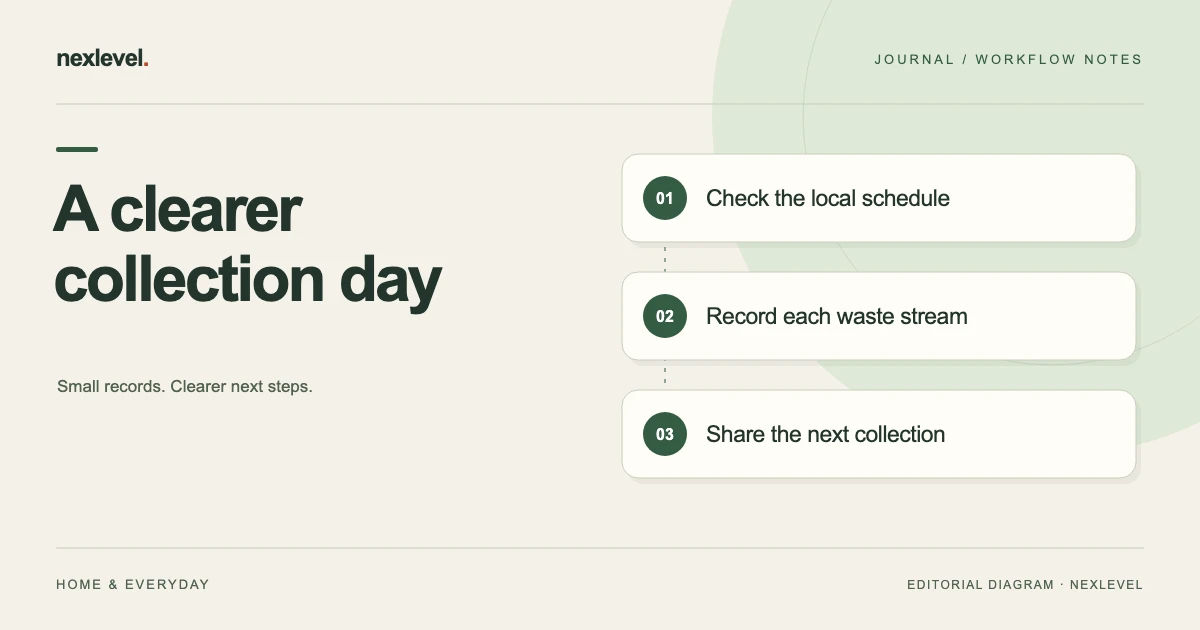
A household collection calendar should answer which bin is next, when it needs attention, and whether a holiday or service change affects the usual pattern. A repeating calendar event can be helpful, but it becomes misleading when one exception accidentally shifts every later pickup.
This template organizes trash, recycling, and other household collection schedules using your actual service provider’s information. It includes a fictional every-other-week example, a method for handling exceptions, and a simple household handoff. It does not supply local collection rules or assume that one city’s schedule applies elsewhere.
Start with the provider and the correct service area
Find the schedule for the exact service arrangement that applies to your home. A municipality, private provider, property manager, or building may define collection differently. Record the source and the address or service-area reference needed to identify the right schedule privately.
Check the date or period covered by the source. An older downloaded calendar can remain easy to find after a new one becomes applicable. Keep the current reference visible instead of relying on a file called pickup-calendar.pdf with no year.
Separate the collection schedule from the rules about what belongs in each stream. A date reminder does not establish accepted materials, preparation requirements, or placement rules. Save the relevant provider route for those questions.
If information conflicts, ask the responsible provider or property contact. A neighbor’s bin outside can prompt a check, but it is not a reliable replacement for the applicable source.
Copy this household collection template
Use one schedule per collection stream and service pattern. Keep a shared source index if several schedules come from the same provider.
- Stream: trash, recycling, compost, yard waste, or another provider-defined service.
- Provider: responsible service, official source, and service-area reference.
- Pattern: weekly, every other week, a defined interval, monthly, or dated occurrences.
- Anchor: a confirmed occurrence that establishes the recurring sequence.
- Next pickup: the current date, relevant local time context, and source.
- Preparation: the actual provider guidance and household task, where applicable.
- Exception: original occurrence, revised event, source, and effect on later dates.
- Reminders: chosen alert, permission state, and person responsible.
- History: verification date, household completion note, and unresolved service question.
Keep private address details out of public or widely shared reminders. A household label can identify the task while the fuller service reference stays in the private record.
Use an anchor for every-other-week schedules
A weekday alone does not define an every-other-week pattern. You also need a confirmed date in the sequence. Without that anchor, two people can create alternating schedules that are each internally consistent but one week apart.
Record the interval in days or the recurrence convention used by the provider. Every 14 days is not the same as twice per month. Monthly dates vary in spacing, while a fixed two-week interval follows a continuous sequence.
Check the next few occurrences against the provider’s actual calendar. This small comparison can catch a wrong anchor before reminders begin. Do not assume that successfully saving a repeating event proves the recurrence matches the service.
If the source lists dates rather than a simple rule, preserve those dates or the source’s intended pattern. Forcing a seasonal or irregular service into a weekly template can create pickups that do not exist.
A fictional example: one delayed recycling pickup
Imagine a household’s fictional recycling source confirms pickups on 6 November, 20 November, and 4 December. The normal interval is 14 days. The household records 6 November as a verified anchor and checks that the next two dates agree.
A later provider notice states that only the 20 November occurrence moves to 21 November, with the next regular pickup remaining 4 December. The household records the notice and changes that occurrence. It does not restart the entire interval from 21 November.
Trash collection follows a separate fictional pattern and receives its own entry. The household does not assume the recycling exception applies to trash simply because both services use the same provider.
The example illustrates a one-time exception because the fictional notice explicitly defines it that way. Real providers may handle changes differently. The calendar should record the actual instruction, including any effect on later dates.
Separate pickup day from the preparation reminder
The scheduled pickup and the household’s preparation task are different events. A night-before reminder can help someone prepare, but it should not replace the recorded collection date.
Use the provider’s applicable guidance for timing and placement rather than a generic assumption. If the guidance changes, update the reference and household task while preserving the reason for the change.
Choose a reminder that fits the household’s routine. A reminder at a convenient planning time and a provider’s service cutoff answer different questions. Label them clearly so a notification does not appear to define the official requirement.
If several people share the task, identify who is responsible for the next occurrence. A shared calendar event can keep everyone informed while still leaving nobody assigned to act.
Record exceptions as specific changes
For each exception, identify the original occurrence, what changed, the source, and whether the later sequence changes. A vague note saying “holiday delay” is difficult to interpret after the holiday has passed.
Distinguish skipped service, delayed service, paused service, and a permanent schedule change. Those states may lead to different future dates. Do not use one generic edit for all of them.
Preserve the old date in the exception record rather than making it disappear. This helps another household member understand why their printed calendar or earlier reminder differs.
After applying the change, inspect the next few occurrences and reminders. The visible next date can be correct while a stale notification still points to the earlier event, depending on the tools used.
Verify reminders and widgets after updates
Check whether notification permission is active and whether the chosen alerts are scheduled. An app displaying a next pickup does not necessarily mean a notification will appear under the device’s current settings.
Use a manual glance at the upcoming schedule as another habit. A notification can be missed, dismissed, or affected by device settings. The calendar’s value should not depend entirely on one alert.
After a schedule exception, check the widget or other secondary display. Confirm it shows the new event and stream. A cached display can lag behind a change, so verify the actual state rather than assume it refreshed.
Keep reminders concise and recognizable. The stream name and household task usually matter more than a long copied provider notice. Preserve the notice in the record for reference.
Hand off the task with a clear receiving check
When someone else handles collection, give them the next stream, date, relevant provider instruction, and any current exception. Avoid sending an entire archive when one clear task summary will do.
Ask the receiver to confirm the next action. “Recycling is the next task, using the revised occurrence in the calendar” is more informative than a generic acknowledgment of the message.
Keep responsibility and completion distinct. A person agreeing to handle the task has not yet completed it. If the household records completion, use a simple factual note rather than treating a reminder dismissal as proof.
Our care handoff checklist demonstrates the general principle of one owner, a clear next action, and a shared current record. Apply that principle without copying unrelated pet-care details into the collection calendar.
Handle a missed or uncertain pickup separately
If collection did not occur as expected, record what is actually known. “Bin still present at the recorded observation time” is different from a confirmed service failure. The provider may have a specific route for missed-service questions.
Check the current source and exception notices before changing the recurring schedule. A missed event does not automatically mean every future occurrence should move by a day.
Record any provider response and the specific event it concerns. An extra collection arrangement should not silently become the new permanent recurrence unless that is what the provider confirms.
Keep the next household action visible: verify the notice, contact the provider through its established route, or check the next confirmed date. Avoid an indefinite note saying “sort bins out.”
Review seasonal and property changes
When moving, changing providers, or entering a new service season, review each schedule’s applicability. A correct calendar for the old address can become misleading without changing any of its internal dates.
Archive retired schedules with a readable label rather than leaving them active beside current ones. Preserve sources if useful, but keep the next-pickup view focused on the household’s present arrangement.
Check services that are not year-round against their actual source. Do not create assumed winter or summer dates from a pattern that applies only during a stated period.
For broader recurring household records, see organizing home maintenance records. The same separation of asset or service, planned task, and actual event keeps history useful.
Use a short monthly source check
Choose a practical review habit for upcoming exceptions and source changes. The appropriate frequency depends on the service and household, but the review should verify information rather than mechanically advance dates.
Check the next occurrence, the anchor, active exceptions, reminders, and household owner. Confirm that completed exceptions no longer obscure the normal pattern.
If two people maintain separate calendars, agree which record is current and how changes are shared. Competing copies can each look tidy while disagreeing on the next collection.
Test one retrieval question: can another household member identify why the next date differs from the usual pattern? If not, improve the source note and exception label.
Keep two service locations from sharing the wrong exception
If you help manage more than one property, give each schedule a readable location label before adding the collection stream. “Recycling, Home A” and “Recycling, Home B” are clearer than two identically named reminders, especially when they use different providers or alternating anchors.
Record the source separately for each location. Even nearby properties may have different service arrangements. A verified exception for one address should not automatically be copied to the other.
For a handoff, show the location, stream, next occurrence, and current exception together. The person doing the task should not have to open several records to determine which property the reminder concerns. Keep the fuller private address available only where needed.
When changing a recurring pattern, inspect other schedules before saving. Confirm that you are editing the intended location and stream rather than a similarly named entry. Then compare the next few dates with that location’s source.
If a property no longer belongs in your active routine, archive its schedules instead of repurposing their names for another place. The old history can remain useful without becoming the basis for a new provider’s pattern.
A quick household review can ask each responsible person to name their next task and the source of any exception. Differences in answers are a prompt to inspect the record, not a reason to create another independent calendar copy. This keeps the shared routine small and current while preserving clear boundaries between locations.
Use Curbora for the next-pickup view
Curbora records weekly, every-other-week, interval, and monthly schedules with anchors, time zones, local reminders, and widgets. Its official listing describes exceptions such as skipping or delaying an occurrence and pausing a schedule. It does not connect to municipal systems.
View Curbora on the App Store for current features and access. Use it to keep the household’s next task visible, while verifying the underlying service information with the responsible provider.
Sources and example scope
App features were checked against the official Curbora listing and product page. The collection dates and exception notice are fictional. No municipality’s schedule, accepted-material rules, placement instructions, or holiday policy is asserted.