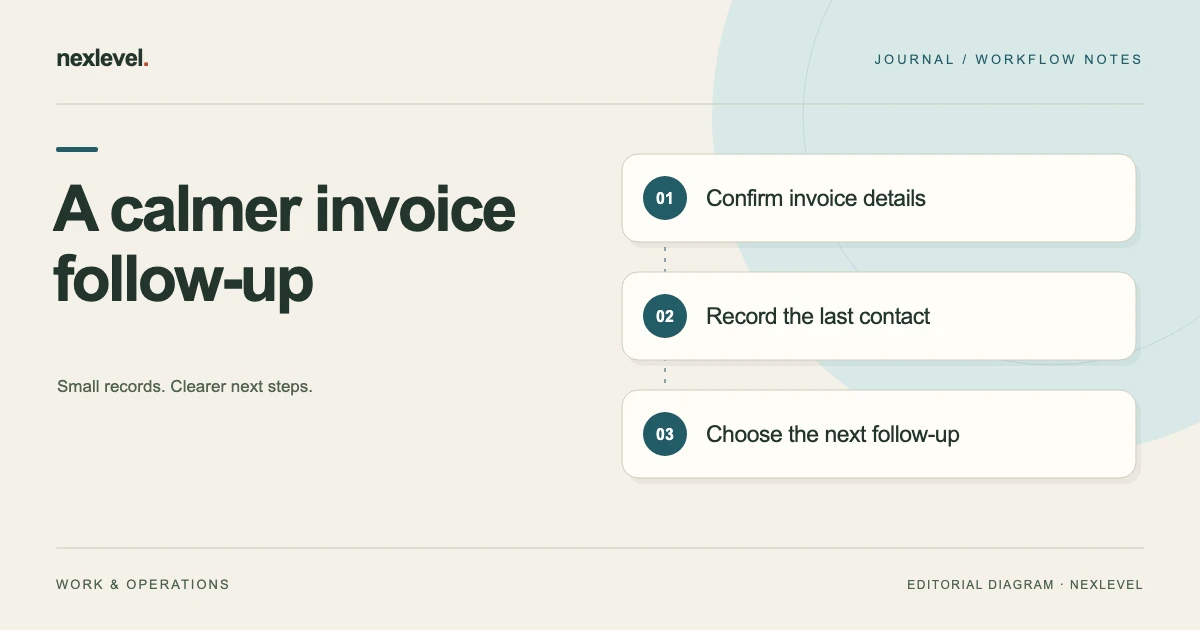
An invoice follow-up tracker should tell you the recorded balance, what happened in the last conversation, and the next appropriate action. A list sorted only by due date can miss a recent payment, a promised date, or a question that needs resolution before another reminder makes sense.
This template organizes invoice records and reviewed follow-up drafts. It includes a fictional payment example and a practical daily queue. It is an organizational workflow, not accounting, legal, debt-collection, or financial advice, and it does not authorize contacting a client or adding charges.
Start with the invoice as the source record
Record the invoice reference, client, issue date, due date, amount, currency, and route to the original document. Use the actual issued invoice and relevant business records rather than reconstructing terms from memory.
Keep one identifiable invoice record. Similar references, repeated clients, and revised documents can create duplicates that inflate the apparent outstanding balance. Check identity before adding another entry.
Preserve the document version where relevant. A corrected invoice or authorized adjustment should remain distinguishable from the original. Do not silently change a historical amount so the follow-up list looks tidy.
Separate the invoice record from the follow-up plan. The due date describes the source obligation as recorded; the next contact date describes your chosen workflow. Moving a reminder should not rewrite the invoice’s original date.
Copy this invoice follow-up template
Use one record per invoice, with linked events for payments and communications. These fields keep the queue understandable:
- Invoice: reference, client, issue date, due date, currency, and original amount.
- Adjustments: authorized changes, source references, and their effect on the balance.
- Payments: received amount, date, reference, and allocation to the invoice.
- Outstanding: calculated remaining amount under the recorded events.
- Last follow-up: date, channel, recipient, reviewed message, and actual sending state.
- Client response: attributed summary, questions, and any promised date.
- Next action: owner, task, review date, and reason.
- Current state: open, awaiting information, promise pending, paid, archived, or another defined state.
Keep full contact and payment details in the appropriate protected record. A notification or shared task view usually needs less information than the private invoice archive.
Calculate the outstanding balance from events
For a simple unchanged invoice, remaining balance is the invoice amount minus payments allocated to it. A fictional invoice for 600 with a received payment of 150 has 450 remaining.
Record the payment event rather than replacing the invoice amount with 450. The original invoice still explains what was issued, while the payment history explains why the outstanding position changed.
Distinguish a payment received from a client saying they sent it. The latter is useful communication evidence, but the business’s normal reconciliation process should establish the actual received state.
If adjustments, credits, refunds, or allocation questions exist, use the appropriate authorized process and source records. Do not force an uncertain difference into a fictional payment just to make the tracker balance.
A fictional example: partial payment and a promised date
Imagine invoice INV-204 was issued for 600. The business records a received payment of 150, leaving 450. The owner checks the payment allocation before drafting another reminder.
The client then says they expect to pay the remaining amount on 18 October. The tracker records the message date, the promised date, and the exact invoice it concerns. It does not mark the balance paid or change the original due date.
The owner chooses a review after the promised date through the business’s normal process. During that period, the queue shows a promise pending rather than an instruction to send the same reminder every day.
If the remaining 450 is received, the owner records the payment and closes the follow-up. If it is not confirmed, the next review begins with the current records and communication history. The example does not assume a promise guarantees payment or define a universal escalation timetable.
Respect a payment promise without losing the balance
A promised date is a communication event and a useful planning input. Keep it separate from the invoice due date, a received payment, and a formal change to agreed terms.
Record the actual wording or a faithful attributed summary. “Expects to pay Friday” can carry a different degree of certainty from a confirmed instruction. The tracker should not strengthen the client’s statement.
Identify what amount the promise covers. A promise about one installment should not automatically pause follow-up on unrelated invoices or the entire client account.
When the date passes, verify the current payment records before choosing the next action. A missed reminder or a stale queue should not be the basis for assuming nothing changed.
Build a daily queue around useful actions
Review invoices with a follow-up due, a promise requiring a check, a recent payment needing allocation, or a question awaiting your response. These are different tasks, even if they involve the same invoice.
Give each item an owner and a specific next action. “Check received payment against INV-204” is clearer than “chase client.” The task should tell the owner what evidence or response is needed.
Keep priority criteria understandable. Overdue age can matter, but so can a recent promise or unresolved question. A queue should direct attention without pretending one score determines the correct action in every case.
Remove paid or archived items from active reminders through the supported workflow while preserving useful history. A closed invoice should not keep producing a warning merely because an old notification was forgotten.
Draft a reminder from verified facts
Before writing, check the invoice reference, amount outstanding, due date, latest payment, and last response. A reminder based on an old total can damage trust even when its tone is polite.
An original neutral draft might read: “Hello, our records currently show 450 outstanding on invoice INV-204. Could you confirm the expected payment date? If payment has already been sent, please share the relevant reference so we can check our records.”
Review every placeholder and adapt the wording to the actual relationship and business process. The example is a drafting pattern, not a message to send unchanged or a statement that the recipient legally owes the amount.
Do not add unsupported fees, legal threats, or claims about consequences. If a matter requires specialist review, route it through the appropriate process rather than asking a reminder template to decide it.
Keep preparation, sending, and response separate
A draft exists before anyone sends it. Copying text to another app does not establish delivery, and a delivered message does not establish that the client agreed with it.
Record the actual event when needed: prepared, reviewed, sent through the chosen channel, or response received. This helps the next person avoid sending a duplicate because they saw only an undated draft.
Use the verified recipient and appropriate communication route. Invoice details can be sensitive, so a convenient shared link or copied email address should not replace the normal recipient check.
Keep the reviewed wording or a concise faithful summary with its date. The history should support the next conversation without becoming an uncontrolled transcript of unrelated client information.
Handle questions and disputes as their own work
If the client asks for a corrected reference, supporting document, or explanation, record the question and who can resolve it. Another generic reminder may not address the issue preventing progress.
Distinguish a disputed amount from a payment promise. Both can affect follow-up, but they need different next actions. The tracker should preserve the actual state rather than force every response into one category.
Keep source documents and decisions linked. If an authorized correction changes the balance, record the source and effect. Do not rewrite the original communication to make it appear the question never existed.
Use factual notes without speculating about motives. “Client requested clarification of line 3” is useful. A guess about why they have not paid is less reliable and may distract from the action that can resolve the question.
Make a handoff understandable to another person
A receiving colleague needs the invoice identity, current balance basis, latest meaningful event, any promise or open question, and next action. They do not need to reconstruct the record from scattered messages.
Ask the receiver to confirm what they will check or do next. This helps prevent duplicate contact and reveals a missing payment update before it causes another incorrect reminder.
Preserve ownership when responsibility changes. A shared list with no clear owner can leave important follow-up untouched while everyone assumes someone else is handling it.
Our handoff checklist offers the general pattern of a current version, relevant evidence, open questions, and a receiving check. Adapt it to the invoice rather than copying unrelated fields.
Keep totals and exports on a defined basis
Outstanding and overdue totals answer different questions. State the date and inclusion rule used by a report. A list of all unpaid invoices is not automatically a list of all overdue amounts.
Keep currencies separate unless a conversion method is deliberately defined. Adding unlike currency amounts creates an unexplained total rather than a meaningful balance.
Inspect exported references, dates, currencies, and amount columns. A CSV may be useful for portability, but it should not be treated as a replacement for the original invoice and payment records.
Share only the fields the recipient needs. A broad report can expose client or business details that are irrelevant to a single follow-up task.
Review the process after closing an invoice
Record the final known state and the evidence supporting it. Full payment, archive, and deletion are different actions. Use the state that reflects what actually happened.
Cancel stale reminders through the supported workflow and confirm the active queue no longer shows the completed task. Preserve the history needed by the business’s normal records process.
Look for one practical improvement: clearer source references, quicker payment allocation, better ownership, or a more accurate next-action label. The aim is a dependable record, not simply a more forceful sequence of messages.
Check a payment that covers more than one invoice
A client may send one amount intended for several invoices. Keep the received payment reference and establish its allocation through the business’s normal process. Do not subtract the entire payment from each invoice merely because the same client appears on all of them.
For a fictional arithmetic example, a received 300 allocated as 100 to one invoice and 200 to another remains a total payment of 300. The tracker should preserve those allocations and the shared source reference. Recording 300 against both would falsely remove 600 from outstanding balances.
If the allocation is unclear, make reconciliation the next action before preparing a reminder based on an assumed balance. The client message and actual received amount can be recorded while the distribution remains unresolved.
After the allocation is established, review each affected invoice’s next action. One may now be paid while another remains partially outstanding. A single client-level status should not hide that difference.
This is also a useful handoff check: ask the next owner to explain how the current invoice balance relates to the original amount and recorded payment events. If they cannot reconstruct it from the sources, improve the references before escalating the follow-up. Clear arithmetic and a readable event history support a more accurate conversation.
Use PaidCue for reviewed follow-up
PaidCue organizes overdue invoices, payment promises, partial payments, next steps, local reminders, and follow-up history. Its official listing describes staged message drafts that you review before copying or sharing. PaidCue never contacts a client automatically.
View PaidCue on the App Store for current features and access. Keep the facts current, review the wording, and complete any communication through your authorized business process.
Sources and example scope
App features were checked against the official PaidCue listing and product page. Invoice INV-204, amounts, dates, and messages are fictional. The guide does not establish legal entitlement, accounting treatment, collection authority, or a guaranteed payment result.