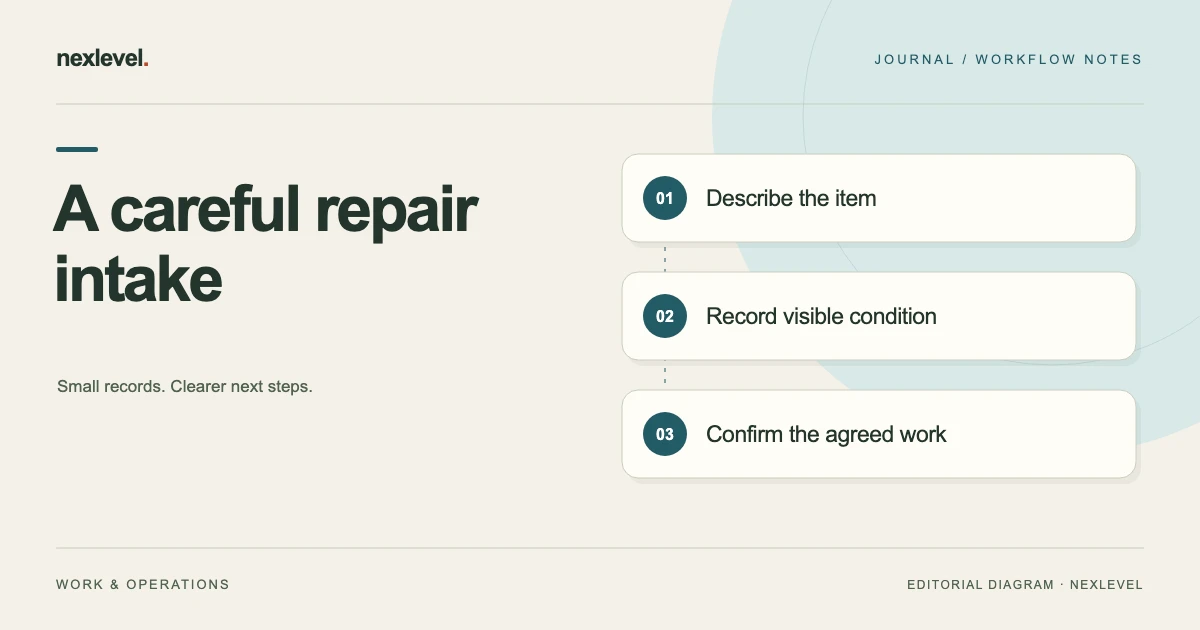
A jewelry repair intake form should connect the right item to the customer’s request, the condition recorded at arrival, the work authorized, and the later custody events. A short description such as “gold ring, repair” can leave important questions unanswered when similar items are on the counter.
This template is for organizing a professional intake and handoff record. It includes a fictional repair ticket and a custody timeline. It does not identify materials or stones from appearance, establish value or ownership, or replace the shop’s legal, insurance, valuation, and security procedures.
Identify the ticket and each physical item
Give the repair a stable ticket reference and each item a readable identity. One customer may leave several pieces, and one repair may include separate components. The record should distinguish them without relying on memory.
Use factual descriptions and references to the shop’s appropriate identification process. Separate what the customer reports from what has been professionally established. A reported material name should not silently become a verified assay result.
Record accompanying components where relevant, such as a detached part or supplied packaging. Keep their relationship to the main item clear in the written record and the shop’s physical handling system.
If a detail cannot be established at intake, mark it as unknown or pending the appropriate assessment. A guessed value can create more confusion than an honest incomplete field.
Copy this repair intake form
Use stable headings so the counter, workshop, and pickup team can find the same information. Add specialized fields only when your actual process requires them.
- Ticket: reference, customer, contact route, intake date, and receiving staff member.
- Item: identifier, readable description, accompanying parts, and evidence references.
- Condition: visible observations, customer-reported history, and limits of the intake assessment.
- Requested work: the customer’s request and any clarification needed.
- Estimate: amount, currency, scope, status, and later changes.
- Authorization: the version presented, scope recorded, person, date, and actual acknowledgment event.
- Custody: dated handoffs, location or responsible role, and item reference.
- Commercial history: deposits, payments, adjustments, and remaining balance.
- Pickup: actual collection event, items returned, receipt, and unresolved notes.
Keep sensitive customer details in the appropriate protected fields. A physical label or reminder does not need to expose every contact or payment detail.
Describe visible condition without overstating it
Record what was observed at intake and how it was documented. A visible mark, a detached component, or a reported issue can be described without claiming that the entire item was examined or certified.
Attribute customer statements. “Customer reports the clasp opened during wear” is different from “the clasp failed a professional test.” Preserve the actual basis rather than translating a report into a technical conclusion.
Keep assessment limits visible. If an area was not examined or an identifier could not be read, record that state. A blank field should not imply that no issue exists.
Use the shop’s appropriate professional process for material, stone, weight, valuation, or technical assessments. The intake template can reference the resulting evidence without pretending a photograph or app field establishes it.
Make photographs support the written identity
Capture selected views that help identify the item and relevant visible condition under your shop’s process. Label each image with the ticket, item reference, and a readable purpose.
A close-up can show detail while losing orientation. Pair it with enough context for an authorized colleague to identify the same area. Avoid a gallery full of images with no explanation of which observation they support.
Keep originals and identify annotated copies. A marker can point to a visible feature, but it should not alter the only preserved view or make an interpretation look like an observed fact.
Review images before sharing. Unrelated customer documents, other items, payment details, or people can appear unintentionally. Share the evidence needed for the handoff rather than the entire counter scene.
A fictional example: one item and a detached component
Imagine ticket JR-042 records a customer’s bracelet and a detached component. The shop identifies the main item as A and the component as A-1, with selected photos and a written relationship between them.
The customer’s request is recorded in plain language. Material identity is entered only to the extent established by the shop’s appropriate process; an unverified description remains attributed. The ticket does not infer value from appearance.
A fictional estimate of 80 is recorded with its scope. The customer pays a 20 deposit, leaving a modeled balance of 60 if the estimate becomes the final unchanged amount. Estimate, authorization, and payment remain separate states.
The custody history records the intake, workshop handoff, return for pickup, and actual collection. Each event identifies A and A-1 as appropriate. The pickup record confirms what was returned without erasing the earlier detached-component history.
Keep requested work and authorized work distinct
A customer’s initial request may need assessment or clarification before the shop defines the work. Preserve the request and the later proposed scope separately.
Record what was presented for authorization, including the relevant estimate or work version. A signature or acknowledgment should stay connected to that version rather than appearing to cover later additions automatically.
If the proposed work changes, record the change and the next decision. Do not silently expand the authorized task because the item is already in the workshop.
Use the shop’s applicable legal and business procedures for authorization. The software records an event; its presence does not independently determine the person’s authority, ownership, or the legal effect of the wording.
Preserve estimate and payment history
Label amounts as estimate, agreed amount, invoiced amount, or payment according to the actual record. They answer different questions and should not share one ambiguous money field.
Record deposits and later payments as events with date, amount, currency, and reference. A plan to pay at pickup is not a received payment.
Keep adjustments identifiable. If an authorized change affects the amount, preserve the supporting source and its effect rather than replacing the original estimate with no explanation.
Before pickup, reconcile the commercial record through the shop’s normal process. A garment or jewelry item being ready for collection does not itself explain the current balance.
Use a custody timeline with meaningful events
Record handoffs that matter to the shop’s chain of responsibility: intake, transfer to a responsible workshop role, return to the counter, and actual collection. Use the item identity consistently.
Keep the event date and responsible person or role. A location note alone may not explain who accepted the handoff, and a person’s name alone may not identify which item moved.
Separate a planned handoff from one completed. “To be sent to workshop” is a task, while “workshop received” is an event supported by the relevant process.
Use the shop’s established physical security and handling procedures. A digital custody timeline can preserve records, but it does not itself secure the item or certify an unbroken legal chain of custody.
Make workshop handoffs readable
The receiving professional needs the item identity, recorded condition, authorized scope, relevant evidence, unresolved questions, and expected next action. Avoid forcing them to reconstruct the request from scattered counter notes.
Use concise location and component references. A request concerning A-1 should not look like an instruction for another similar part on another ticket.
Ask the receiver to identify the current scope and any blocker. A receiving check can expose a missing authorization or unclear component relationship before work begins.
Our handoff checklist gives a general structure for versions, inputs, owners, and open questions. Apply only the fields appropriate to the repair workflow.
Record changes and additional findings explicitly
If assessment reveals another question or proposed task, record it as a new finding or proposal with its source. It should not appear as an intake fact that was known from the beginning.
State what decision is needed and who can make it under the shop’s process. A recommendation is different from an instruction already authorized.
Preserve the original ticket and earlier work version when the scope changes. This keeps the later pickup discussion connected to the actual sequence.
For the communication structure, our revision request template separates a new request, its practical effects, and the recorded decision. It does not determine a repair contract’s legal meaning.
Prepare the pickup record before collection
Review the ticket against the actual item and accompanying components. Check the current work record, exceptions, amount state, and receipt details through the shop’s normal process.
Keep ready-for-pickup and collected distinct. A notification or reminder does not establish that the item left the shop.
At collection, record the actual event and items returned. If only part of a multi-item ticket is collected, keep the remaining items visible rather than closing everything together.
Preserve any follow-up question with an owner and next action. A clean receipt should not hide a recorded exception or unresolved communication.
Archive a record someone else can understand
Keep the final ticket, relevant evidence, authorization version, custody events, commercial history, and pickup reference connected. A PDF alone may present a summary without preserving the entire working record.
Test retrieval using the ticket and item reference. An authorized colleague should be able to find the earlier condition and current outcome without needing the original recorder’s memory.
Inspect exported documents before sharing and keep private records separate from customer-facing copies. Know what the supported export and recovery controls actually preserve.
When creating another repair for the same item, use a clean new intake linked to history. Earlier condition, payment, or authorization should not silently become the current record.
Handle two similar repairs collected on different days
Suppose one customer has tickets JR-042 and JR-043 for two similar items. One is ready and the other still has an unresolved work question. Keep the ticket and physical item references visible at the counter rather than using the customer’s name as the only lookup key.
At the first pickup, record the item actually returned under its ticket. The second ticket remains in its true state. A customer-level note saying “collected” would be too broad if it obscured the remaining item.
If a payment covers both tickets, preserve its received reference and establish the allocation through the shop’s normal process. Do not record the full amount independently against each ticket. The commercial history should explain each balance without creating duplicate payments.
For the remaining repair, retain the current authorization version and the specific open question. The first pickup does not resolve that question or authorize additional work on the other item.
When the second collection occurs, check the same identity and receipt relationships again. Preserve the separate dates so the history does not suggest both items left together. This is a recordkeeping example, not a claim that a single app ticket must contain multiple independent items.
A useful closing check is to ask a colleague which item is still held, where its current scope is recorded, and what communication remains open. If the answer requires the original counter person’s memory, improve the cross-references before archiving either ticket. Similar-looking objects are a good test of whether the written identity is doing useful work.
Use KaratDocket for intake and custody records
KaratDocket connects customer and item details, visible-condition records, photos, requested work, estimates, payments, authorization capture, custody history, and pickup receipts. Its official listing describes searchable tickets and PDF records, with local data and deliberate export controls.
View KaratDocket on the App Store for current features and access. Use it to preserve the recorded handoff while maintaining the shop’s professional, security, insurance, and legal procedures.
Sources and example scope
App features were checked against the official KaratDocket listing and product page. JR-042, the item, component, and amounts are fictional. No material identification, valuation, ownership finding, repair method, or legal signature effect is asserted.