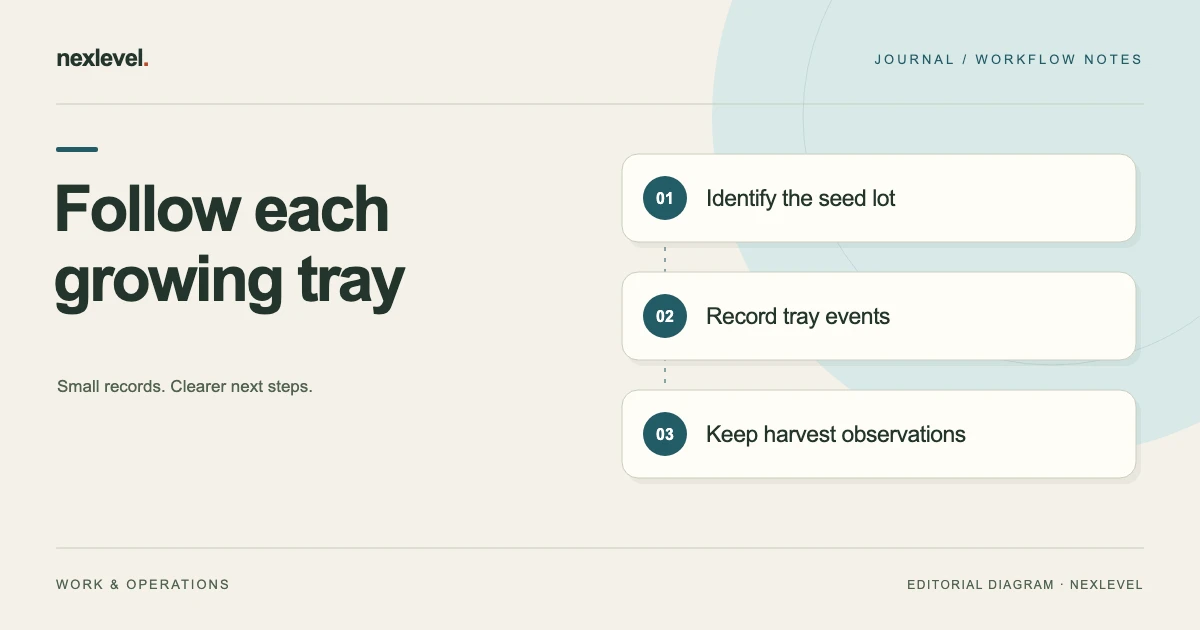
A microgreen production record should connect the delivery commitment to the plan, the actual stage events, and the yield eventually recorded. A projected harvest date is useful, but it cannot explain a late delivery or a changed tray count unless the assumptions and events remain visible.
This template organizes production planning and review. It includes fictional tray arithmetic without prescribing a crop variety, seed rate, growing conditions, handling method, or harvest interval. A schedule and cost record do not establish crop quality or food-safety release.
Start with the delivery commitment
Record the customer or internal destination, delivery reference, required quantity and unit, date, and farm time zone. A quantity without a unit can confuse trays, grams, containers, and finished packs.
Keep confirmed demand separate from tentative demand. A possible order can be useful for planning, but it should not look like a committed delivery merely because it appears in the same calendar.
Identify the crop and variety through your actual production records. Similar names can conceal different assumptions, so preserve the specific profile version used for this plan.
Record who owns the commitment and who reviews changes. A customer-date change can affect several stages, materials, and other plans; it deserves an explicit revision rather than an overwritten date.
Copy this production record template
Use linked sections for demand, assumptions, planned work, and actual events. A concise record can contain:
- Plan: reference, version, customer, crop, variety, delivery quantity, date, and time zone.
- Assumptions: source profile, projected yield per tray, loss treatment, reserve, and timing basis.
- Inputs: tray count, seed requirement, material or lot references, and relevant availability.
- Schedule: planned stages, dates, responsible person, and dependencies.
- Events: actual stage completion, date, recorder, and exception notes.
- Output: actual yield, unit, waste, exclusions, and delivery allocation.
- Economics: entered revenue and direct-cost basis where tracked, with scope.
- Review: variance, cause supported by evidence, and next planning improvement.
Preserve unknown values rather than using zero. No recorded waste measurement is different from a measured zero, and unconfirmed stock is different from available material.
Version the crop assumptions
A crop profile should explain the source of the yield and stage assumptions used by the plan. Your own reviewed history, a documented production method, or another appropriate source can inform it, but the record needs to identify which one.
Keep planning assumptions separate from actual output. A projected yield copied into the harvest field creates an apparently completed record without a measurement.
When the profile changes, preserve the version attached to earlier plans. Otherwise, a historical plan can appear to have used assumptions that were developed only after its production finished.
Label the boundaries. A yield estimate under one production context is not automatically transferable to every tray, variety, facility, or season. The plan should make its context retrievable.
A fictional tray-count calculation
Suppose an illustrative delivery requires 3,000 g, and the planning profile uses 150 g per tray before a separately modeled loss allowance. The baseline is 3,000 ÷ 150 = 20 tray equivalents.
If the model assumes 10% loss against that yield basis, the required planning count is 3,000 ÷ (150 × 0.90), or approximately 22.22 trays. Rounding up gives 23. An independently chosen reserve of one additional tray gives 24 planned trays.
The modeled output at 24 trays is 24 × 150 × 0.90 = 3,240 g. This is arithmetic under fictional assumptions, not a predicted harvest or a recommended buffer. The example is independent of any app’s specific calculation settings.
Simply adding 10% to the baseline 20 gives 22 trays, whose modeled output under the same loss assumption would be 2,970 g. The difference shows why the meaning and placement of a percentage matter.
Keep units consistent through demand and output
Convert quantities onto the same basis before calculating. A demand in kilograms and yield in grams can be compared after a clear conversion. A demand in packs also needs the defined pack quantity.
Keep the original customer unit in the record even when the worksheet uses another unit internally. The handoff should still explain what the customer expects to receive.
Distinguish gross output, recorded usable output, waste, retained material, and delivered quantity according to your actual process. These values can differ and should not share one unexplained total.
For a new measurement, record the unit and relevant method. A number copied from a label or estimated visually should not look like a measured harvest value.
Work backward without hiding the timing basis
A backward plan starts with the delivery event and applies the entered timing assumptions to earlier stages. Keep each assumption and stage relationship visible rather than displaying only a seed date.
Use the actual farm time zone and calendar conventions. A date shift caused by time-zone interpretation is different from a deliberate production adjustment.
Do not substitute generic intervals for the crop’s appropriate reviewed process. This guide provides no seeding-to-harvest schedule or environmental instructions. The record should preserve the timing source you actually use.
When the delivery date changes, review all affected stages and availability. Moving the final date alone can leave earlier reminders, materials, or overlapping plans inconsistent.
Record stage completion as an event
A planned stage and an actual completed stage are different records. Keep the intended date, actual date, recorder, and relevant exception. This makes later schedule review possible.
Use a precise plan identity when several crops or deliveries are active. A completion button should refer to the intended plan and stage, not merely the next row someone sees.
If a stage is delayed or incomplete, preserve that state. Repeatedly changing the planned date to today can erase the information needed to understand what happened.
Keep reminders and completion events distinct. A dismissed alert does not establish that the underlying work was performed.
Handle material and seed records with context
Link the plan to the actual material and lot references used under your production process. A generic crop label may be insufficient when later questions concern a particular source or batch.
Keep planned input requirements separate from actual recorded consumption. A calculated seed requirement is a planning result, not proof that the amount was used.
If text is extracted from a label or grow sheet, review each field before accepting it. Product names, units, and lot references can be misread. Preserve the appropriate original source.
A recordkeeping app does not replace the traceability or safety procedures your operation requires. Use the plan to connect the relevant records rather than imply that a complete form establishes compliance.
Compare yield and waste on the same basis
After production, enter the actual output and any recorded waste using defined categories. Compare them with the plan without replacing the original projected values.
Explain important differences using evidence. A changed tray count, unrecorded exclusion, or different unit can produce an apparent variance even before biological variation is considered.
Do not infer a stable loss percentage from one event. A useful review can identify a question for the next plan without presenting a small sample as a statistical guarantee.
Keep delivery allocation visible when one production run serves several commitments. The same output should not be counted in full against every customer plan.
Keep economic summaries scoped
If you track revenue and direct costs, identify which amounts belong to the plan and which remain estimates. A production subtotal does not automatically include every overhead, selling, or financing cost.
Use currency and cost-unit labels. A seed pack purchase and the portion consumed by one plan are different quantities. Preserve the allocation basis rather than charging the full pack to every plan.
Keep projected contribution and realized results distinct. A planned revenue figure should not look like a received payment, and a calculated margin should identify its denominator and included costs.
Our batch costing guide explains the general principle of supplier units, consumption, yield denominators, and actual-versus-plan review. Its fictional figures are not microgreen production inputs.
Freeze a plan before revising it
Save the demand, assumptions, calculated quantities, and schedule version used for the decision. A later profile update should not silently change the historical plan.
When demand changes, create an identifiable revision and record its effect on inputs, stages, and allocation. Keep the customer communication or internal decision source connected.
Use a receiving check when work moves between people. The next person should be able to identify the active version, next stage, outstanding exception, and required evidence.
The versioned procedure guide offers a general way to preserve planned instructions and actual events without treating a checkbox as an entire process.
Test the production record after delivery
Choose one completed plan and reconstruct the path from demand to output. Can you identify the profile version, tray calculation, actual stage dates, output unit, and delivery allocation?
If not, improve the missing relationship before adding more reporting complexity. A dashboard cannot recover context that was never recorded.
Check exported data for versions, units, dates, and relationships. A portable file should remain understandable outside the original device, including what was planned and what actually occurred.
Preserve a useful history while following the operation’s actual access, retention, and safety processes. The record’s purpose is a clear production trail.
Allocate one output record across two commitments
Suppose a fictional production group supports two delivery lines: 2,000 g for Customer A and 1,000 g for Customer B. The combined planning demand is 3,000 g, but each delivery still needs its own identity and allocation.
If the recorded output available under the operation’s actual process is 2,800 g, assigning 1,800 g to A and 1,000 g to B uses the full 2,800. A’s line remains 200 g below its planned amount. The arithmetic does not decide the commercial or production response; it makes the unresolved difference visible.
Do not assign the entire 2,800 to both customers because both plans point to the same production record. That would create 5,600 g of apparent allocated output from one 2,800 g event.
Keep proposed reallocations separate from completed deliveries. A revised customer arrangement needs its own actual communication and decision record. A spreadsheet quantity changed by the planner does not establish that the customer accepted it.
Record the next action and owner for the short line. The task might be to verify the output entry, review other available production through the appropriate process, or discuss the commitment with the responsible person. This guide does not prescribe a crop-handling response.
When the allocation changes, preserve the earlier plan and identify the current version. Then check related packing and delivery records so the same quantity does not remain committed elsewhere.
A useful receiving check asks another person to reconstruct demand, actual output, allocated quantity, and remaining difference. They should be able to do that without treating projected yield as physical stock. This makes the production record useful for coordination while leaving quality, safety, and commercial decisions with the responsible process.
Use Traylume for delivery-led planning
Traylume works backward from delivery using entered crop assumptions, with tray, seed, loss, and buffer calculations. Its official listing describes saved snapshots, stage completion, yield and waste records, local reminders, JSON export, and optional Pro insights or private iCloud synchronization.
View Traylume on the App Store for current features and access. Review the assumptions before acting and keep actual production evidence separate from projected results.
Sources and example scope
App features were checked against the official Traylume listing and product page. Demand, yield, loss, and reserve figures are fictional arithmetic examples. No crop protocol, seed rate, growth interval, handling instruction, or food-safety release is supplied.