An aquarium maintenance log becomes useful when it connects a reading to the tank, time, method, and events around it. A list of numbers can show movement without explaining whether the test method changed, maintenance occurred first, or the value belongs to another aquarium.
This template organizes readings, maintenance events, keeper observations, and follow-up. It includes a fictional timeline without recommending water parameters, dosing, treatment, or maintenance intervals. A log helps preserve context; it does not diagnose animals or establish that a setup is safe for a species.
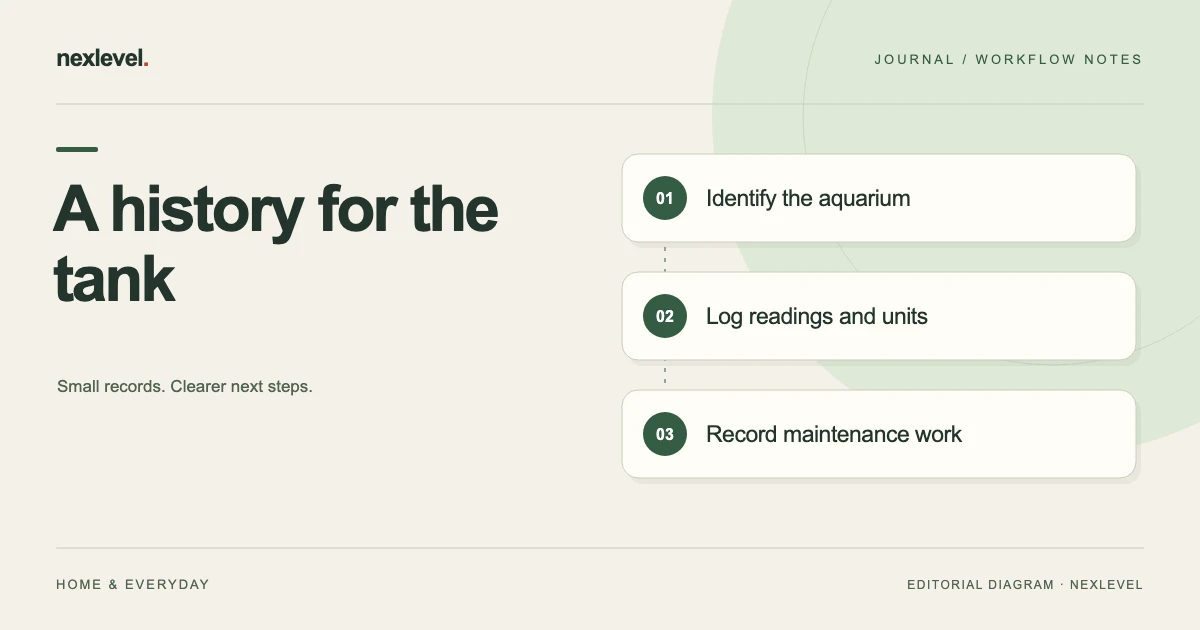
Give every aquarium its own identity
Record a readable tank name and stable reference. Multiple aquariums can have similar equipment or livestock while requiring independent histories. The record should make it difficult to enter a test against the wrong tank.
Keep relevant setup information and its source, including volume where you actually know it. An estimated capacity should remain labeled as an estimate rather than become an exact value used in later calculations.
Record meaningful setup changes as events. Replacing equipment or changing the arrangement should not silently rewrite what the tank looked like when earlier readings were taken.
Keep archived tanks separate from active ones. Reusing an old name for a different setup can accidentally combine two histories that do not describe the same aquarium.
Copy this aquarium log template
Use separate event types within one chronological history. These fields preserve enough context for review without requiring a long essay for every entry.
- Tank: identifier, setup reference, and relevant current context.
- Test session: date, time, recorder, and whether it occurred before or after a relevant event.
- Parameter: readable name, exact entered value, unit, method, and any uncertainty.
- Reference band: keeper-entered target or review range, its source, and version.
- Maintenance: actual action, date, recorded amount where relevant, and responsible person.
- Observation: factual note or photo, with attribution and limits.
- Follow-up: question to review, source to check, and chosen reminder.
- History: corrections, equipment changes, and export or report references.
Keep unknown and zero distinct. A parameter not tested should not appear as a zero reading, and a task with no recorded completion should not automatically look done.
Record the test method beside the number
Include enough method information to interpret a reading later. A visual test, an instrument reading, and a value reported by another person have different sources. Label what actually happened.
Preserve the unit and parameter identity. Two values with similar labels may use different reporting conventions. Do not merge them into one trend merely because their numbers look comparable.
If the method or instrument changes, record the change and assess comparability through the appropriate source. An apparent step in the graph may reflect a measurement difference rather than a change in the aquarium.
Keep relevant product or equipment instructions available for your actual testing process. This guide does not specify how to perform or interpret a particular water test.
A fictional timeline for two tanks
Imagine Tank A and Tank B are separate records. On one date, the keeper logs a test session for Tank A before a maintenance event. The session records its parameter names, values, units, and method without copying a result from Tank B.
The keeper then records the maintenance as a separate event. A later session has its own time and method note. The timeline can show that it came after maintenance without claiming the maintenance caused every difference.
A photo and short observation are added to Tank A. The note describes what the keeper observed rather than diagnosing an animal or asserting a treatment outcome.
Tank B remains unchanged in the record. Its reminders and target references are independent. The example illustrates event order and identity, not a recommended maintenance sequence or water target.
Keep target bands attributable and revisable
If you use a target or review band, record who entered it and the source relevant to the setup. A colored range in a log should not appear to be a universal standard for every aquarium.
Keep the range’s purpose clear. It may support a keeper’s review workflow rather than provide a diagnosis. The actual species, setup, and appropriate professional information still matter.
When a band changes, preserve the earlier context where possible. A historical reading should not appear to have been evaluated against a reference that was entered only later.
Do not change the band merely to make every historical result look acceptable. Record the reason and source of the revision instead of using the display as reassurance.
Record maintenance as actual events
A recurring task is a plan. A completion entry records what someone did. Keep the scheduled date and actual event distinguishable so the history remains useful when work happens earlier or later.
Describe the action and relevant equipment or product identity. If you record a quantity, preserve its unit and basis. A note saying “added some” may be difficult to interpret in a later review.
Keep intended actions separate from completed ones. A reminder to inspect equipment should not appear in the timeline as a confirmed inspection merely because the alert was dismissed.
This template supplies no dosing quantities, treatment plans, or replacement schedule. Use the actual appropriate instructions and record what happened rather than deriving an intervention from a generic log format.
Use observations that remain understandable later
Write what you saw, when, and in which tank. A concise factual note is more useful than an unexplained label such as “bad day.” Attribute information reported by another keeper.
Keep photographs connected to their dates and subjects. Similar-looking images can be difficult to place after equipment or livestock changes. A caption should explain what the photo was intended to document.
Separate observation from interpretation. A change in appearance, behavior, or equipment state can be recorded without a diagnosis or a claim that one action solved it.
If the note leads to a question, record the question and the appropriate source to consult. A log can support a professional conversation by preserving context without replacing it.
Read trends alongside the event history
A trend is easier to interpret when the relevant events are visible: method changes, maintenance, equipment replacement, or another recorded setup change. Keep those events dated rather than burying them in a general tank description.
Compare readings on a consistent basis. A difference in time, method, or units can limit what the comparison establishes. Note those limits before drawing conclusions from the graph.
Do not treat a sequence alone as proof of cause. An event preceding a reading can be useful context while several other factors remain unrecorded.
Preserve unusual readings with their method and uncertainty. Deleting every inconvenient value can make the history look smoother while removing information that deserves review.
Manage recurring work without losing ownership
Use task names that identify the tank and action. A reminder saying only “maintenance” becomes ambiguous when several setups are active.
Record who owns the next task in a shared care arrangement. Several people seeing the same reminder does not establish that one person has agreed to act.
Check actual completion before doing the same work again. A shared current record can prevent duplicate actions when one keeper acts before another opens their reminders.
For a broader shared-care method, our pet-care handoff guide explains clear ownership, factual history, and receiving checks. It does not provide aquarium-specific care instructions.
Correct a log without changing its meaning
If a reading was entered against the wrong tank or with a wrong unit, identify the correction and its source. Preserve enough history to explain the changed trend.
Distinguish a corrected entry from a new test session. A transcription fix should not create the appearance that another measurement occurred.
Review related summaries after a significant correction. A report or exported table may still contain the earlier value, so identify the current version where the difference matters.
When uncertain about an old entry, label the uncertainty instead of inventing a replacement value. A readable gap is better than false precision.
Prepare a focused tank handoff
The receiver needs the tank identity, current relevant context, latest recorded events, open questions, and next agreed task. A complete archive may be unnecessary for a short care handoff.
Include actual instructions through the appropriate source rather than asking the receiver to infer actions from a graph. A log of prior events is not automatically a plan for future care.
Ask the receiver to identify the next task and how they will record completion. This can reveal an ambiguous reminder or missing source before it causes confusion.
Keep private household details and unrelated photos out of the shared packet. Deliberate sharing helps the record stay useful without exposing more than the task requires.
Check exports and long-term retrieval
Open a sample CSV or PDF outside the app. Confirm tank identity, parameter labels, units, dates, notes, and event types remain understandable. A column of numbers alone loses much of the context.
Know which export or recovery option preserves photos and relationships. A report and a full recovery copy can serve different purposes.
Keep retired setups identifiable and active views focused. A later keeper should be able to find the old history without mistaking it for the current tank.
Our maintenance-record guide explains the general separation between an asset, a recurring plan, and an actual event. That structure also makes an aquarium history easier to retrieve.
Review a week’s history without filling gaps from memory
Choose the latest few relevant events for one tank and read them in order. Confirm which entries are test sessions, maintenance actions, observations, and reminders. A mixed timeline is useful only when the event types remain clear.
If a reminder passed but there is no completion record, do not automatically add the action or repeat it. Clarify what happened through the responsible keeper and record the actual known state. The history should distinguish missing documentation from work known not to have occurred.
For a late entry, preserve the event date if known and identify that the note was recorded afterward. A remembered approximate time should not become an exact timestamp merely to fit the form.
Check one reading against its method and unit. If the method changed during the week, label that point before treating the values as a directly comparable series. The graph can remain useful while its limits are explicit.
Then identify one practical record improvement: a clearer tank name, a missing product reference, a photo caption, or a next task with an owner. Avoid rewriting every earlier note to make the week look perfectly complete.
For a shared setup, give the next keeper a short summary of the current record and open question. They should not need to infer a care instruction from an unexplained value. Keep actual future actions connected to the appropriate source and agreement.
This review is about the quality of the log, not an assessment of animal health or water suitability. A clear chronology can support a qualified conversation without supplying the conclusion itself.
Use TankLedger for readings and events together
TankLedger connects tank-specific test panels, exact readings, keeper-defined bands, maintenance tasks, observations, equipment events, and photos. Its official listing describes local records, CSV data, PDF reports, and optional Pro tools including private iCloud synchronization.
View TankLedger on the App Store for current features and access. Use the timeline to preserve context while relying on appropriate species research, product instructions, and qualified advice for actual care decisions.
Sources and example scope
App features were checked against the official TankLedger listing and product page. Tank A and Tank B are fictional. No parameter ranges, dosing, treatment, species compatibility, maintenance interval, or veterinary conclusion is supplied.