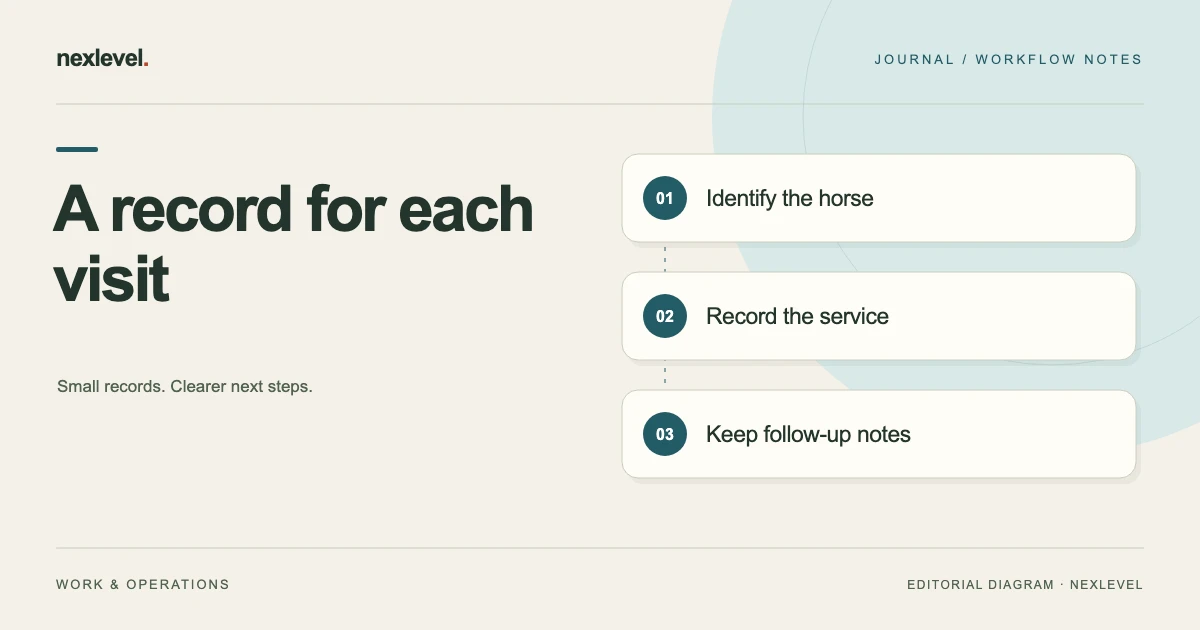
A farrier visit record should identify the horse, show what was done to each hoof, and preserve the context for the next visit. A note saying “usual set” may be easy to write but difficult for another professional to interpret after the setup, owner, or service history changes.
This template organizes professional work records, owner-reported observations, materials, photos, and scheduling. It includes a fictional visit without prescribing farriery technique, shoe selection, treatment, or service intervals. The record supports professional recall rather than replacing veterinary or other qualified assessment.
Give the horse a stable identity
Use a horse reference that remains recognizable when a barn, owner, or contact changes. A stable record should not depend only on the current yard name or a common nickname.
Keep the owner, responsible contact, and service location in their own fields. They can change while the horse’s history remains the same. Record meaningful changes rather than silently repurposing another horse’s profile.
Use identifying information through the appropriate professional process. If a detail is uncertain, mark it as uncertain instead of copying it from a similar record.
Separate active horses from archived records while keeping useful history retrievable. An inactive profile should not continue generating an active due-work entry merely because its last date remains present.
Copy this farrier visit template
Use one dated visit with distinct hoof entries and a concise whole-visit summary. The following fields provide a practical starting point:
- Visit: reference, horse, date, professional, location, and record state.
- Context: relevant prior visit and attributed owner-reported information.
- Hoof identity: left fore, right fore, left hind, or right hind under a consistent naming convention.
- Work recorded: the actual action for that hoof and relevant component details.
- Materials: shoe type, size, modification, or material where actually applicable.
- Evidence: selected photos, readable captions, and related professional notes.
- Outcome: observations, limits, and any follow-up question.
- Business record: service amount and payment state where tracked.
- Next action: professional scheduling decision, appointment state, and owner.
Keep a missing entry separate from a recorded action that does not apply. A blank hoof field should not automatically mean the same work was done as on the opposite side.
Record each hoof rather than assuming symmetry
The four-hoof map provides a useful identity structure even when several entries happen to match. Review each actual action instead of relying on a whole-horse label that may conceal a difference.
Use consistent names and orientation in notes and photos. The next reader should not have to infer left or right from an image alone, especially when images are viewed in a different arrangement.
Keep the action and component information related. A removed component, an item retained, and an item newly recorded describe different events. Do not carry an old material field forward automatically when it no longer applies.
This template describes how to record professional inputs. It does not advise what work should be performed on a particular hoof or how to carry it out.
A fictional mixed-action visit
Imagine Visit FF-031 for Horse H-12. The professional opens the previous record for context, then creates a new dated visit rather than editing the old service to look current.
Each hoof receives its own actual-work entry. Some component details match the earlier record, while another field changes. The professional reviews those entries individually instead of applying the previous setup unexamined to all four.
An owner-reported observation is recorded with attribution and date. It stays separate from the professional’s own observation and does not become a veterinary diagnosis.
The next-action section records the professional’s scheduling decision and whether an appointment has actually been arranged. The example contains no technical shoeing instruction or recommended interval.
Keep owner reports and professional observations distinct
Record what the owner says faithfully, with enough context to understand the question. “Owner reports a change since the last visit” is different from a professional assessment of its cause.
Keep your observations dated and connected to the visit or hoof they concern. A general note at profile level can lose the sequence of what was known when.
Avoid turning a working note into a diagnosis or a permanent label. The history should support the appropriate professional conversation without claiming more than was assessed.
If a question requires another qualified professional or source, record the next step under the actual process. The record can preserve the question and responsible person without inventing the answer.
Preserve component details with their context
Use readable component identities and units where relevant. A size or material code may need the associated system or description to remain interpretable later.
Distinguish a proposed setup from the work actually recorded. A note for consideration at a later visit should not appear as though it was already performed.
When a component changes, preserve the new detail and the reason recorded by the professional. Do not overwrite historical visits merely to keep a current profile convenient.
Keep source notes and attachments linked where they support recall. A component record should be understandable without guessing which product or hoof a loose photograph belongs to.
Use photos for identification and visual history
Attach selected images to the correct horse, visit, and hoof reference. A consistent caption can be more useful than a large collection of unlabeled photos.
Record enough orientation and context to identify the subject. A close image may show detail while obscuring which hoof or event it represents.
For comparisons, note relevant differences in view, lighting, or recording circumstances. Images can support visual recall without proving that an intervention caused a later change.
Share deliberately and through the appropriate permissions. A professional summary may need selected evidence without including unrelated people, locations, or private owner information.
Use presets as starting points
A reusable setup can reduce retyping, but a new visit still needs review against the actual horse and work. A copied field is not evidence that the action occurred.
Keep preset names and versions readable. A label such as “usual” can become ambiguous when the professional’s materials or practice changes.
Check every hoof after applying a preset. Similar entries can be intentional, but a single bulk action should not conceal an exception.
Keep client or owner-specific notes out of a general preset unless the workflow deliberately requires them. Reuse should preserve useful structure without copying unrelated private context.
Separate due work from booked appointments
A professional’s chosen service cycle or review window is a planning reference. A confirmed appointment is an agreement with a date and relevant participants. Keep those states distinct.
Record the basis of the next action through the professional’s actual judgment and process. Do not apply a generic interval from an article to every horse.
When an appointment changes, preserve the actual arrangement and communication state. A reminder moved to another date does not establish that the owner confirmed the change.
For a shared-care handoff, our care handoff guide illustrates clear ownership, dated events, and an agreed next action. Apply those recordkeeping principles while leaving farrier scheduling to the relevant professional process.
Keep route planning separate from service records
A route order helps organize the day, while a visit record explains what happened at a horse’s service. Moving a stop in the route should not alter the historical visit date or work entries.
Identify the actual horse and location before confirming a mobile or wrist action. A glanceable next item can be convenient while several similar names are active.
If an action queues while devices are disconnected, verify its saved state through the supported workflow before entering it again. A pending action and a confirmed record are different states.
Keep a practical manual route to the record when a device or connection is unavailable. The professional’s history should remain useful without relying on one display.
Record amounts without mixing them into work status
A service amount, an estimate, a payment, and an outstanding balance describe different business information. Keep the actual source and date for any financial event you record.
A completed visit does not establish that payment was received, and a payment does not describe what was done to each hoof. The summary should preserve both facts without using one status for everything.
Use currency labels and the business’s normal reconciliation process. If an allocation or adjustment is unclear, record the question rather than inventing a payment to make the total agree.
The invoice follow-up template explains a general method for connecting original amounts, received payments, promises, and next actions. Apply it only to the actual business process.
Prepare an owner-ready summary
Use readable dates, horse identity, actual work, relevant notes, amount state where appropriate, and the next agreed action. An owner should not need to interpret internal shorthand to understand the service record.
Keep professional observations and owner-reported statements attributable. A summary should not strengthen a tentative note into a confident conclusion.
Review selected images and private notes before sharing. The owner-facing document may not need every working field or unrelated history.
Preserve the version shared if later correction matters. A revised note should remain connected to the original visit without making earlier communication disappear.
Test the history at the next visit
Open the last completed record and check whether you can identify the work for each hoof, component details, relevant observations, and the reason for the next review.
If the answer depends on memory, improve the field labels or source references while the context is available. More notes will not necessarily fix a missing relationship between horse, hoof, and visit.
Check a sample export outside the app. Dates, identity, actions, amounts, and notes should remain readable. Know what the supported export or recovery process preserves before relying on a portable copy.
Keep archived horses and earlier setups identifiable, with the active queue focused on current work. A clear history is useful long after a single appointment is finished.
Keep continuity when the horse changes location
If Horse H-12 moves to another yard, preserve the horse identity and earlier visits while updating the current location through the actual recordkeeping process. The move is context for later work, not a reason to create an unrelated history under a similar name.
Check the responsible owner or contact and the appropriate sharing arrangement. Earlier summaries can contain information relevant to their original period without belonging in every new handoff.
At the next visit, identify which prior work and observations are relevant, then record the current event separately. A new location does not establish that the previous setup is unchanged or that a prior scheduling arrangement still applies.
For a receiving professional, provide the permitted current packet: horse identity, relevant visit reference, hoof-specific history, open questions, and actual next arrangement. Keep unrelated owner or business information out of a small transfer.
Ask the receiver to explain which record they will use for context and what still needs confirmation. If they identify only the old yard name, improve the horse reference before relying on the transfer.
The same principle applies when an active profile is archived and later reopened. Preserve the earlier dates and current status rather than making the gap disappear. A useful history explains continuity and change without turning a remembered setup into an automatic instruction.
Use FarrierForge for hoof-specific records
FarrierForge records horse history and individual hoof actions, with component details where applicable. Its official listing describes offline capture, CSV export, a Watch companion, and optional Pro owner summaries, route reminders, presets, and photo comparison.
View FarrierForge on the App Store for current features and access. Use the record to preserve the work performed and the next professional action, without treating it as veterinary advice.
Sources and example scope
App features were checked against the official FarrierForge listing and product page. FF-031 and H-12 are fictional. No shoeing technique, component recommendation, treatment, service interval, or veterinary conclusion is supplied.