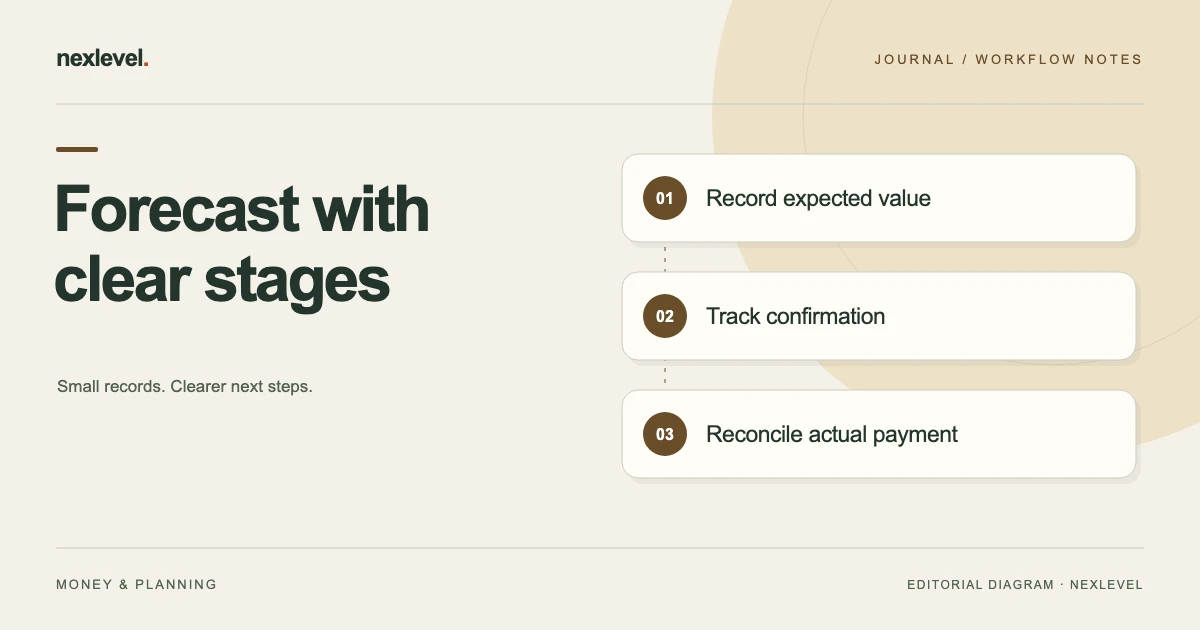
A commission forecast tracker should show the inputs, plan version, and calculation behind an expected payout. A total without that trail becomes difficult to explain when a deal is credited differently, a tier changes, or the payment statement does not match the estimate.
This template organizes deal inputs, rule versions, scenarios, and payment comparisons. The examples are fictional gross calculations. They do not establish an employer’s obligations, interpret a compensation contract, calculate tax, or guarantee when a payment will arrive.
Start with the plan document and its scope
Record the plan’s identity, effective period, source, and relevant version. A remembered rate or informal conversation should not silently replace the actual document used for the estimate.
Identify which person, role, product, period, or deal type the entered rules apply to. Similar plan names can conceal different eligibility or crediting conditions.
Keep unresolved wording visible. If you do not know how a cap, adjustment, or accelerator applies, record the question rather than choosing the interpretation that produces the largest result.
Separate the forecast’s rule record from actual employer payment decisions. The tracker applies entered assumptions; the relevant plan documents and statements remain the sources to check.
Copy this commission forecast template
Use a plan index and one record per deal or credited event. Keep the calculation readable enough for a later reconciliation.
- Plan: title, version, effective period, source, and open rule questions.
- Deal: private alias, relevant date, eligible amount, currency, and eligibility basis.
- Credit: share attributed to this person and its source.
- Calculation: rate, tier or accelerator treatment, adjustments, cap, and result.
- Timing: expected payout date and the assumption behind it.
- Scenario: base, likely, stretch, or another clearly defined inclusion set.
- Statement: actual reported amount, period, source, and reconciliation state.
- Follow-up: variance question, evidence, owner, and resolution note.
Keep unknown and zero different. A deal with unverified eligibility is not automatically a zero commission, and a missing statement amount is not proof that nothing was paid.
Separate deal value from eligible value
The visible sale amount may not be the amount used by the entered plan. Record the eligible basis and why it applies rather than automatically multiplying every deal’s headline value by the same rate.
Keep currency beside the amount. A portfolio total should not add unlike currencies without a defined conversion method and source.
Record the relevant event date under the plan’s actual terms. Closing, booking, collection, and payout can be different events. The tracker should not collapse them into one ambiguous date.
When a source changes the eligible amount, preserve the new event or correction and its basis. Replacing the original value without a note removes the evidence needed to explain a later difference.
A fictional flat-rate calculation
Suppose a fictional plan uses an eligible deal amount of 25,000, an entered credited share of 80%, and a rate of 3%. The credited basis is 25,000 × 0.80 = 20,000. The modeled commission is 20,000 × 0.03 = 600.
Keep all three inputs visible. Entering only 600 prevents the next reader from checking whether the difference came from the deal amount, credited share, or rate.
A second fictional eligible deal of 15,000 at full credit and a 2% rate produces 300. A scenario including both deals totals 900 under those assumptions. That total is a forecast, not a statement that the employer has approved or paid it.
The figures exclude any unlisted adjustment or withholding. If the actual plan requires another input, record it explicitly rather than implying the example covers every compensation arrangement.
Make tier treatment explicit
A tier rule needs more than a threshold and a higher percentage. Record whether the entered plan applies a rate only to the amount within a band or changes the treatment of a broader amount.
For an independent arithmetic illustration, 10,000 at 2% plus the next 5,000 at 3% gives 200 + 150 = 350. Applying 3% to the entire 15,000 gives 450. Both calculations are mathematically clear, but they represent different rules.
Do not choose between them from the numbers alone. The actual applicable source must establish the treatment. If the wording is unresolved, keep separate labeled scenarios or leave the calculation pending clarification.
Keep the entered rule version with the result. A later rule change should not rewrite a closed calculation as though the new terms had always applied.
Record adjustments and caps separately
A clawback, manual adjustment, or cap can change a modeled amount. Preserve the source, date, affected deal or period, and calculation effect.
Do not use an unexplained adjustment line to make a forecast match a statement. The match is meaningful only when the difference has an evidence-based explanation.
Keep proposed and confirmed adjustments distinguishable. A question raised during review should not automatically become a final reduction or addition.
If a cap applies, state the amount and scope used by the entered model. A per-deal cap and a period cap are different rules. This guide supplies no universal compensation interpretation.
Define what each forecast scenario includes
Base, likely, and stretch labels are useful only when their inclusion criteria are clear. Record which deals and assumptions belong to each scenario.
Do not turn a label into an unsupported probability. A scenario called likely is not automatically a statistically calibrated prediction or a guarantee of payment.
Keep uncertain eligibility and timing visible. A deal can meet one scenario’s inclusion rule while its payout date remains unknown.
When comparing scenarios, use the same currency and period basis. Otherwise, a larger total may reflect a different window rather than a meaningful change in the forecast.
Preserve expected payout dates as assumptions
An expected payout date should identify its source and current certainty. A plan schedule, a statement date, and a personal planning estimate are different information.
Keep a later date change linked to the reason. Do not repeatedly move a date forward without preserving that the earlier expectation was different.
Separate gross expected commission from actual cash available. A future estimate does not establish the timing or amount of a deposit.
Assign a personal review date separately from the expected payout event. The review can prompt a source check without changing the historical forecast or implying that a payment is due under unverified terms.
Compare a statement with the correct forecast version
Record the statement period, amount, source, and relevant deal or group. Use the forecast snapshot that was actually created for that comparison rather than a later edited model.
If the fictional 600 estimate is compared with a statement entry of 570 on the same defined basis, the difference is 570 − 600 = −30. That arithmetic identifies a variance, not its cause.
Keep gross, net, and other amount labels clear. Two figures with different definitions should not be treated as an unexplained shortfall merely because their numbers differ.
Check period alignment, eligibility, credit share, rates, and recorded adjustments before drawing a conclusion. If the cause remains unknown, preserve the question for the appropriate source.
Build a focused evidence packet
Include the relevant plan version, deal alias, entered inputs, calculation, statement reference, and concise question. The recipient should be able to follow the issue without receiving an unrelated portfolio archive.
Protect confidential customer and employer information. Use appropriate aliases and access controls, and share only through an authorized route.
Record what was actually communicated and the response. A prepared PDF or copied message does not establish that the question was delivered or resolved.
Our follow-up tracker guide provides a general method for separating factual records, reviewed drafts, actual communications, and later responses. Its invoice example does not establish compensation rights.
Resolve differences without erasing them
When a variance is explained, record the source and resolution. A corrected input, timing difference, or confirmed plan rule should remain identifiable.
Keep the original forecast snapshot and the revised understanding distinct. Otherwise, the history can appear perfectly accurate only because earlier expectations were overwritten.
Use the resolution to improve future data entry or rule review. One unusual deal may deserve a specific note rather than a new default for every forecast.
If the matter requires payroll, legal, tax, or plan interpretation, use the appropriate responsible process. The tracker can organize the evidence without deciding the issue.
Test the record with a read-back
Choose one calculation and ask an authorized reader to identify the eligible amount, credited share, rate treatment, adjustment, period, and expected total.
They should be able to reconstruct the arithmetic and distinguish entered assumptions from confirmed statements. If the result depends on the original author’s private explanation, improve the labels.
Check exported data for currency, percentages, dates, and version references. A column of totals alone loses the audit trail that makes the forecast useful.
Keep local recovery copies through the supported workflow and know what happens to attachments. A shared evidence brief and a full private archive can serve different purposes.
Keep a plan change from rewriting a closed calculation
Suppose Deal D-01 was recorded under Plan V1, producing the fictional 600 estimate above. A later Plan V2 introduces a different entered rule for another defined group of deals. Preserve which version applies to each record rather than replacing every stored rate with the newest one.
For an independent example, a later eligible basis of 10,000 at an entered 4% produces 400. At 2%, it would produce 200. The 200 difference follows from the changed input, but the arithmetic does not determine which version the employer applies.
Record the source and effective scope before assigning V2 to the later deal. If applicability is disputed or unclear, keep the question visible. A newer file date alone may not resolve every historical period or deal condition.
When revising a forecast, label the snapshot and preserve the earlier one. A reader should be able to distinguish a new forward-looking scenario from a correction to the original inputs. Those are different reasons for a number to change.
Use a five-question reconciliation worksheet
Before raising a statement difference, answer five questions from the record: which plan version, which eligible basis, which credited share, which rate treatment, and which payment period? These questions help identify an actual evidence gap instead of beginning with an assumed error.
Add a short line for adjustments and amount definitions. If the statement figure is not on the same basis as the forecast, label that limit before presenting a variance as a shortfall. The first task may be to establish comparability.
Prepare a small packet containing only the relevant source excerpts or references and the calculation. An authorized reviewer should be able to reconstruct the result without receiving confidential details about every other deal. Keep private identity mappings outside a broadly shared summary.
Finally, record the response and the exact question it resolves. A clarification of timing does not automatically resolve a separate credit-share question. Close only the supported issue and leave the remaining action visible. This makes the tracker a usable discussion record rather than a list of numbers adjusted until they match.
For a final check, read the result backward: begin with the expected total, then locate the adjustment, rate treatment, credited basis, eligibility source, and plan version. This reverse trace can expose a detached total that a forward data-entry check missed. Keep the open question specific and factual if one relationship cannot be established.
Use PayoutVerity for versioned calculations
PayoutVerity records entered commission plans, credited shares, rates, tiers, adjustments, scenarios, and expected payouts. Its official listing describes preserved plan versions, statement comparisons, variance evidence, and optional Pro exports. It does not replace employer plan documents or payroll records.
View PayoutVerity on the App Store for current features and access. Keep the source, exact math, and unresolved question connected before relying on a forecast.
Sources and example scope
App features were checked against the official PayoutVerity listing and product page. All deals, rates, tiers, and statement figures are fictional. No compensation entitlement, employer policy, tax treatment, or guaranteed payout is asserted.