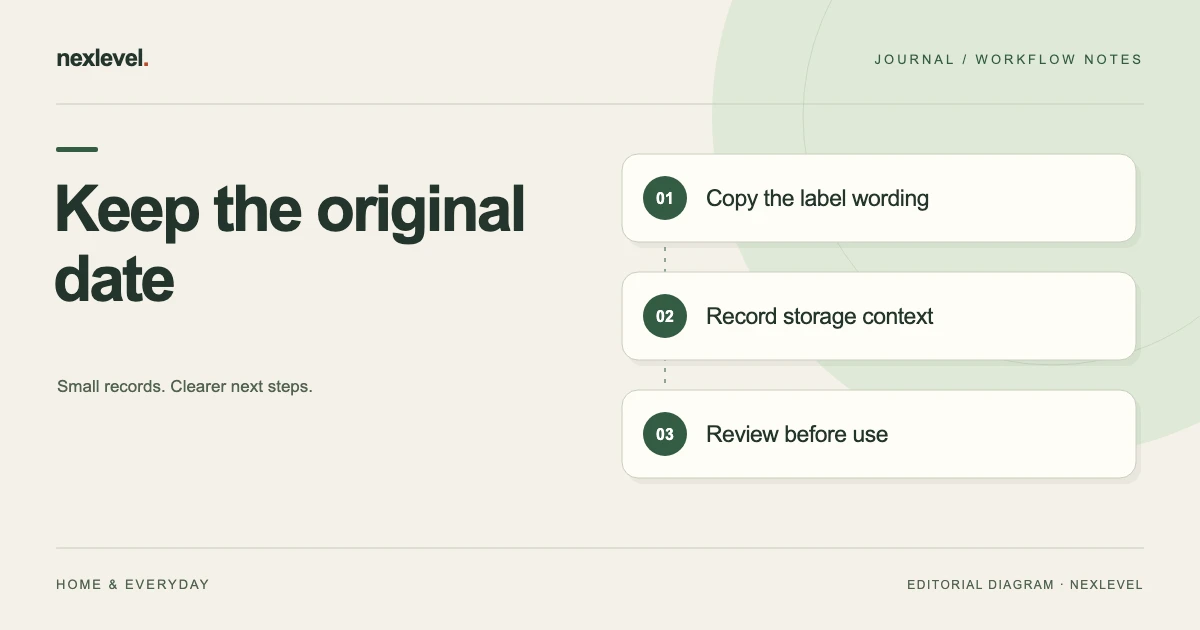
A food date-label tracker should preserve what the package actually says, which product it belongs to, and what happened after purchase. A date copied into a generic expiry field can lose the wording, storage instruction, or opened-date context needed to understand it.
This template organizes labels, events, locations, and reminders. It includes a fictional household example and links to official guidance. It does not determine whether a food is safe, assign universal storage periods, or turn an app suggestion into a manufacturer’s instruction.
Start with product identity and the original label
Record the product, variant, package size, and a useful identifier where relevant. Two packages can look similar while having different dates or instructions.
Preserve the exact printed wording and date as a source reference. A note or permitted photo outside the tracker can help when the package is no longer easy to inspect.
Keep a lot or batch reference when it is useful to your record. A date alone may not identify which of several similar packages the entry describes.
Do not copy information from another package merely because the brand matches. The record should reflect the item actually in your kitchen.
Copy this food date-label template
Use one entry per item or clearly defined group that shares the same relevant history. These fields preserve context:
- Food: name, variant, package identity, quantity, and unit.
- Label: exact wording, printed date, instructions, and original source reference.
- Interpretation: confirmed date format or an unresolved question.
- Events: acquired, opened, prepared where relevant, and frozen dates.
- Location: actual fridge, freezer, pantry, or another clearly named place.
- Reminder: chosen review date and why it was selected.
- Current state: active, used, discarded, archived, or another defined event.
- Follow-up: label question, official source to check, or household owner.
Keep the source date and personal review date distinct. Moving a reminder does not change the package’s printed information.
Keep label wording instead of translating everything into expiry
In its U.S. consumer guidance, the FDA explains that date wording varies and supports “Best if Used By” as a quality-oriented phrase. That does not make every printed date a universal safety deadline.
Preserve the wording so a later reader can check the appropriate guidance. Do not automatically replace every phrase with “safe until” or assume the same meaning across products and jurisdictions.
This U.S. reference does not define labeling rules everywhere. Follow the actual product instructions and appropriate local authoritative guidance when interpreting a real label.
If the label is unclear, record the question and use the manufacturer’s appropriate contact or information route. A plausible interpretation entered confidently is still an assumption.
A fictional three-item inventory
Imagine a household records Product A, Product B, and Product C. A has a readable package date and instruction. B has an ambiguous numeric date format. C has a known frozen event but an uncertain earlier opened date.
A’s record preserves the source wording. B’s record keeps the original digits and a question rather than choosing month-first or day-first without evidence. C’s record preserves the known event and the gap in history.
The household assigns personal reminders to review the relevant information. Those reminders do not establish safety, and C’s later frozen date does not erase the uncertainty about its earlier history.
When an item is used or discarded, the actual disposition is recorded. The fictional example supplies no product-specific storage period or instruction to consume an uncertain item.
Resolve ambiguous date formats explicitly
A numeric date can be read differently across conventions. Preserve the source as printed and confirm its intended meaning through the appropriate product information.
After confirmation, store an unambiguous date representation where your workflow supports it. Keep the source reference so another household member can understand the interpretation.
Do not use a convenient reminder date as evidence that the label format was resolved. Those are separate fields and decisions.
If the date cannot be established, keep the uncertainty visible. The tracker should not manufacture precision to complete the form.
Record acquired, opened, and frozen events separately
Purchase or acquisition date describes how the item entered your household. Opened date describes another event, and frozen date another. They should not overwrite one another.
Keep any relevant label instruction connected to the event it concerns. A printed instruction about handling after opening should not disappear into a general product note.
If an event date is approximate, label it as such through the appropriate record or note. A guessed exact date can make later interpretation unreliable.
A new event is part of the history, not a reset button for everything that happened earlier. The record should preserve the sequence rather than create a falsely fresh item.
Make storage location match the physical item
Use locations the household can recognize, such as a specific shelf or freezer area where useful. A record is less helpful if the item cannot be found when the reminder appears.
When the item moves, record the actual change. A planned move and a completed move are different events; do not update the location before the household has acted.
Keep source instructions separate from the recorded location. The fact that a product is on a pantry shelf does not establish that the location matches its requirements.
For prepared containers rather than packages, the prepared-food inventory guide focuses on container identity, preparation history, and household handoffs.
Choose review reminders with a reason
A reminder should tell you what to check, such as the source label, an opened-date question, or the actual remaining quantity. A calendar alert does not make the underlying information authoritative.
Keep the selected date under human control. A suggested date can speed entry, but it should remain a suggestion until you review its applicability.
Do not treat a reassuring queue position or a disabled alert as evidence of safety. The app is organizing entered information rather than measuring food condition.
Check notification permission and actual scheduling state. A saved reminder and an alert you noticed are different events.
Keep quantity changes and disposition honest
Record whether the item was used, partly used, discarded, or archived under the available workflow. Removing an item from the active view should not automatically imply it was eaten.
For a partly used item, preserve the identity and remaining quantity on a clear basis. A new entry should not duplicate the original amount unless it represents a genuinely separate item.
Use estimated values honestly if you track cost or waste. A planning estimate is not a receipt-based measure of all household spending.
Keep corrections separate from new events. Fixing a mistaken status should not create an extra use or discard in the history.
Use a short household review
Start with items whose records need attention, then locate them physically and check the relevant source information. The review is about the actual item, not just clearing rows from an app.
Identify duplicates, missing identities, changed locations, and unresolved labels. Give each useful follow-up an owner instead of adding another vague reminder.
Do not let a waste-reduction goal override appropriate food-safety guidance. An unknown record should lead to a source check or appropriate action, not a forced consumption target.
The FDA page linked above includes U.S. safe-storage information and routes to official resources. Use guidance appropriate to the food and circumstances rather than deriving a universal rule from this template.
Improve shopping from actual history
A use or discard history can reveal practical questions: repeated duplicate purchases, confusing package sizes, or records left active after items were gone.
Keep interpretation proportionate to the data. A few entries can suggest a review without proving a stable waste rate or a guaranteed saving.
When comparing pack sizes, use a consistent unit and the amount you can realistically use under the actual guidance. The unit-price guide explains the arithmetic without deciding food suitability.
Preserve the original cost basis if you record value. A later shop price should not silently rewrite the estimated value of an earlier disposition.
Share and export with context
A household handoff should identify the item, current location, source label, open question, and next owner. The receiving person should not have to infer meaning from a bare date.
Check exported columns for label wording, date meanings, quantity units, and status. A list of dates detached from their types can be misleading outside the app.
Keep private household details and unrelated receipt information out of a broad shared file. Use the deliberate export route appropriate to the recipient.
Know what your recovery copy preserves. A summary table may not include the original package reference or every attachment stored elsewhere.
Work through an ambiguous printed date
Suppose a fictional package shows a short numeric date that could be read under more than one convention. Preserve the digits and wording exactly, then record the unresolved format question. Do not choose a calendar date simply because it fits the reminder you want.
Check the product’s actual information through an appropriate source. If the intended date is confirmed, record the interpretation and keep the reference. If it remains uncertain, the tracker should preserve that limit rather than create an authoritative-looking expiry entry.
Keep a personal review reminder separate while the question is open. A date selected to prompt research does not become the package’s date. The receiving household member should be able to identify which one came from the label.
This exercise concerns record interpretation, not permission to consume the item. An app cannot supply missing identity, storage, or safety information from a convenient calendar value.
Keep similar packages from sharing the wrong history
Imagine two packages of the same product, A-1 and A-2, have different labels or opening histories. Give them separate identities where those differences matter. A single combined quantity could hide which package a reminder concerns.
If you group items, define the group and confirm that the relevant dates and events genuinely match. Splitting the group later should preserve the original relationship without duplicating the full quantity in every new entry.
For a household review, choose one item and ask another person to find its actual package, source wording, entered interpretation, location, and current state. If they locate a different package with the same brand, improve the identity before relying on the reminder.
Then check whether used or discarded items remain active. A stale entry can generate unnecessary shopping or a misleading attention list. Correct the actual record rather than changing the source date to make the alert disappear. This keeps the tracker grounded in the physical kitchen while leaving food-safety decisions with the appropriate information and guidance.
For a concrete format question, a fictional label showing 04/05 may be read as April 5 or May 4 under different conventions. Preserve the original and resolve the meaning from the product’s actual information; do not select the interpretation that gives a later reminder.
Check the year as well if it is unclear or omitted from the visible reference. A device’s current year is not evidence of what the manufacturer intended. Once confirmed, retain both the unambiguous entered date and the source wording. This makes the household record easier to audit without treating the interpretation as a food-safety decision.
Use SavorSoon for dates and locations
SavorSoon organizes entered food dates, optional acquired, opened, and frozen events, storage locations, reminders, disposition history, and CSV export. Its official listing describes user-controlled suggestions and a daily attention view, not a tool that determines edibility.
View SavorSoon on the App Store for current features and access. Keep actual wording and history available alongside the convenient date view.
Sources and example scope
App features were checked against the official SavorSoon listing and product page. The FDA consumer page supplies the U.S. date-label context. Products A, B, and C are fictional; no product-specific expiry period or safety assurance is supplied.