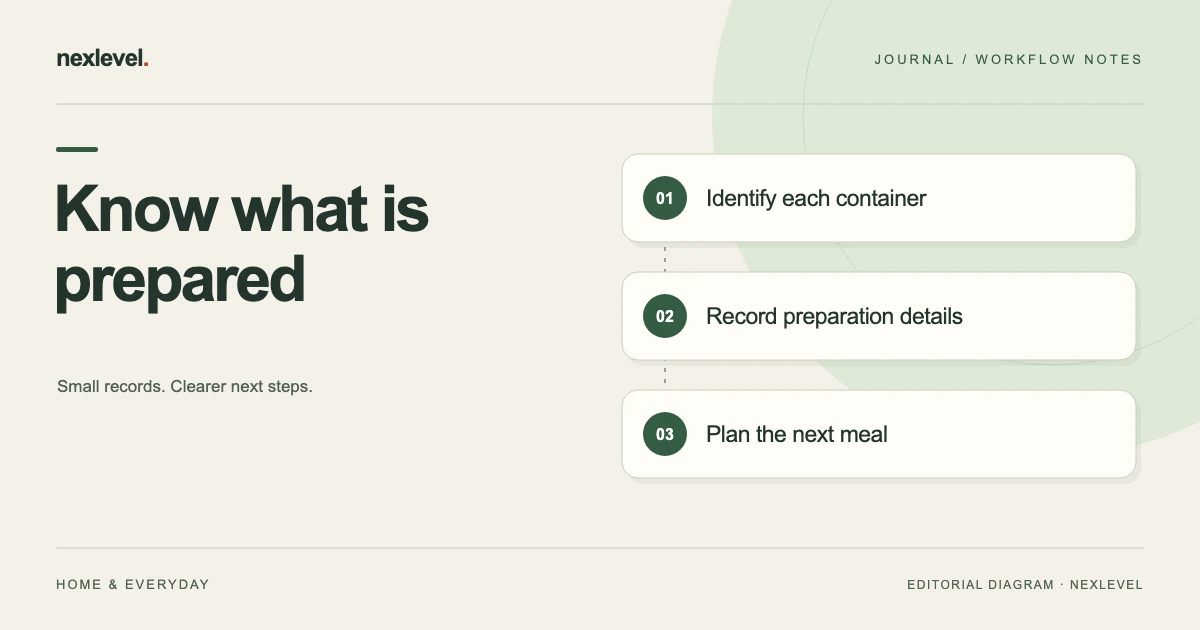
A prepared-food inventory should help the household identify a container, understand its recorded history, and choose the next appropriate action. A photo of an unlabeled box or a reminder saying “use soon” leaves important questions about contents, dates, location, and ownership.
This template focuses on prepared food rather than every package in the pantry. It includes a fictional container example and official U.S. food-safety context. An inventory organizes information; it cannot determine edibility, reconstruct unknown handling, or certify that food is safe.
Identify the container and its contents
Give each container a readable reference and a description you can confirm. Similar boxes can hold different food or different batches. A physical label and digital record should refer to the same item.
Keep uncertain contents visibly uncertain. A photograph or extracted label can help entry, but it should not invent ingredients or dietary suitability.
Record the prepared or acquired event that actually applies. Food cooked at home and food brought home from another source may have different available histories.
Use the appropriate product, dietary, and official guidance for real decisions. The inventory’s role is to preserve the relevant information rather than replace those sources.
Copy this prepared-food template
Use one entry per container or clearly defined group with the same relevant history. These fields make the record useful during a household handoff:
- Identity: container reference, confirmed description, and optional image or label source.
- Origin: prepared or acquired date and any relevant known handling event.
- Location: actual fridge or freezer position, with moves recorded as events.
- Quantity: containers or portions on a clear basis, without inventing precision.
- Guidance: relevant source instructions and unresolved questions.
- Reminder: chosen check date and why it was selected.
- Disposition: eaten, frozen, shared, discarded, archived, or another faithfully recorded event.
- Handoff: owner, next action, and receiving confirmation where needed.
Keep the prepared date, frozen date, and personal review date separate. A reminder change should not make the food appear newly prepared.
Keep safety decisions outside the queue ranking
U.S. FDA household guidance says perishable food should not remain at room temperature for more than two hours, or one hour above 90°F. It also recommends a refrigerator at 40°F or below. These handling conditions cannot be established by a calendar reminder.
Follow the actual label and official guidance appropriate to the food and circumstances. The U.S. reference does not replace product-specific instructions or relevant local guidance.
A use-first position is an organizational priority based on entered information. It is not a statement that the food is safe to eat or suitable for a particular person.
If important identity or handling information is uncertain, do not let a reassuring app date supply the missing assurance. Use the appropriate authoritative guidance and judgment.
A fictional two-container example
Imagine a household records a prepared batch under reference LF-012, with containers A and B. Both connect to the same known preparation event, while each has a distinct physical label and location.
Container A is later recorded as eaten. Container B remains active. The household does not close the whole batch merely because one container was used.
B is then moved to the freezer under the household’s appropriate process. Its new location and frozen event are recorded without erasing the original preparation history.
A personal check reminder remains a planning choice. This example provides no storage duration or assurance about the batch’s actual safety; it demonstrates identity and event relationships.
Capture quickly, then verify suggestions
A photo, text label, or voice note can make entry easier. Review the actual description, dates, and location before relying on the record.
Text recognition can misread a handwritten date or container label. An extracted value should remain a draft until a person confirms it against the source.
Keep the original reference where useful. A suggested description should not replace the only evidence that could resolve an uncertainty later.
Do not treat visual similarity as proof that two containers share a history. Confirm the relationship instead of merging entries because they look alike.
Use dates for their actual meanings
Prepared, acquired, opened, frozen, and reviewed can describe different events. Use the fields or notes appropriate to the known history rather than forcing them into a single expiry label.
Record approximate dates honestly. A guessed exact timestamp can make a later review appear more certain than the evidence supports.
Keep source instructions connected to the event they concern. The inventory should make it easy to find the actual guidance rather than substitute a generic preset.
For packaged products and printed wording, the food date-label guide focuses on preserving the label itself and resolving date-format questions.
Record location changes after they happen
A planned move and an actual move are different states. Update the record when the container is physically in its new place, not simply when someone decides to move it later.
Use recognizable location labels. A useful record can point to the correct shelf or freezer area without becoming a complicated household map.
Keep movement events connected to the original identity. Creating a completely new entry for the same container can duplicate quantity and obscure earlier dates.
A location update records what happened. It does not certify the suitability of storage conditions or reset every prior handling event.
Make use-first order explainable
A queue is more helpful when you can identify why an item appears near the top: entered dates, a selected rule, or a personal review reminder.
Keep the rule source and human choices visible. A default or template can support organization without becoming authoritative food-safety guidance.
Do not clear the queue by marking uncertain items eaten. The history should reflect actual disposition rather than an attempt to improve a progress display.
If several items need attention, choose the next appropriate check using their actual information. Queue order alone should not decide consumption.
Assign household actions clearly
A shared household needs one current record and a clear owner for a task. A message to several people can create awareness while leaving nobody responsible.
State the container reference, location, known history, open question, and next action. The receiver should not have to identify a box from a vague description.
Ask for a short receiving confirmation where the task matters. This checks that both people mean the same container and action.
Do not assume an app’s private device synchronization creates a multi-person household workflow. Use the actual supported sharing arrangement or a deliberate manual handoff.
Keep partial use and disposition distinct
One container may be partly used while another is untouched. Record the quantity or state on a basis the household understands.
Use the actual event label. Eaten, shared, discarded, and archived describe different outcomes. Removing an item from the active queue should not automatically mean it was consumed.
If a status was entered by mistake, use the supported undo or correction process and check the resulting record. Avoid creating another full item that duplicates the same food.
Keep a concise history so later reviews can explain what happened without preserving unnecessary personal information.
Review the physical shelf and the record together
Compare active entries with containers actually present. A tidy digital list can still contain items that were used, moved, or discarded without a recorded event.
Check identity, dates, location, quantity, and open questions. Fix the relationship that matters rather than adding more reminders to an uncertain entry.
For a small review, choose a few containers and test whether another household member can find them from the record. If not, improve labels or location descriptions.
Keep waste-reduction goals subordinate to appropriate safety guidance. An inventory should make responsible decisions easier rather than pressure someone to consume uncertain food.
Use history to improve preparation and shopping
Actual disposition can reveal organizational questions: containers too large for the routine, duplicate entries, or reminders reviewed after the item was already gone.
Do not turn a few records into a guaranteed savings claim. The history can guide a practical experiment without proving a stable waste rate.
If comparing purchase quantities, the unit-price guide explains consistent units and pack arithmetic. Cost comparisons do not establish safe storage or dietary suitability.
For a meal with several dishes, the dinner timeline guide helps organize serving tasks. Preserve actual preparation and storage history separately afterward.
Keep exports and private sharing understandable
Check a sample export for container identity, date meanings, location, state, and history. A table of unexplained dates can be misleading outside the original app.
Share only the relevant household record and chosen destination. A small handoff may not need every photo, preference, or historical item.
Know what the supported export or recovery workflow preserves. A summary and a complete local archive can serve different purposes.
Keep old records identifiable without allowing them to clutter the active use-first view. The current shelf and historical archive should remain easy to distinguish.
Reconcile a batch split across several containers
Suppose a fictional batch is represented by four labeled containers. One is recorded as eaten, one is moved to the freezer, and two remain in their recorded fridge locations. The active inventory should identify three remaining containers, with their distinct locations and the original batch relationship intact.
Do not create a new full batch entry for the frozen container while leaving its original active entry unchanged. That would duplicate the same food in the record. A move or supported disposition should preserve identity rather than manufacture quantity.
Keep the original prepared event connected to all relevant containers. A later location event should not change the preparation date or imply a fresh handling history. This is an indexing principle, not a storage-life calculation.
Ask the receiving household member to find the freezer container and identify its source record. If they cannot distinguish it from the two fridge containers, improve the labels before the next handoff.
Separate acquisition evidence from preparation history
A takeaway receipt can establish a purchase reference and time without establishing every earlier preparation or handling event. Record what it actually supports rather than copying its timestamp into an unsupported prepared-time field.
If food comes from another household member or source, preserve the known description and information provided, with uncertainty where relevant. A clear source reference can support a later question without pretending the full history is known.
For an entry exercise, capture the container identity, confirmed contents, actual location, known date meaning, and next source check. Review any extracted or dictated suggestion against the available information before accepting it.
Finish by comparing the record with the physical container. The name, label, and location should agree. Correcting a typo or uncertain description improves the inventory, but it does not itself establish edibility or safe handling. The point is to make the next appropriate decision easier to support with real information, rather than to turn an incomplete record into a reassuring date.
A location label such as fridge is not a temperature measurement. Keep any actual known condition and source separate from the location name, and do not infer a safe handling history from a familiar shelf. The inventory can preserve a useful question without supplying the missing evidence. That distinction matters when another person sees only the digital record.
Use LeftoverFirst for the prepared-food queue
LeftoverFirst connects containers, descriptions, photos or labels, prepared dates, locations, reminders, and disposition history. Its official listing describes editable on-device suggestions, a use-first queue, exports, and optional private iCloud features. It does not determine edibility, expiration, or safety.
View LeftoverFirst on the App Store for current features and access. Use the queue to organize the next check while keeping actual labels, handling history, and official guidance in view.
Sources and example scope
App features were checked against the official LeftoverFirst listing and product page. U.S. handling context is linked to the FDA above. LF-012 is fictional; no product-specific storage life or safety assurance is supplied.