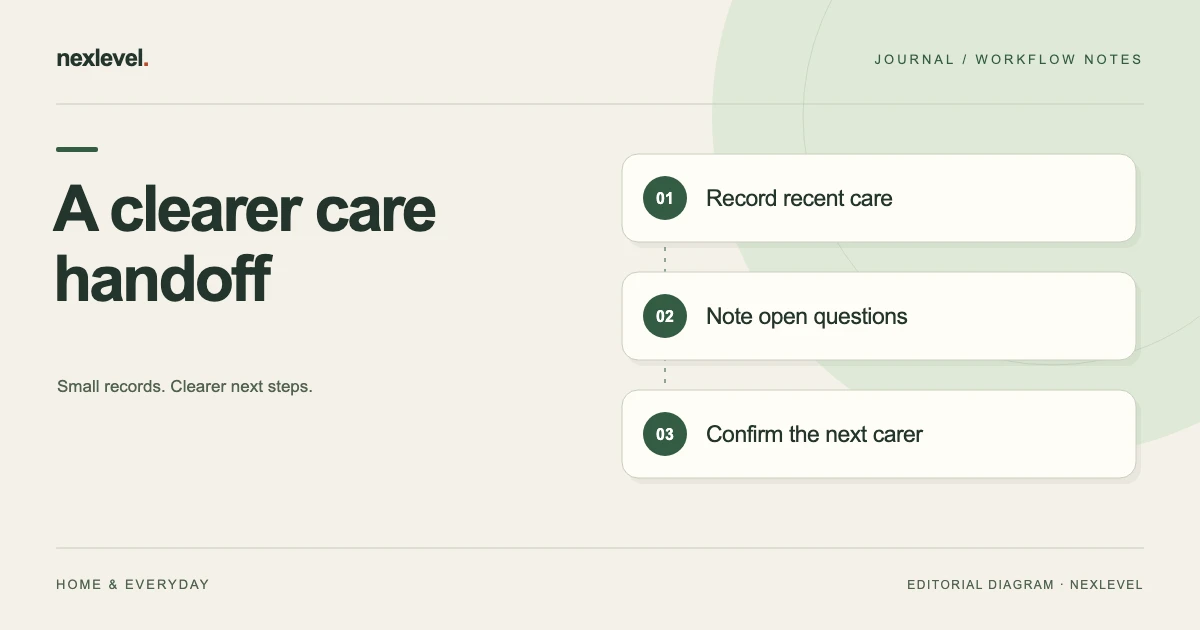
Baby-care handoff notes should help the next caregiver understand what was recorded, what remains uncertain, and who owns the next agreed action. A nap suggestion, a planned feed, and a completed event are different kinds of information. Combining them into one confident-looking schedule can make the handoff harder to interpret.
This template organizes a journal and receiving conversation. It does not prescribe wake windows, feeding intervals, sleep training, medication, or an individual care plan. Use current safe-sleep guidance and the qualified advice appropriate to the baby.
Keep the care plan separate from the journal
The plan describes agreed future care through the appropriate sources. The journal describes what was actually observed or recorded. A saved suggestion should not become an event merely because its proposed time passed.
Identify the baby and the current caregiver arrangement. A family may have several people helping, but awareness of a shared note does not establish who is responsible next.
Keep any individual professional instructions accessible through the appropriate route. Do not reconstruct them from a graph, an app default, or somebody’s memory of an earlier conversation.
Record uncertainty honestly. If an event time is approximate, preserve that limit rather than choosing a precise minute to make a timeline look complete.
Copy this handoff note template
Use a short current summary linked to the actual event record. A practical worksheet can answer:
- Identity: baby, date, current caregiver, and relevant contact route.
- Latest events: actual wake, nap, feed, or diaper entries with times and sources.
- Event state: completed, currently in progress, planned, or uncertain.
- Care instructions: the appropriate current source rather than an inferred rule.
- Suggestion: any app range, its editable status, and the fact that it remains a cue.
- Open question: missing context or information to clarify.
- Next action: the actual agreed task and person taking over.
- Receiving check: confirmation that the next caregiver understands the current state.
A complete form is not a medical assessment. The note should preserve the care information and its source without claiming more than the record supports.
Record actual starts and ends
A wake event, nap start, and nap end describe different moments. Keep them identifiable so a duration can be reconstructed without guessing.
For pure arithmetic, a fictional nap recorded from 10:20 to 10:50 lasts 30 minutes. That is an elapsed-time calculation, not a recommended nap duration or an assessment of the baby’s needs.
If the end was not recorded, preserve that state rather than automatically using the next reminder time. An inferred end can change several later summaries.
When an entry is corrected, review the timeline and receiving note. A caregiver who already read the earlier summary may need a concise update.
A fictional handoff with one uncertain time
Imagine Morgan records a wake event, a later nap, and another care event. One entry was added afterward and its exact time is uncertain. The note identifies that uncertainty rather than presenting every row as equally precise.
Riley takes over and checks the current journal. Morgan states the latest actual event, the open question, and the next agreed action under the family’s actual care plan.
An editable nap range remains visible as a suggestion. Riley does not treat it as a diagnosis, a guaranteed sleep time, or a reason to disregard the baby’s situation and appropriate care guidance.
The receiving confirmation is brief: which record is current, what is uncertain, and who is responsible. The example gives no wake-window target or feeding instruction.
Keep elapsed time distinct from a recommendation
An app can calculate time since an entered wake event. If the fictional event was 09:10 and the review is 10:00, the elapsed time is 50 minutes. The calculation depends on the input being correct.
That number does not establish when a particular baby should sleep. A personal or age-aware suggestion has a different role from a medical instruction.
Keep the range’s explanation and editability clear where the tool provides them. A changing suggestion can reflect changed records or settings rather than a newly established fact about the baby.
Do not make a tidy timeline more important than appropriate observation and care. A journal supports a caregiver; it does not replace one.
Use safe-sleep guidance independently of the app
The NIH Safe to Sleep guidance describes an infant sleep surface that is firm, flat, and level, with only a fitted sheet. A nap timer or prediction does not verify the physical sleep environment.
Keep current authoritative guidance available to everyone who provides care. A handoff note should not imply that recording a nap establishes safe conditions.
This guide does not attempt to replace the full guidance or individual professional advice. It provides a record structure, not a clinical or sleep-safety assessment.
When sharing a plan, distinguish the actual instruction source from app-generated timing suggestions. The receiver should know which information has which role.
Review quick entries before relying on summaries
A one-tap action can save effort while a caregiver is tired, but mistakes can still happen. Check the actual saved event and use the supported undo or correction process when needed.
Keep duplicate entries separate from repeated real events. Similar timestamps alone do not prove duplication; use the known context to establish what happened.
If a watch action is queued, distinguish pending transfer from a confirmed saved record. Do not immediately re-enter the same event on another device without checking the current state.
A visual acknowledgment and the final journal state can serve different purposes. The handoff should rely on the actual record available to the next caregiver.
Treat sentence suggestions as drafts
If a tool converts a sentence into proposed event fields, review the time, event type, and meaning before accepting anything. A fluent interpretation can still be wrong.
Keep the source wording or relevant context available through the supported workflow. Do not let an inferred event appear as though it was directly observed and confirmed.
Use optional network processing only deliberately, with the information-sharing choice understood. The core manual journal should remain useful when a network feature is unavailable.
The recordkeeping principle is simple: a draft suggestion is not a saved event until a person confirms it.
Give the next task an owner
State who is taking over and what action they have actually agreed to handle. A message addressed to a whole household can create ambiguity about responsibility.
Ask the receiver to explain the immediate next action in their own words. This can reveal a missing instruction or a different interpretation of the latest event.
Keep planned actions and completed actions separate. A caregiver accepting responsibility does not mean the task has already occurred.
When arrangements change, update the current owner and communicate through the agreed route. A stale reminder label should not stand in for the actual handoff.
Keep partial records honest
A missing entry can mean an event was not recorded, the time is unknown, or the relevant record is elsewhere. It should not automatically become proof that no event occurred.
For a late note, preserve the basis and uncertainty. Avoid filling gaps from a remembered routine as if the specific day had been observed continuously.
A chart based on partial logs describes those logs. It should not appear to diagnose the baby’s health or predict a guaranteed future pattern.
If a concern needs qualified attention, use the appropriate healthcare route. A useful journal can support that conversation by preserving observations and limits.
Prepare a temporary-caregiver packet
Provide the relevant identity, current care instructions from their actual source, recent meaningful events, open questions, contact route, and next owner.
Keep it short enough to use. A temporary caregiver may need a focused current summary rather than every historical entry and private note.
Confirm access and understanding. Sending a file does not establish that the receiver can open it or interpret the event labels.
Do not assume a local app creates automatic multi-person sharing. Use the actual supported export or a deliberate manual handoff, and verify which version is current.
Check a simple receiving worksheet
Ask five questions: which event is latest, is anything still in progress, which time is uncertain, what is the actual instruction source, and who acts next?
For the fictional Morgan-and-Riley handoff, the answer should not be “the app says so.” The receiver should identify the actual event record and the appropriate plan.
If two people disagree, inspect the source rather than create a second competing summary. Keep one current note and preserve meaningful corrections.
This exercise tests communication. It does not score a caregiver or establish a recommended schedule for the baby.
Share or export with its scope clear
Check dates, times, event states, and corrections in the actual exported file. A portable table should retain the distinction between an event and a suggestion.
Share only the information needed for the recipient and purpose. Baby-care records can contain private household information unrelated to a short handoff.
If the log is used in a professional conversation, explain its recording method and gaps. A manual journal is not continuous monitoring.
Know what the app’s history, export, and deletion controls preserve. A summary and a recovery copy can serve different purposes.
Keep the date when an event crosses midnight
A clock time alone can be ambiguous in an overnight journal. For a purely fictional arithmetic example, an event beginning at 23:50 on one date and ending at 00:10 on the following date spans 20 minutes. The dates are part of the calculation.
Keep the actual event state and date relationship visible. Do not assume an early-morning end belongs to the same date as the previous evening’s start. If the information is uncertain, preserve that limit rather than manufacturing a duration.
Check any sentence-to-draft interpretation that contains a time such as nine without morning or evening context. A proposed field can look precise while representing the wrong part of the day. Review the suggestion against the actual source before saving it.
These examples explain record interpretation, not recommended sleep lengths or care intervals. A corrected timestamp changes the journal and any elapsed-time display; it does not retrospectively change the care event.
Use a short spoken read-back with the written note
A fictional handoff could say: “The latest completed nap has an actual end entry. One earlier event time is approximate. The displayed next-nap range is a suggestion. The current care instructions are in the agreed source, and Riley is taking over the next task.”
Ask the receiver to identify the event still in progress, if any, and the source of the next action. If the answer is unclear, inspect the journal together rather than add a second competing summary.
Keep corrections specific. A wrong event label, an uncertain time, and a changed future plan require different updates. The handoff should explain which one changed without rewriting every earlier note.
For a temporary caregiver, show the actual way to confirm a saved entry and obtain help with an unresolved question. A small practical receiving check can be more useful than a long document nobody can navigate while tired. Keep the record supportive, with clinical and safety decisions grounded in the appropriate guidance.
Use Naplume for planning and actual care events
Naplume records wake, nap, feed, and diaper events with editable nap ranges and observational planning. Its official listing describes offline manual logging, reminders, Watch actions with queued states, and optional Pro sentence-to-draft sessions that do not save events automatically.
View Naplume on the App Store for current features and access. Keep suggestions, actual events, and qualified care guidance distinguishable.
Sources and example scope
App features were checked against the official Naplume listing and product page. Safe-sleep context is linked to NIH above. Morgan, Riley, and times are fictional; no individualized care schedule, medical conclusion, or guaranteed sleep outcome is supplied.