A pool maintenance chemistry log should connect a water test to its method, the exact product label used for a calculation, and the actual events that followed. A saved dose plan is not proof that a product was applied, and a retest reminder is not a recorded retest.
This template organizes evidence and professional review. It includes a fictional record without operating values, chemical doses, treatment targets, or application instructions. Follow physical product labels, applicable requirements, and qualified pool-professional guidance for real actions.
Identify the pool and its volume basis
Give the pool a stable reference and record the volume information used by the model. An estimate should remain labeled as an estimate, with its source and unit.
Keep the unit convention explicit. A number called gallons without the relevant convention can be ambiguous. A converted value needs its basis rather than a bare total.
Record meaningful changes to the pool profile separately from historical tests. A later volume correction should not silently rewrite the inputs behind every earlier calculation.
The log should preserve uncertainty rather than replace an unknown volume with a convenient default. A precise-looking calculation cannot repair an unsupported input.
Copy this chemistry log template
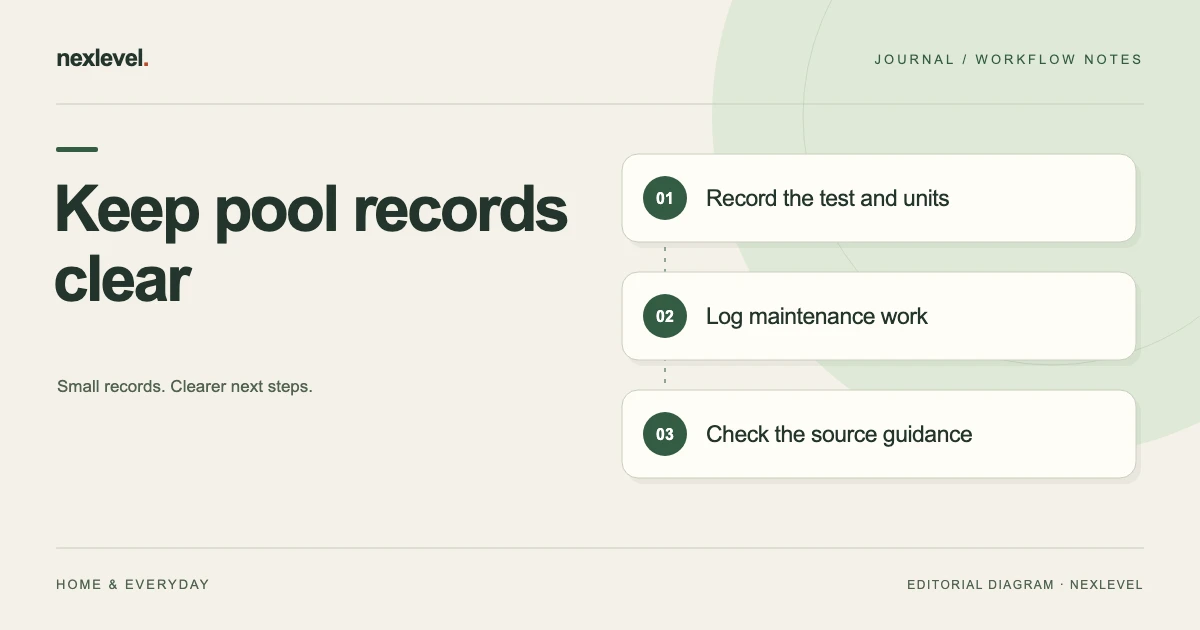
Use distinct records for tests, product labels, calculated plans, actual events, and retests. A practical template includes:
- Pool: identity, volume, unit, source, and profile version.
- Test: date, time, parameter, entered value, unit, method, and uncertainty.
- Reference: the source and meaning of any target or review band.
- Product: exact identity, physical label, strength, units, and label version or source date.
- Calculation: inputs, conversions, formula version, rounding, caps, and review state.
- Plan: proposed action, responsible person, and explicit confirmation state.
- Actual event: what was recorded as done, when, by whom, and from which source.
- Retest: actual later reading, method, context, and unresolved question.
Keep unknown, not measured, and zero distinct. An unrecorded parameter should not appear as a real zero reading in the calculation.
Keep chemical safety independent of the log
The CDC pool chemical safety guidance warns about injury from chemical mixing and emphasizes trained handling, communication, and documenting use. A digital plan does not replace those safeguards.
Use the physical product label and the appropriate qualified process for real handling, protective equipment, separation, circulation, and application decisions.
This guide supplies no mixing method, dose, target concentration, or reopening criterion. Its purpose is to keep the source and event trail clear enough for the responsible person to review.
If information needed for a safe decision is uncertain, stop the calculation-to-action assumption and obtain appropriate clarification. A green app display should not supply missing authority.
Record the water test before choosing a plan
Preserve the parameter name, exact entered value, unit, test method, time, and pool identity. A number detached from those fields can be difficult to interpret later.
Keep measured, reported, and estimated information distinguishable. A value supplied by another person should not look like a measurement you performed directly.
Record method or instrument changes. An apparent trend difference may be limited by how the values were obtained rather than establish a change in water conditions.
For equipment evidence, the calibration register guide explains how to preserve item identity, events, and source documents. It does not determine suitability for a particular pool measurement.
A fictional test-to-plan sequence
Imagine Pool P-04 has Test T-01 with a recorded method and entered values. One needed field is missing, so the review leaves the calculation incomplete rather than entering zero.
The responsible person checks Product L-01 against its physical label. A source detail requires clarification, and the label record remains pending until that question is resolved.
A reviewed calculation becomes Plan D-01 with its input and formula references. It remains a plan. The log does not automatically mark it applied merely because the calculation was saved.
A later actual event and retest receive their own dates and sources. The example contains no chemical amount or conclusion about whether the water meets any standard.
Match the exact product and label basis
Similar product names can conceal different strengths, formulations, or instructions. Record the identity actually used by the calculation rather than selecting a familiar generic name without checking.
Keep the physical label source and relevant entered fields. A custom entry should be reviewed against the real product, not treated as verified because it saved successfully.
Preserve units and the label basis in the record. A mathematically valid conversion can still represent the wrong product or scope if the original input was misunderstood.
When the label or product changes, create an identifiable new reference. Historical calculations should retain the basis they actually used.
Make calculation inputs inspectable
A transparent plan should show pool volume, current entered reading, selected target basis, product strength, conversions, rounding, and applicable model limits.
Keep each value connected to its source. A total output alone cannot explain whether an unexpected result came from volume, units, concentration, or another assumption.
Do not alter inputs merely to make the result look familiar. If the output is surprising, review the source fields and seek appropriate qualified clarification.
Rounding and maximum-dose caps are calculation features, not a general safety certification. The responsible person still needs the actual label and applicable process.
Keep saved plans distinct from application evidence
A calculated plan can be reviewed, revised, or abandoned without any product being applied. The record should preserve that state.
Record actual application events only through the supported process and appropriate source. A planned time, a dismissed alert, or a copied report does not establish the action occurred.
Before another person acts, check the current event history and responsibility. An incomplete handoff can create uncertainty about whether a planned action already happened.
This guide does not resolve an uncertain application by advising another dose. Clarify the actual state through the responsible qualified process.
Record retests as new observations
A reminder identifies a planned review point. The actual retest needs its own time, method, entered values, and relevant context.
Do not copy a target into the result field to close the task. The target and observed reading answer different questions.
Keep the earlier test intact so the sequence remains understandable. A later reading should not replace the only record of what informed the earlier plan.
Use the appropriate source for interpreting results and deciding further actions. A log can show the sequence without determining whether the pool is safe or compliant.
Read trends with the underlying events
A graph is more useful when you can locate the test and event behind each point. Preserve relevant method, product, and profile changes alongside the readings.
Keep comparisons on a consistent basis or label their limits. Different units or methods can make superficially similar values non-equivalent.
Do not treat temporal order alone as proof that one action caused a later result. The history can support review without representing every relevant factor.
Preserve unusual entries with uncertainty and corrections rather than deleting them to make a smooth chart. A truthful record is more useful for the next qualified decision.
Use a clear operator handoff
The receiver needs pool identity, latest actual test, product source, plan state, actual recorded events, open questions, and next responsibility.
Ask them to identify what has happened and what remains only proposed. This short receiving check can reveal a dangerous ambiguity in the record before anyone relies on it.
Keep authority and training appropriate to the actual task. Access to an app or a shared report does not itself establish that a person is qualified to handle chemicals.
Use the versioned procedure guide for the general relationship between approved instructions, actual events, and exceptions. It does not supply a pool-treatment procedure.
Preserve corrections and issued reports
If a volume, label field, or reading was entered incorrectly, record the correction and its source. Review the affected calculations and shared summaries.
Keep a correction distinct from a new test or application. Otherwise, the history can appear to contain an event that never happened.
Preserve the report version actually shared where the process requires it. A later corrected file should be identifiable rather than silently replacing an earlier decision basis.
Open the exported PDF or CSV and check units, field labels, dates, formula references, and plan-versus-actual states. The recipient should not need the original author’s memory to interpret them.
Run a small evidence read-back
Choose one plan and trace it backward from output to rounding, formula, product label, test, and pool volume. Every link should identify a real source or an explicit unresolved state.
Then trace forward to actual events and retests. If no application is recorded, the answer should remain unknown or not recorded rather than automatically complete.
Give an authorized reviewer the same packet and ask which item still needs action. If the answer depends on an unexplained color or a private conversation, improve the record.
This exercise tests documentation, not chemical efficacy or water safety. Keep those decisions with the appropriate qualified process.
Work through a corrected input without inventing an action
Suppose a fictional saved plan used a pool-volume field whose unit was later found to be uncertain. Preserve the plan and identify the input question. Do not assume the output remains applicable merely because the calculation itself completed.
Review the actual volume source and unit convention through the responsible qualified process. If the input is corrected, create an identifiable revised calculation with the new source. Keep the earlier version available where it explains a report already shared.
The correction does not establish whether any product was applied. That is a separate event question requiring actual evidence. A revised calculation should not create an application entry or silently delete an earlier real event.
Then inspect the report, reminder, and receiving handoff for stale references. A corrected field in the working screen may leave an old exported plan elsewhere. The next person should know which version is current and what remains unresolved.
Test three states in the receiving packet
Ask an authorized reviewer to distinguish a proposed calculation, a reviewed saved plan, and an actual recorded event. They should be able to identify the evidence behind each state rather than infer it from a completion icon.
Next, ask them to find the physical product-label reference and the test method. A plan detached from those sources is difficult to audit even if its numerical result is visible.
If a retest is merely scheduled, keep it in the planned state. A future date and a target value should not become a measurement. The actual retest requires its own observed inputs and context.
Finish with the next responsible action and its owner. The answer may be to clarify a source or obtain qualified review, rather than proceed with a chemical action. This exercise provides a documentation check only. It supplies no application sequence, dose, mixing instruction, target concentration, or decision about whether swimmers may enter the water.
Use PoolVerity for transparent test and plan records
PoolVerity records entered water tests, product-label details, visible calculation inputs, conversions, rounding, caps, formula versions, plans, and retest context. Its official listing describes local reminders and optional Pro history or CSV/PDF exports. It is not an automatic dosing system or chemical authority.
View PoolVerity on the App Store for current features and access. Keep the physical label, actual event evidence, and responsible review connected.
Sources and example scope
App features were checked against the official PoolVerity listing and product page. Safety context is linked to CDC above. P-04, T-01, L-01, and D-01 are fictional; no chemical dose, target range, treatment instruction, or safety determination is supplied.