A weekly alteration review should tell you which garments can move, which promises need attention, and which tickets cannot safely progress without another answer. A list of due dates alone cannot do that. A jacket might be due on Thursday but still need a fitting; a finished pair of trousers might occupy collection space because nobody recorded the pickup arrangement.
Use the review to reconcile three things: the physical garments, the written tickets, and the available work time. The result should be a short action list with named owners, rather than a second set of records that immediately drifts away from the first.
This checklist is for a small tailoring or alteration studio. Its order numbers and timings are fictional planning examples. Adjust the review frequency to your workload, and use the alteration ticket template if the underlying intake records need repair first.
Choose a cutoff and gather the current queue
Set a clear review boundary: for example, all open tickets at closing on Monday. Include work waiting for collection, garments awaiting customer answers, and orders paused for materials. Excluding paused work makes the queue look smaller without explaining the promises that still exist.
Gather tickets from the places where work actually happens. Check the fitting area, cutting table, sewing stations, incoming rail, and finished rail. A handwritten note attached to a garment is still part of the current situation, even if it has not reached the main record.
Write the cutoff time on your review sheet. A new order arriving afterward belongs to the next intake decision, rather than silently changing the capacity calculation you just completed. For a busy studio, keep a small additions list and evaluate those arrivals separately.
Match every physical garment to a ticket
Start with a simple count by ticket, not merely by hanger. One order might contain three garments, while a jacket and its detached belt might occupy different work areas. Record both the ticket identifier and the number of physical items expected.
For each order, confirm the garment description, visible ticket tag, current location, and person responsible for the next step. If two similar black dresses share a rail, “black dress” is not enough to identify either one. Use the studio’s own unambiguous order reference.
Put mismatches on an exception list immediately. “Ticket exists, garment not located” and “garment present, ticket not found” are different problems. Assign a person to investigate without guessing which customer or instruction belongs to an unidentified item.
Sort by the next action, not only by a broad status
A category such as “in progress” hides useful distinctions. Separate orders that are ready to sew from those waiting for a fitting, material, clarification, approval, final inspection, or collection. Then write the next observable action for each stalled order.
Replace “waiting on customer” with something someone can do: “Ask whether the original cuff should be retained; response needed before sleeve work begins.” The second statement identifies the missing decision and explains why it matters. It can be assigned and checked at the next review.
Do not change the ticket’s status merely to make the queue look tidy. If the garment is sewn but final checking has not happened, keep that distinction visible. Physical progress, customer confirmation, and readiness for pickup are separate facts.
Review the promises that affect the coming week
Read the agreed fitting, completion, and collection arrangements. These may be different dates. A customer might need a fitting on Wednesday and collect on Saturday; scheduling the whole order against Saturday could miss the earlier dependency.
Identify the source of each promise. Was the date agreed during intake, revised in a later conversation, or merely proposed by someone in the studio? Record uncertainty as uncertainty. Avoid turning a penciled suggestion into a confirmed commitment through repetition.
Where a date appears difficult, prepare a specific communication task. Include the order reference, the unresolved issue, the person who will contact the customer, and the time by which that contact should happen. Do not record an alternative date as accepted until it has actually been confirmed.
Compare ready work with real capacity
Estimate the remaining effort for the next stage, rather than recycling the original estimate for the entire alteration. Separate sewing time from fitting appointments, inspection, pressing, customer communication, and collection administration. The useful level of detail depends on how your studio schedules work.
Calculate capacity after known interruptions. A four-hour work block is not four available sewing hours if it includes two fitting appointments. Use realistic available minutes for the person and equipment required. A free machine does not create capacity if the person who performs that operation is unavailable.
Keep waiting work visible beside ready work. It represents conditional demand. A missing zip arriving tomorrow may add work back into an already full week. Decide what would need to move if that condition changes, rather than treating the paused order as permanently absent.
Work through a fictional six-order queue
Imagine a studio with 240 minutes of relevant production capacity remaining after its booked fittings. Five orders still require work: A221 needs a 45-minute hem, A222 needs a 90-minute zip replacement, A223 needs 75 minutes of dress work, A224 needs 40 minutes of sleeve work, and A225 needs 20 minutes of button work. A226 is finished and awaiting collection.
The five unfinished orders total 270 minutes: 45 + 90 + 75 + 40 + 20. That is 30 minutes above the available 240. However, A222 is waiting for the correct zip. The immediately ready work totals 180 minutes, leaving 60 minutes of current capacity. These numbers describe different situations; neither should be hidden.
The reviewer records a conditional action: confirm the zip’s availability before promising A222’s next date. If the material arrives, the studio must resolve the 30-minute gap through a real scheduling decision. A226 receives a collection follow-up, but no invented production allowance. The review has separated a material dependency, a capacity issue, and a customer-contact task.
Use a compact weekly review sheet
Keep one row per ticket. A practical blank format is: order reference; garment count and location; current stage; next action; action owner; required answer or material; next promised event; remaining effort; and review outcome. Add a link or reference back to the original ticket.
Use short review outcomes such as “ready to schedule,” “clarification needed,” “material dependency,” “inspection pending,” and “collection follow-up.” These are proposed working labels, not a requirement to replace the studio’s existing system. Define them so different people interpret them consistently.
For an exception row, add three fields: the discrepancy, the source checked, and the correction owner. For example: “A224 ticket says Friday fitting; calendar says Thursday. Check the latest customer confirmation. Owner: studio manager.” Leave the result unresolved until someone checks the evidence.
Check changes, balances, and pickup readiness separately
Review alterations that changed after intake. Look for a clear description of the additional or revised work, the relevant garment details, and the recorded customer discussion. Do not assume that a fitting note automatically authorizes every possible change to the original request.
Check payment records against the studio’s own agreed arrangements. A deposit, remaining balance, and pickup status answer different questions. If a figure is unclear, flag it for reconciliation rather than silently adjusting the amount to match a convenient total.
For ready orders, confirm that the final checks, item count, and collection details are recorded. If the studio uses a pickup receipt, verify that its description matches the actual order. A weekly review is a chance to catch missing records before collection, not a substitute for checking the garment itself.
Finish with owners and a short next-check list
Before closing the review, read each action aloud or check it with its owner. “Someone will call” is not an assignment. Record who will act, what they need to establish, and when the result should be visible in the ticket.
Limit the next-check list to exceptions that can change the plan: an urgent fitting decision, an unidentified garment, a material arrival, or a disputed date. Routine sewing steps remain in the normal work queue. Copying every task into another checklist creates maintenance work without adding useful control.
At the next review, close an action only when its result is recorded. If the customer has not replied, preserve that fact and choose the next communication step. Repeatedly moving an unresolved item to a new week without an owner makes it easier to overlook, even when the list looks current.
Adjust the cadence when weekly is too slow
A weekly review suits recurring reconciliation, but it may be too slow for same-day alterations, event garments, or a rapidly changing fitting diary. Use a brief daily check of today’s fittings, due work, and collections alongside the broader weekly reconciliation.
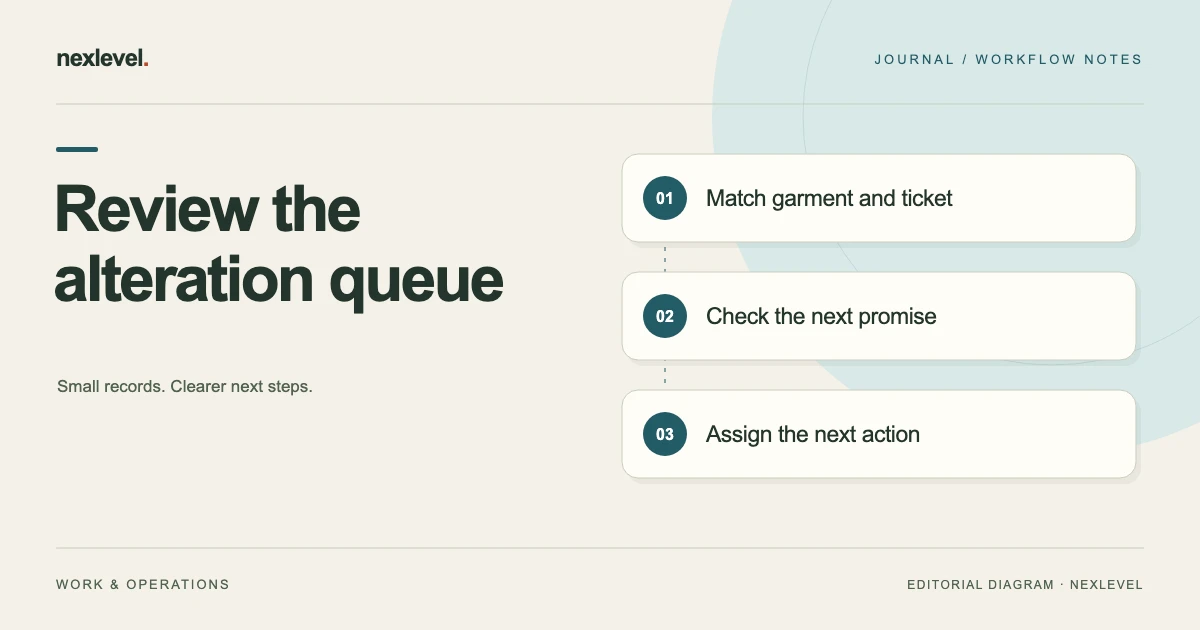
Conversely, a very small studio with only a few active orders may need a simpler routine. Match the records to the garments, check the next promise, and confirm the next action. You do not need an elaborate scoring model to discover that one order is waiting for a customer measurement.
After several reviews, ask which fields actually helped decisions. Remove duplicated information and keep source references that resolved real discrepancies. A useful review grows from the studio’s work, rather than forcing every order through an elaborate process designed for a different business.
Test the plan against one plausible interruption
Before treating the queue as settled, choose one interruption that could realistically happen in your studio. A fitting runs late, a customer asks for another adjustment, or the person who performs a specialist operation becomes unavailable. Ask which promise becomes vulnerable first and which orders can continue independently.
In the fictional queue, suppose A223’s customer cannot attend the planned fitting. Do not use its 75-minute allowance as free capacity without checking what work can still proceed. Some preparation might remain possible; the final alteration might depend on the fitting. Record that distinction in the next-action field, then revise the plan using the work that is actually available.
The purpose is to identify an actionable fallback, not to predict every disruption. You might prepare the material-dependent order’s paperwork, inspect finished work, or bring forward a ready task. Keep the fallback provisional so it cannot quietly replace an agreed customer arrangement.
Resolve conflicting notes without erasing the history
If the garment tag, fitting note, and ticket disagree, preserve the conflicting statements until the discrepancy is resolved. Record the source and date of each. “Latest” is useful evidence about sequence, but it does not prove that a later note was understood or accepted by everyone involved.
For example, the ticket for a trouser hem might specify one finished length while an undated rail note shows another. The reviewer should identify the relevant fitting record and ask the responsible person to confirm the intended instruction. Do not average the two measurements or choose whichever produces a faster alteration.
Once confirmed, write a concise correction in the active ticket, identify the note it supersedes, and make the current instruction easy to find at the workstation. Keep the earlier record distinguishable from the current one. At the next review, check that the physical tag and working instruction now point to the same decision.
Keep the review connected to the alteration record
AlterationTicket is designed to keep customer and garment details, alteration notes, measurements, fitting history, payments, approval snapshots, and pickup records together. Its current listing also describes optional local pickup reminders. Those records can support a weekly review, while the capacity worksheet above remains a suggested studio practice.
The app does not replace judgment about garment construction, fitting quality, scheduling, or customer instructions. Review the current features and available plans in the official AlterationTicket App Store listing. Choose a workflow that keeps each physical garment connected to a clear ticket and an explicit next step.