A shared baby-name shortlist can grow faster than the conversations that make it useful. Names arrive from family messages, books, personal memories, and browsing sessions. Without an occasional review, it becomes hard to remember which names you both want to discuss and which are simply ideas someone saved.
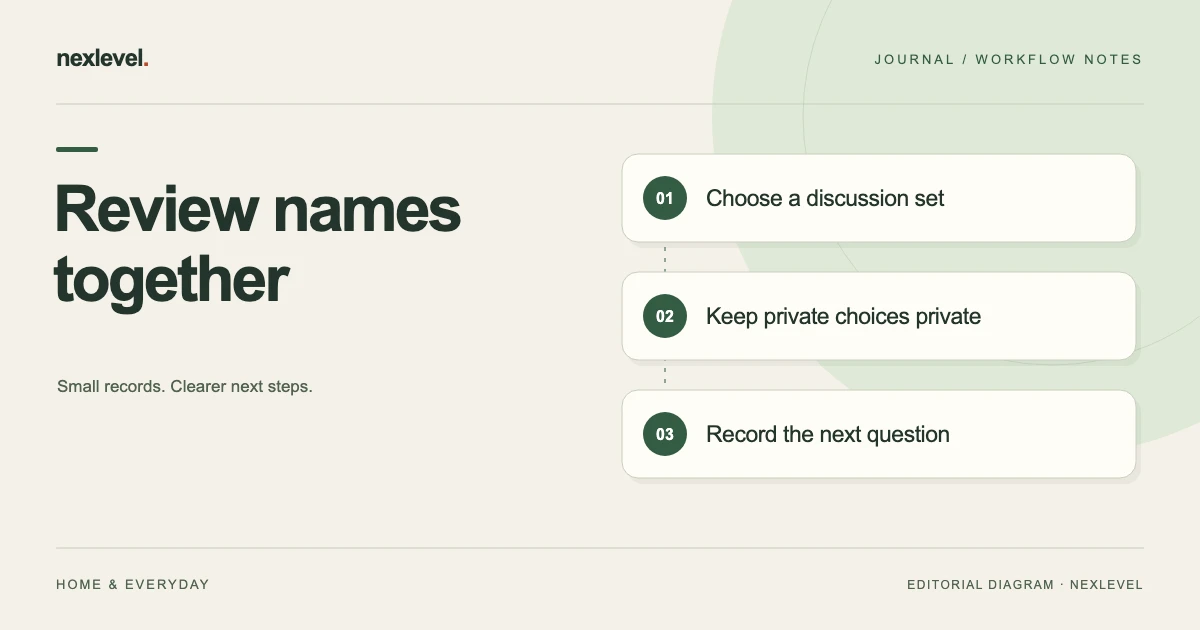
A short weekly review can give the list a purpose without turning a personal choice into a scoring contest. Agree what you will discuss, keep individual preferences private where you want them private, and leave with a small next step rather than a forced final answer.
This guide offers an original review routine and a fictional example. It makes no claims about the meanings, cultural origins, or legal suitability of particular names. Use the shared baby-name shortlist template if you need a starting structure.
Choose one modest purpose for the review
Decide what would make this conversation useful. You might narrow a long list, check the spelling of a few candidates, revisit one uncertain name, or agree what you want to explore next. Those are manageable purposes that do not require choosing a final name every week.
Keep the purpose visible at the start. If the conversation shifts into naming every possible future sibling or debating every relative’s suggestion, return to the question you agreed to consider. Save interesting tangents for another discussion if both people want to revisit them.
Choose a review rhythm that suits you. Weekly is a suggested cadence, not a rule or a measure of progress. A shorter list may need less frequent attention, and either person may prefer to pause rather than have a conversation when they are distracted or tired.
Agree which list you are reviewing
Identify the candidates included in this conversation. A shared shortlist, personal saved ideas, and names mentioned by relatives are different collections. Mixing them can make someone appear to support a name they have only noted for later consideration.
If you keep several lists, give them clear roles. For example: personal ideas, names ready for shared discussion, and a smaller active shortlist. These are proposed organizational labels, not a requirement to use particular app screens or reveal private choices.
Check the actual current list before starting. A photograph of last week’s notes or an old exported copy may not include the latest agreed changes. Record which version or date the review concerns when that helps you keep the conversation understandable.
Separate curiosity from a shared preference
A saved name can mean “interesting,” “worth checking,” or “a name I like.” Ask what the list entry means before treating it as a joint preference. A candidate can remain open without either person promising to choose it.
Use plain-language states that you both understand. “Discuss next time” and “check pronunciation” can be useful next actions. They describe what remains to be explored without turning uncertainty into a negative judgment about the name or the person who suggested it.
Avoid inferring a partner’s private response from the absence of a shared match. In a tool that uses private votes, the other person may not have reviewed that name yet, or a pending action may not have synchronized. Ask about the review process without demanding disclosure of private choices.
Limit the set for one conversation
Choose a small group of candidates that you can discuss attentively. The useful number depends on the conversation, not a universal ideal shortlist size. Keep the remaining ideas available without bringing every saved name into each review.
Decide how a name enters the discussion set. You might each suggest a few candidates, choose names with an unanswered question, or revisit the names already on the active shortlist. Agree on the method so the conversation does not become a competition to add more entries.
Leave room to remove a candidate from the active conversation without erasing its history. A note such as “not discussing this month” can be enough. You do not need to keep debating a name simply because it has occupied a row in the list for several weeks.
Prepare individually before comparing notes
Each person can review their own thoughts before the shared conversation. Consider what draws you to a candidate, what you want to check, and what you prefer to keep private. Preparation does not require sharing every individual vote or personal note.
Bring specific questions rather than a complete argument for why a name should win. “I want to hear how this spelling is pronounced by people familiar with it” gives you something to explore together. A numerical score alone may hide the reason behind a preference.
Decide in advance which notes are intended for shared use. Personal associations can be sensitive. Keeping a private note private is compatible with having an honest conversation about whether a candidate belongs on the shortlist.
Work through a fictional three-name review
Imagine Jamie and Alex reviewing Lea, Mira, and Rowan. These are example candidates, with no implied meaning, origin, or recommendation. Their purpose this week is to identify which questions remain before narrowing the list.
They keep Lea on the active list while checking their preferred pronunciation and spelling. They agree that Mira needs no further discussion this week but remains a candidate. Rowan moves to a later review because one person wants more time to consider a personal association. None of those outcomes is recorded as a final choice.
Their shared note contains the candidate, the open question, the agreed next action, and whether they want to revisit it. Their individual reasons remain private unless they choose to share them. The conversation has produced a usable next step without converting every uncertainty into a vote against a name.
Use criteria as conversation prompts
Possible prompts include spelling, pronunciation, how the full name sounds, personal associations, and the contexts in which you expect to use it. Choose the prompts that actually matter to both of you rather than adopting an exhaustive checklist from someone else’s preferences.
Keep observations and preferences distinct. “We pronounce this differently” is an observation to discuss. “I prefer the shorter spelling” is a preference. Neither needs to be presented as an objective rule that the other person must accept.
If you use ratings, record what they mean and whether you both want to use them. Avoid treating the total as an automatic decision. A deeply important personal consideration may not be well represented by adding several smaller convenience scores.
Check spelling and pronunciation deliberately
Record the exact spelling being considered, including any marks or variants that matter to you. Two similar-looking entries may represent different choices. A shortlist that changes spelling from week to week can make your review history difficult to interpret.
When pronunciation is uncertain, identify what you want to learn and a suitable source or person to ask. Do not assume that a catalog entry establishes one pronunciation for every language or community. Keep any remaining uncertainty visible in your notes.
Try the full name in the settings that matter to you, as a personal exercise rather than a prediction about how everyone else will use it. Record your own observations, and avoid turning one awkward attempt or an outside comment into an unsupported universal claim.
Treat name references as context to verify
Catalog information about meanings, origins, and popularity can help you explore a name, but the relevant details may vary across languages, traditions, and years. Identify the source and date of information that matters to your decision.
If a cultural or family connection is important, check it with an appropriate source instead of repeating an attractive description as settled fact. Keep a reference beside the note so you can revisit what was actually established.
A popularity ranking describes the dataset and period behind it; it does not predict a child’s experience. Avoid presenting a catalog’s ranking as a promise that a name will be rare or common in every place where your family may live.
Handle family suggestions with a separate boundary
Decide whether outside suggestions belong in your active shortlist or in a separate ideas collection. Receiving a suggestion does not obligate you to debate it in every review. Keeping a separate list can help you acknowledge an idea without treating it as a shared commitment.
Agree what you want to share externally. You may choose to share a small shortlist, a pronunciation question, or nothing until later. Avoid forwarding private notes or vote histories simply because they are available in the same workspace.
If you share a copy of the shortlist, identify it as the selection you intended to share at that time. A later change does not require you to preserve an outdated external impression as your current preference. Keep your own review record clearer than the surrounding informal conversation.
Revisit a candidate without restarting the whole list
Bring back a name when there is a specific reason: a question has been answered, a spelling preference has changed, or one person wants another discussion. Link the new conversation to the earlier note instead of pretending the candidate has never been considered.
In the fictional example, Rowan could return when Alex is ready to discuss the personal association. The earlier note explains why it was deferred. It should not be read as proof of a permanent rejection or as an invitation for repeated pressure.
Keep a simple record of what changed and what remains open. This helps the conversation move forward while allowing either person to have an evolving preference. The list is a working aid, not a promise to defend every earlier reaction indefinitely.
Account for offline or delayed activity
If you use paired devices, distinguish local activity from information that has reached the other device. Check the tool’s actual behavior rather than assuming every action appears immediately. A delayed update should not be interpreted as a statement about the other person’s preference.
For a review that needs shared information, choose a moment when you can both inspect the current relevant list. If a device is offline, you can still discuss a deliberately chosen local copy, provided you understand that it may not contain every pending action.
Keep the conversation independent of technical uncertainty. You can defer a comparison, write down a question, or review a few named candidates together without trying to infer hidden votes from a screen that has not finished updating.
End with a short review record
Use a blank record with these fields: review date or label; purpose; candidates discussed; questions checked; shared next actions; names to revisit; and the next review if you want one. Add only the notes you both intend to keep in the shared record.
A fictional entry could read: “Purpose: identify open questions. Lea: check preferred pronunciation. Mira: keep on the active list. Rowan: revisit when requested. No final choice made. Shared export: not prepared.” This preserves the actual outcome without exposing private reasons.
Finish when the agreed purpose has been served or when the conversation needs a pause. You can leave a useful shortlist with open questions. A review routine should help you understand your options and each other, without requiring an artificial weekly winner.
Use VetoVow with its privacy boundaries intact
VetoVow supports private Pass, Maybe, and Yes choices, with a match appearing when both people choose Yes. Its current listing describes offline personal votes, shortlist and notes, optional device pairing without an email account, and pending vote synchronization when a connection returns.
Export only the shortlist you deliberately want to share, and keep personal notes and individual choices within the intended privacy boundaries. Check current features and purchase details in the official VetoVow App Store listing. The review routine above remains your own shared conversation, not an automated naming decision.