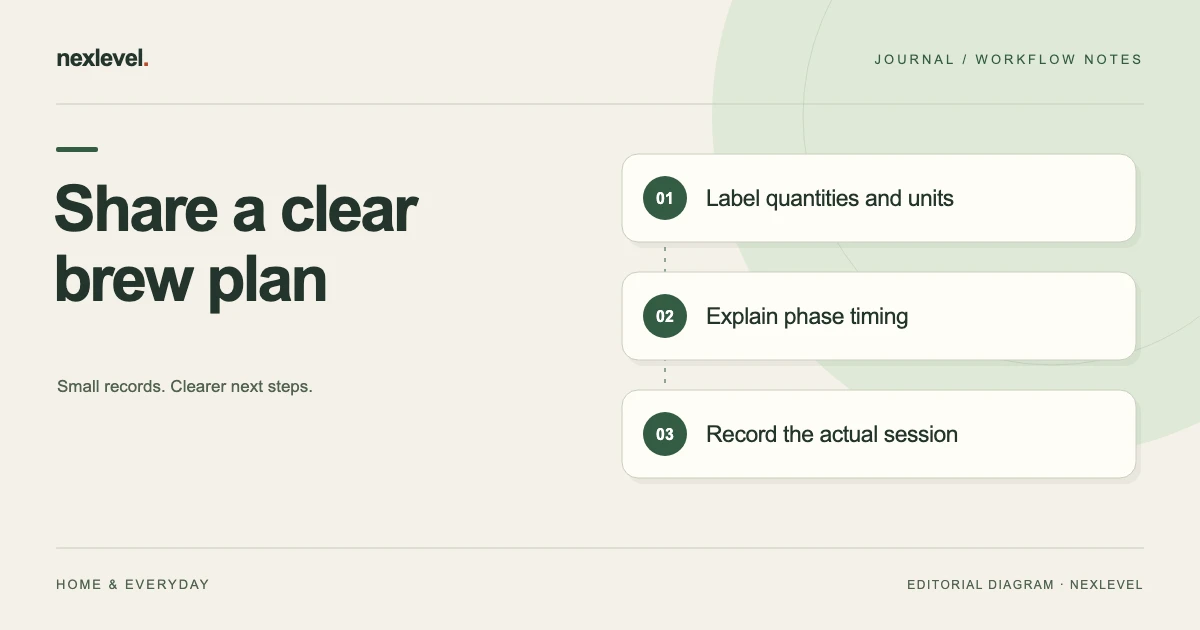
A coffee recipe is difficult to share when it consists of a ratio, a grinder number, and “brew as usual.” The person receiving it may use a different grinder, interpret a pour amount as cumulative water, or mistake one successful session for a complete repeatable method.
Share a recipe with enough context to identify the method, quantities, sequence, and observations. Keep the intended recipe separate from what actually happened in a particular brew. That gives the recipient a useful starting point and a way to record their own result.
This guide provides an original handoff template and a fictional pour-over example. Its quantities and timings illustrate clear recordkeeping, not an ideal recipe or instructions for every brewer. Follow the relevant equipment guidance. For a session record, see the coffee brew log template.
Distinguish a recipe from a brew session
A recipe describes the intended method and settings. A session records the particular attempt: what quantities were used, how the sequence unfolded, and what the person observed. Keep those records connected without treating them as the same thing.
If you share a recipe based on a session, identify which observations informed it and which values you deliberately selected for the next attempt. An accidental pause or an incomplete pour should not become an unexplained instruction merely because it occurred in a cup you liked.
Give the recipe a readable version label. A recipient should be able to tell whether you sent the original method or a later adjustment. Keep their session result associated with the version they actually used.
Name the brewing method and equipment
Record the brewing method and the relevant brewer or setup. A ratio by itself does not identify the sequence or equipment assumptions. The recipient needs to know which workflow your notes describe before deciding whether it fits their own setup.
Include the filter or other relevant equipment context when it matters to your recorded method. Describe what you used rather than claiming a universal requirement. If the recipient substitutes equipment, record that substitution as a difference in their session.
Keep operating guidance with the equipment’s own instructions. A recipe handoff should not invent compatibility, temperature limits, or handling advice for unfamiliar equipment. The worksheet is a record of the proposed brew and its context.
Record quantities with explicit labels
Write the coffee amount, intended water amount, and units. If you include a ratio, state which quantities it compares. Avoid a number such as “16” without context or a recipe note that mixes differently labeled amounts.
For the fictional pour-over here, the recipe uses 20 grams of coffee and 320 grams of added water. The coffee-to-added-water ratio is 1:16 because 320 divided by 20 equals 16. These are example values, not a recommendation for every coffee or brewer.
Keep different measured quantities distinguishable. If you record an amount collected in the cup as well as water added, label each field clearly. The recipient should not have to guess which measurement the recipe’s headline number represents.
Describe grinder context without pretending settings transfer
A setting number is meaningful only within the relevant grinder and its working context. Record the grinder identifier and the setting as you used it. Do not assume another person’s grinder uses an equivalent scale or produces the same result at that number.
If the recipient uses different equipment, have them record their own setting and observations. That makes the difference explicit and gives you something useful to discuss after the brew. Avoid relabeling an unfamiliar grinder setting as a precise equivalent without a basis.
Keep any descriptive note tied to your own session. A phrase such as “setting used for recipe R02 on grinder G1” is more traceable than an unqualified instruction to use the same number everywhere.
Keep bean context identifiable
Record the coffee identity or bag reference that you want the recipient to understand. Include relevant label information and the date or batch context if you track it. Describe the source of that information rather than filling gaps from memory.
If the recipient has a different coffee, record that as a deliberate substitution. The same numeric recipe can still serve as a starting point, but it should not be described as a repeat of every condition in your original session.
Keep tasting observations personal and specific. “I recorded a lighter body in session S04” describes your observation. It does not establish that everyone will perceive the same result or that the recipe guarantees a particular flavor.
Write a sequence someone can follow
Break the intended brew into phases with clear actions and timing labels. Identify whether a time is measured from the start or from the beginning of the current phase. Keep waits, pours, and observations distinguishable.
For each pour, state whether its quantity is an additional amount or a cumulative target on the scale. Ambiguous quantity labels can make an otherwise detailed recipe hard to use. A recipient should not need to infer the arithmetic during the brew.
Use the level of detail appropriate to the method. Avoid adding decorative precision to values you did not actually choose or measure. A simple clear sequence is more useful than a long list of unexplained timestamps.
Work through a fictional phase plan
Recipe R02 uses the example 20 grams of coffee and 320 grams of added water. Its first phase adds 60 grams by 00:15 on a clock measured from the brew start, then waits until 00:40. The next pour brings the cumulative water to 190 grams by 01:15.
A final pour brings cumulative water to 320 grams by 01:55. The added amounts are 60, 130, and 130 grams: 60 + 130 + 130 = 320. The handoff explicitly labels 190 and 320 as cumulative targets so they are not mistaken for additional pours.
The recipient records the actual timings and subsequent observation in a session log. These invented phases illustrate notation. They are not universal brewing targets, and the recipe does not promise that a different coffee or setup will produce the original taster’s result.
Separate elapsed times from phase durations
Label a clock timestamp such as 01:15 as elapsed time from the brew start when that is what you mean. A phase duration is a different quantity. Mixing the two can make the recipient wait far longer than the recipe intended.
In fictional R02, the interval from 00:40 to 01:15 is 35 seconds. The 01:15 label is not a request to spend another 75 seconds on that phase. Write the meaning alongside the phase list rather than relying on a shared habit.
If a phase-aware timer is used, inspect its actual setup and labels. Do not assume that copying the visible numbers from one timer into another preserves the same sequence. Check the intended actions against the displayed progression.
Use a copyable recipe handoff template
Include: recipe ID and version; method and brewer; coffee identity; coffee amount and units; added-water target and units; ratio meaning; grinder and setting; phase sequence; timing convention; cumulative or added pour labels; and the source session if relevant.
Add fields for deliberate substitutions, open questions, and what the recipient should record afterward. Keep these separate from the recipe’s intended values. A substituted filter or different coffee is useful context, not automatically a mistake.
Finish with a short observation prompt: actual quantities, actual timing, result notes, and changes made during the brew. This gives the recipient a practical way to report what happened without needing to reconstruct it from a remembered impression.
Scale quantities without promising the same result
If the recipient chooses 18 grams of coffee while retaining the example 1:16 relationship, the corresponding added-water amount is 288 grams: 18 multiplied by 16. Label the scaled recipe as a distinguishable version or deliberate variant.
The arithmetic establishes the relationship between those two quantities. It does not establish equivalent timing, equipment behavior, or taste. Keep any changes to the sequence explicit instead of multiplying every number automatically and assuming the whole method has transferred.
Check whether the proposed quantities fit the recipient’s actual equipment and guidance. A worksheet should not imply that any batch size is appropriate simply because the ratio calculation is straightforward.
Let the recipient record a real session
Ask the recipient to keep the recipe version, actual quantities, equipment differences, timing observations, and their own result notes. Give them a usable blank record rather than a list of the flavors they are expected to report.
If something changes during the brew, record it as an event. A pause, early stop, or missed target can be useful information for the next attempt. Do not rewrite the intended recipe afterward to make the session appear to have followed it exactly.
Compare the session with the intended plan before choosing an adjustment. This helps you distinguish a deliberate recipe change from a difference in execution or equipment context. It does not turn the comparison into a controlled scientific result.
Share a deliberate readable copy
Choose a format the recipient can inspect and use. A text recipe can be enough when it includes the necessary labels and context. If you export structured data, check what the file actually contains and how the recipient will read it.
Do not assume an export is importable by another app or that it reproduces every timer setting. Those are separate capabilities that need to be verified in the actual tools. Keep a readable phase summary available where it will help the person brewing.
Inspect the shared copy after preparation. Confirm the recipe version, units, phase labels, and any relevant notes. Remove unrelated private observations if they do not belong in the handoff.
Make one deliberate revision at a time
After reviewing a session, identify the change you want to test next and record the reason. Keep the prior recipe available as history. A new version should explain what differs rather than replacing the earlier numbers without a note.
If you change coffee amount, grinder context, and phase timing together, record all those differences. The next comparison may still be useful, but it should not be described as isolating the effect of just one variable.
Use your own observations and preferences to judge whether the next attempt is worthwhile. Avoid presenting a fictional example or another person’s rating as proof that a particular sequence will suit every recipient.
Test whether the handoff is understandable
Before brewing, ask the recipient to explain the coffee amount, total added water, and the meaning of each pour target. They should also be able to tell whether the times are elapsed or phase-specific and identify the recipe version.
For R02, the recipient should recognize that the second pour adds 130 grams to reach 190, and the third adds 130 to reach 320. If they interpret 190 as an additional pour, improve the wording before using the plan.
Record questions that recur during the test. A clearer unit label or one line explaining the clock convention can be more useful than adding another tasting adjective. Keep the handoff focused on what another person needs to reproduce the intended process.
Use BrewRatio as a local brewing companion
BrewRatio calculates coffee, water, or ratio from two values and supports guided phases, timing, and session observations. Its current version 2.0 listing describes Pro custom phase choreography, grinder profiles, history, and JSON or CSV export.
Check the contents and capabilities of any export you use for a handoff. Review current features and plan details in the official BrewRatio App Store listing. Keep the intended recipe, the actual session, and the recipient’s own observations distinguishable.