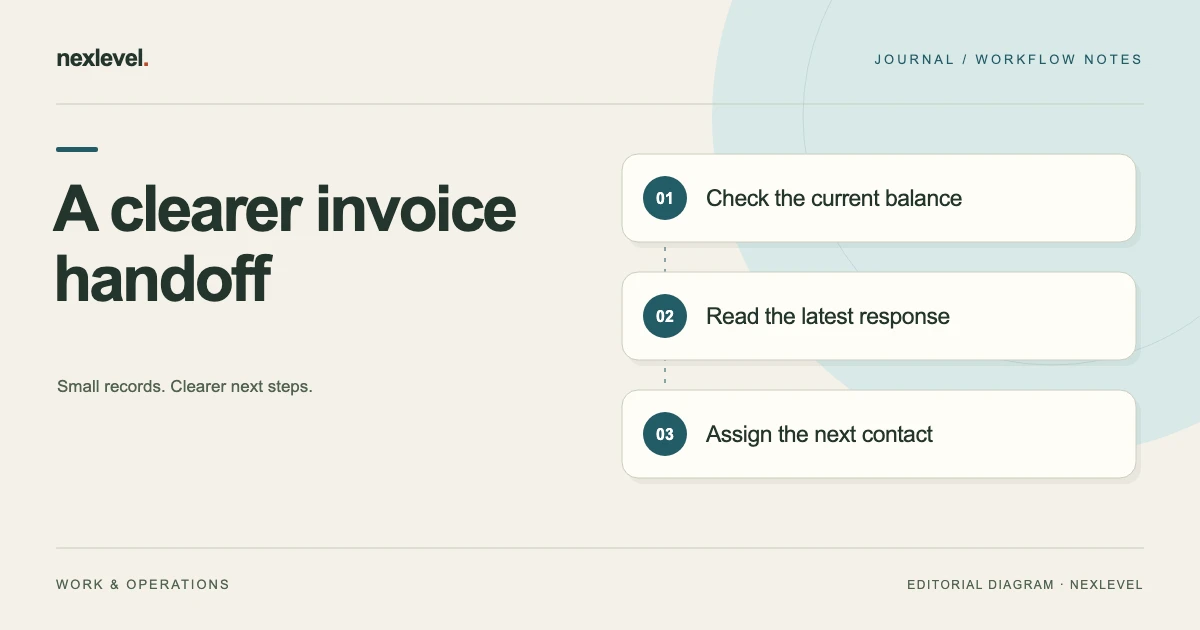
To hand off invoice follow-up, give the successor the current balance basis, latest relevant communication and the status of any prepared draft. Name one owner for the next action and state when responsibility changes. A draft or copied message should never be mistaken for a message already sent.
Transfer one current next action
- Confirm the invoice, client reference, handoff cutoff and incoming owner.
- Reconstruct the current amount from the original invoice and recorded payments.
- Locate the latest response or promise and label older drafts as current, superseded or sent.
- Check source access and reminders, then ask the successor to state the next action.
Working fields:
Invoice | Amount/payments/balance | Latest response | Promise date | Draft status | Next action | Owner | Handoff cutoff
Useful next steps: Use the invoice follow-up template, Update a partial-payment balance, Check the promise before another reminder.
Choose the exact invoice and handoff boundary
Identify the invoice reference, client or project alias, original amount, issue and due dates as recorded, and current owner. Use the source invoice to check the details rather than relying only on a broad project title.
Record when the handoff takes effect. A useful boundary names the date and time and explains whether the outgoing owner will handle any already scheduled action. This matters when two people are covering the same queue during an absence or workload change.
Keep the scope clear. The successor may be taking over follow-up coordination without becoming responsible for changing the invoice, interpreting contract terms, or resolving a disputed payment. Identify the appropriate route for questions outside the handoff.
Recheck the current balance from its components
Record the invoice amount and the payment events that support the current outstanding figure. Keep partial payments identifiable by amount, date, and reference where available. Do not hand over a balance whose calculation nobody can reconstruct.
For a fictional invoice of 900 currency units with one recorded payment of 300, the outstanding amount is 600. The worksheet should show those components, not only the resulting 600. If an adjustment or additional payment is uncertain, record the question separately.
Confirm the source and current status through your actual business process. A prepared message about a balance is not proof of that balance. Check new information before the successor uses an old draft to contact the client.
Summarize the last meaningful communication
Include the last relevant contact date, channel, concise purpose, response, and source reference. The successor should be able to locate the actual communication if the summary raises a question. A note saying “chased twice” offers little context.
Distinguish a sent message from an internal draft, a copied text, or an exported record. Those actions may prepare a follow-up without establishing that the client received it. Use explicit labels so the new owner does not send a draft assuming it is a previous message.
Keep the summary focused on the invoice and next action. Unrelated correspondence can remain in its appropriate location. The handoff needs useful context, not an uncontrolled copy of every conversation with the client.
Make a payment promise visible
If a client has stated a payment date, record the actual wording or a reliable reference, the date it concerns, and any limitation. A suggestion to check internally is different from a definite statement about a payment date.
Use a complete date where the context needs it. A note saying “Friday” can become ambiguous when copied into a later week’s handoff. Preserve the source date and clarify the intended date through the normal communication process when necessary.
Keep the promise separate from a recorded payment. It may change the next follow-up step in your process, but it does not mean the invoice has been paid. The successor needs both the promise and the current balance.
Work through a fictional coverage handoff
Imagine Sam handing invoice I104 to Rae for a short coverage period. I104 totals 900, with a recorded 300 payment and 600 outstanding. The latest client response says payment is planned for 20 June in the fictional project record.
Sam prepared a follow-up draft before that response arrived, but did not send it. The handoff marks the draft as superseded, retains the latest response reference, and assigns Rae to check the relevant record after the promised date under the business’s actual process.
Rae receives one current next action instead of a generic instruction to remind every overdue client immediately. If new payment information arrives, the balance and next step can be updated before another message is prepared.
Use a compact handoff sheet
Include: invoice ID; client or project reference; original amount; recorded payments; current outstanding amount; source locations; last meaningful contact; response or promise; current draft status; next action; action owner; and handoff cutoff.
Add an unresolved-questions field and a reference to any dispute, adjustment, or access issue that affects the next action. Keep the question factual and identify who can resolve it. The successor should not have to guess whether an unusual amount is an error or an intentional adjustment.
Finish with a receipt check: the successor can locate the invoice, understand the balance, find the latest relevant response, and state the next action. Receiving the packet does not mean every invoice question has been resolved.
Give one person the next contact action
State who is responsible for the next communication or verification step. If several people contribute, distinguish contributors from the person coordinating contact. This helps avoid two independently prepared reminders reaching the same client.
During overlap, use a brief working note when an action is taken and make it visible through your actual shared process. Do not assume that a local app on one person’s device provides simultaneous team coordination unless that behavior is explicitly supported.
For temporary cover, record who takes the work back and when. The return handoff should include new payments, responses, messages actually sent, and unresolved questions. Otherwise the original owner may restart an outdated follow-up sequence.
Review prepared messages against current facts
Before using a draft, check its invoice reference, recipient, amount, date, tone, and requested action. Compare those details with the latest record. An old draft can remain grammatically correct while describing a balance that has changed.
In the fictional example, the draft prepared before the 20 June promise needs a fresh review. It should not be sent automatically just because it exists in the handoff folder. The latest response may change what information or question is appropriate.
Keep any revised wording under human review. A tool can help prepare a message, but the responsible person should choose whether and how to communicate through the business’s normal channel.
Record partial payments without losing the sequence
If another payment arrives during coverage, record the event and its source before updating the outstanding figure. For I104, an additional relevant payment of 200 would reduce the example balance from 600 to 400.
Preserve both payment entries and their relationship to the invoice. Replacing a single “paid so far” total without context can make it harder to explain how the balance changed or whether a particular receipt was already included.
Check any pending draft or scheduled follow-up after the update. The next message should reflect the current verified record through the actual workflow, rather than continuing to request the amount shown at the original handoff.
Handle an unclear or disputed item as a separate task
If the client questions an item or the records do not agree, identify the specific issue and route it to the responsible person. Avoid rewriting the handoff summary to imply agreement that has not been recorded.
The follow-up owner may need to pause a prepared message while another colleague checks an adjustment, reference, or project question. State what is being checked and what event will trigger the next review. Keep the actual invoice status distinguishable from the investigation task.
Use the appropriate professional or organizational process for questions about terms, rights, accounting treatment, or collection action. This worksheet organizes the facts and ownership; it does not supply those determinations.
Keep local reminders aligned with the handoff
Review reminders maintained by the outgoing owner and those the successor intends to use. A reminder on an unattended device does not coordinate the next action by itself. Decide how the working handoff process will keep the responsible person informed.
Distinguish the reminder date from the invoice due date, the payment promise, and the actual next action. Those events may be related but are not interchangeable. Clear labels help someone understand why a prompt appears.
After full payment or a deliberate archive action, check the tool’s actual behavior and your other maintained copies. Avoid assuming that a separate calendar note or manually created reminder changes just because one application record has changed.
Prepare a deliberate portable copy
If you export a list or history, inspect the actual file before handing it over. Check identifiers, amounts, dates, message status, and open questions. State which information remains elsewhere and how the intended recipient can access it.
Share only what the successor needs under the business’s confidentiality arrangements. A focused coverage packet may not require every client record or unrelated payment detail. Keep the main retained record in its appropriate location.
Do not assume that a CSV export recreates the complete working application, its reminders, or every communication attachment. Describe the copy’s actual scope so the successor knows what still needs to be checked.
Test the handoff through one realistic question
Ask Rae to explain the current outstanding amount on fictional I104, identify the latest client response, and state who acts next. The answer should connect the 900 invoice, 300 recorded payment, and 600 balance at the cutoff.
Then ask whether the earlier draft was sent. If the packet makes that unclear, improve the draft label and communication reference before relying on it. The distinction directly affects the risk of duplicate or inconsistent contact.
Record any access or interpretation gaps found in the check. A brief reconstruction can expose missing context without requiring the successor to read every historical message before beginning coverage.
Close temporary coverage with an update
When responsibility returns, summarize actions actually taken, payments recorded, promises received, and current next steps. Identify the cutoff for the return handoff just as you did for the initial transfer.
Keep unresolved questions assigned to a person rather than letting them disappear between owners. If the balance changed, show the supporting components and the current record. If no action occurred, state that plainly.
Review the handoff afterward for recurring gaps. A missing draft-status field or ambiguous promise date can be added to the template. Use the observed problem to improve the next transfer instead of creating a larger packet with no clearer next action.
A fictional internal draft could read: “Our record for invoice I104 shows 600 outstanding after the recorded 300 payment. Your latest message mentions payment planned for 20 June. Please confirm any updated reference or information we should check.” This is example wording for review, not a message to send unchanged. The responsible person should verify the current amount, date, recipient, and purpose before deciding whether it is appropriate.
Keep that draft labeled with its preparation context. If another payment is recorded before it is used, review the amount again. If the client has already supplied the requested information, change the next action instead of sending a redundant question. Record actual communication only after it occurs through the chosen channel.
Use PaidCue without assuming automatic client contact
PaidCue records invoice balances, partial payments, follow-up history, and payment promises. Its current listing describes message previews that you review before copying or sharing, optional local warnings, and a sequence that respects recorded promise dates. It never contacts a client automatically.
Check current features, export scope, and plan limits in the official PaidCue App Store listing. Keep the next action and responsible person explicit, especially when a local record is part of a wider handoff process.