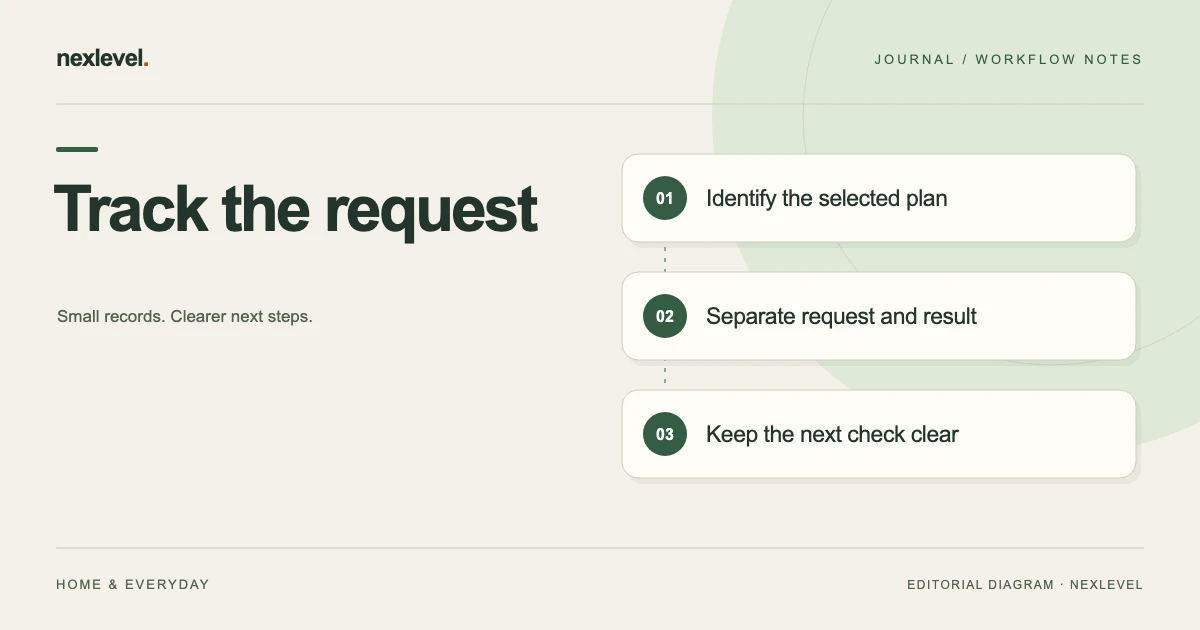
Track a cancellation request in separate stages: preparation, submission, provider response and the outcome that response actually establishes. A saved link or acknowledgment may leave the final result unresolved. Keep the selected plan, source wording and next check visible.
Record the strongest outcome the provider source establishes
- Match the service and selected plan to the actual billing route.
- Record the request stage and source without upgrading preparation to submission.
- Read the provider response for plan identity, exact outcome and any stated effective date.
- Update the local tracker from that evidence and keep unclear results assigned for follow-up.
Working fields:
Service/plan | Billing source | Request stage/date | Response source/wording | Effective event | Unresolved question | Next owner
Useful next steps: Keep the underlying renewal record, Review pending actions in the monthly check, Hand off an unresolved provider question.
Identify the exact service and subscription
Use the actual service and plan relationship, including the billing route where established. A product name may refer to more than one subscription, and the place you use a service may differ from the place that manages its billing.
Record enough source context to find the correct account through the intended private process. Do not copy passwords, full payment credentials, or unnecessary personal information into a general reminder note.
DueNudge’s current listing describes manual subscription entry and stored cancellation details without a bank connection. It does not independently establish which external account owns a particular plan. That relationship needs the actual source.
Separate the stages of the cancellation record
A saved cancellation link is a route to a possible action. A prepared message is a draft. A submitted request is an attempted action. A provider response can establish an outcome with its own wording and date.
Keep these stages readable in an independent worksheet or the supported notes workflow. Do not mark the question resolved merely because you found the right page or wrote a message.
The current app description explicitly says DueNudge cannot cancel third-party subscriptions for you. The tracker helps retain the information and next check; the actual provider workflow establishes what happened to the subscription.
Use an outcome-tracking worksheet
Suggested fields are service reference, plan, billing source, next entered renewal, cancellation route, request date, response source, provider wording, effective date if established, unresolved question, and next check owner.
These are proposed administrative fields, not a claim that DueNudge includes a formal cancellation-case system. Use its actual supported records and notes for appropriate information, and keep an independent companion record where needed.
Use explicit outcomes such as request prepared, request submitted, response received but unclear, or outcome established from the source. A single checkbox called “cancelled?” can hide the difference between an intention and a confirmed result.
Work through a fictional request
Imagine fictional service S9 and a manually entered renewal date in a household tracker. The owner saves a cancellation link, opens it, and prepares a request. At this point, the record establishes preparation, not submission or provider acceptance.
Suppose the owner later submits the request through the actual supported provider route. The independent worksheet records that event and its source. The entered renewal is not automatically rewritten merely because a request was sent.
When a response arrives, the owner checks which service and plan it concerns and reads the actual outcome. A generic acknowledgment may say only that a request was received. It should not be silently translated into a confirmed effective cancellation.
This fictional example makes no claim about how any real provider processes a request. Its purpose is to preserve the relationship between what the owner did and what the external source actually established.
Read the confirmation for its actual scope
A response can concern a particular plan, account, period, or requested action. Verify those identifiers before closing the tracker question. A response for a different plan is not evidence about the selected subscription.
Copy a short accurate description of the outcome and retain the source route. Keep any effective date, remaining access period, or next step in the provider’s actual terms rather than inventing a general rule.
This guide does not determine what a confirmation legally means or whether a charge will be refunded. If those questions are unclear, use the actual provider information and appropriate advice. The tracker should show the unresolved issue instead of supplying a guessed answer.
Keep renewal, access, and response dates distinct
The entered next renewal is one date. A request date is another. A provider may establish a separate effective outcome or access-related date. Do not compress all of them into a single field labeled “ends.”
For fictional S9, the worksheet can retain the original entered renewal while recording a later source-confirmed change separately. Only update the working record according to what the actual source establishes.
If a source uses an unclear time zone or date format, preserve the wording and ask the specific question. The current device’s locale does not automatically establish how an external source intended an ambiguous date.
Use reminders to prompt a source check
DueNudge’s listing describes local reminders at configurable day offsets. A reminder can prompt you to review an unresolved request or approaching renewal. It does not query the provider or verify that a cancellation took effect.
Choose the actual reminder arrangement that fits your task and inspect its current state. This article provides no universal lead time or promise that a particular interval prevents a charge.
Keep the next check specific: inspect the response for S9’s selected plan, or verify the source outcome through the actual billing route. “Sort subscriptions” is too broad to preserve the question that prompted the reminder.
Handle a request with no clear response
An unanswered request remains a source question. Record what was actually submitted and where the source can be found. Do not create a confirmed-looking outcome simply because a reasonable amount of time seems to have passed.
Use the provider’s actual available process for clarification. This guide does not recommend a universal escalation sequence, interpret response deadlines, or authorize messages to anyone.
If you prepare a follow-up draft independently, label it as a draft until it is actually sent through the appropriate arrangement. The administrative record should distinguish preparation, communication, and established outcome.
Keep the question owner visible, especially if another household member is helping. A shared note without a next owner can be repeatedly reviewed without anyone knowing who will obtain the missing source.
Keep a trial record separate from an assumption
The current app supports marking free trials and recording cancellation details. A trial label in the tracker reflects entered information. It does not establish current eligibility, external billing terms, or a completed cancellation.
Review the actual source for the particular trial and billing route. Preserve the entered renewal and any source-confirmed change with their meanings intact. Do not copy a rule from another service merely because both are called trials.
This article deliberately supplies no generalized trial-cancellation deadline. The useful record is the one that points to the right source and shows whether the outcome was established.
Review totals after the source outcome is established
DueNudge’s current listing describes monthly and annualized totals with different currencies kept separate. Those are organizational views of entered subscription records, not a live bank reconciliation.
Do not treat a changed dashboard total as independent proof that a provider stopped billing. First establish the external outcome, then inspect the working record according to the actual supported workflow.
Likewise, removing a tracked entry does not itself cancel an external plan. Keep the provider relationship and the tracker relationship distinct. A clean local dashboard cannot substitute for source confirmation.
Preserve currency and billing-cycle context
When reviewing the S9 record, keep the actual currency and billing cycle attached to its entered amount. A monthly view and an annualized estimate describe different scopes. Avoid adding amounts across currencies without an established conversion method and purpose.
This worksheet does not supply exchange rates or claim that an estimated recurring total equals actual spending. It helps identify which entered records remain active or unresolved according to the source evidence you have.
If a plan changed during the review, identify the actual source and effective relationship before adjusting the entry. A request to change a plan is not automatically a completed change.
Inspect the copy used for a handoff
If another person is taking over the administrative review, prepare a concise summary with the selected service, request state, source route, and next question. Keep private account access in its appropriate secure arrangement.
DueNudge’s listing places CSV export in Pro. Check the actual plan and inspect any output you prepare. Do not assume every independent worksheet detail or provider attachment appears automatically in a CSV.
Open the actual recipient copy and confirm it distinguishes a request from an established outcome. A saved filename or a dashboard screenshot is not enough to show that the handoff contains the source context the reader needs.
Test the record with a second reader
Ask the intended reviewer to explain the fictional S9 state using only the summary. Can they identify what was prepared, what was submitted, what response was received, and which outcome remains unconfirmed?
If they infer that the subscription is cancelled because a link exists, improve the state labels. If they cannot find the relevant plan or source, improve the identity and source route.
The test checks administrative clarity. It does not determine external rights, guarantee billing behavior, or replace the actual provider process.
Close the question with a specific receipt
A fictional review receipt can say: “S9 and selected plan matched to the billing source. Request and response recorded separately. Actual outcome wording and date retained where established. Entered renewal reviewed against that source. Remaining question assigned to the next owner.” Replace each clause with the actual result.
If confirmation remains unclear, retain the limitation. “Response received; effective outcome not yet established” is more useful than a completed checkbox whose meaning nobody can reconstruct.
Use recurring problems to improve the next entry. Saving the right cancellation route or preserving the plan reference at setup can reduce later reconstruction without pretending that the tracker performs the external action.
Handle two sources that appear to disagree
A retained confirmation and a later account view can concern different dates, plans, or stages of the same request. Compare their identity and scope before declaring one wrong. Keep the actual wording available rather than shortening both to “cancelled.”
For fictional S9, suppose a response establishes receipt of a request while the working account view still shows the entered plan. Those facts do not by themselves establish the final outcome. The next question is what the actual provider source says about the selected request and subscription.
Record that narrow question and the next owner. Do not change the local tracker repeatedly to match whichever source was opened most recently. Once the relationship is established, update the administrative record according to that evidence and inspect the resulting copy.
If a billing-source question remains, use the actual appropriate process for it. This worksheet does not decide whether a charge is valid, reverse a transaction, or establish refund entitlement. It keeps the source conflict readable so the responsible person can continue without reconstructing the whole history.
Keep the final source route usable for your future self. An accurate outcome note is more useful when the supporting confirmation can still be found.
Use DueNudge as a private reminder workspace
DueNudge organizes manually entered services, cycles, renewal dates, cancellation details, notes, and local reminders. Pro adds unlimited active subscriptions and CSV export according to the current listing.
Check the official DueNudge App Store listing for current capabilities and plan details. Keep external source outcomes distinct from local reminders so the record explains what is established and what still needs checking.