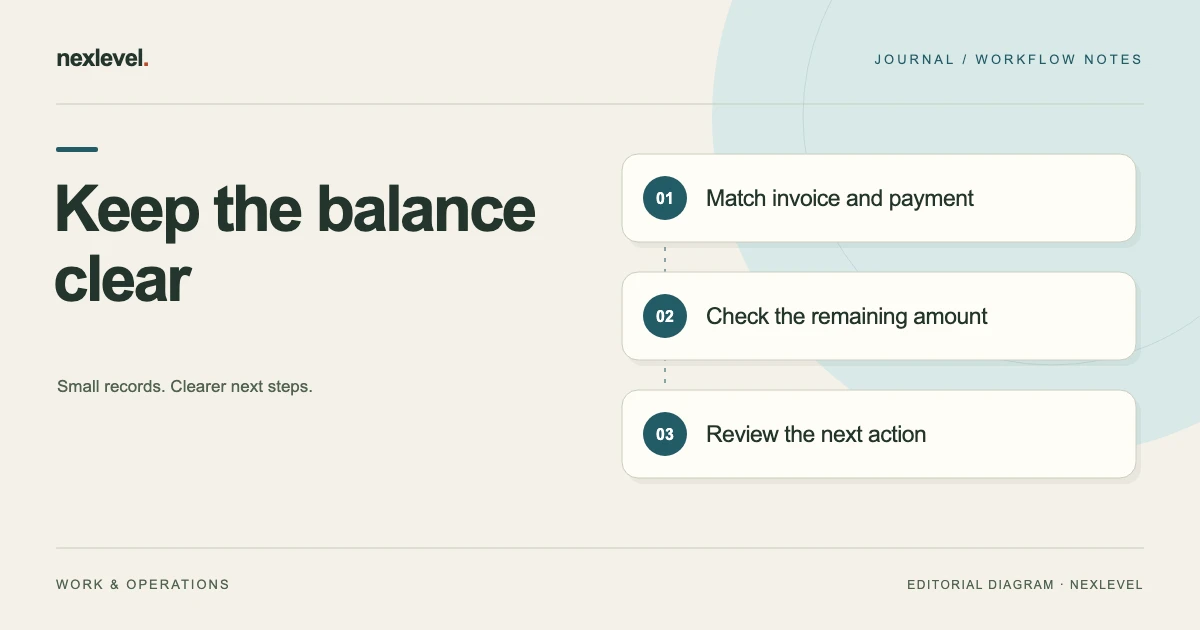
A partial payment reduces the recorded balance when its amount and invoice allocation are established. Keep each payment as a separate event, preserve the original invoice amount and leave any remaining follow-up open. A promise to pay the rest does not reduce the balance.
Record the payment without closing unfinished follow-up
- Match the payment source to the correct invoice and currency.
- Check whether the same payment is already represented in the record.
- Enter the established amount and recalculate the remaining balance.
- Review promises, prepared messages and reminders against the updated record.
Working fields:
Invoice/currency | Original amount | Payment source/date | Amount/allocation | Already recorded? | Cumulative payments | Remaining | Next review
Useful next steps: Set up the invoice record, Keep a remaining-balance promise separate, Hand off the current payment history.
Match the payment to the actual invoice
Begin with the client and invoice reference in the original source. Similar amounts or nearby dates do not independently establish which invoice a payment concerns. One client may have more than one open invoice.
Retain an appropriate private source route that lets the responsible reviewer confirm the relationship. Avoid copying full bank credentials or unnecessary personal information into a general follow-up note.
PaidCue’s current listing describes a local invoice follow-up workspace with manual payment recording. It does not advertise automatic bank reconciliation. Do not treat an entered payment as independently verified merely because the app displays it.
Separate evidence from an intention to pay
A client’s promise describes an intended payment. A source-confirmed payment describes what was established through the actual review process. A message draft describes something prepared for possible communication.
Keep those states distinguishable in the working history and any independent worksheet. Do not subtract a promised amount from the outstanding balance solely because a promise was recorded.
The app’s current listing describes promise dates that pause the normal follow-up sequence and resume afterward. That organizational behavior does not establish that the promised funds arrived or that every external term has been satisfied.
Use a partial-payment worksheet
Suggested fields are invoice reference, original recorded amount, currency, payment source, source date, amount established, allocation question, cumulative recorded payments, remaining balance, promise state, next review action, and owner.
These are proposed review fields, not a claim that PaidCue contains a dedicated reconciliation worksheet. Use the actual supported payment and history controls and keep additional source notes in the appropriate private companion record.
Use explicit question states. “Payment source identified; invoice allocation not yet confirmed” is more informative than “paid?” A blank cell should not imply either receipt or final settlement.
Work through a fictional partial payment
Imagine invoice I42 with an original recorded amount of 1,000 units in a single fictional currency. The responsible reviewer establishes a payment of 250 units belonging to I42. With no other adjustments in this simplified example, the remaining amount is 750 units.
The arithmetic is 1,000 minus 250 equals 750. Record the established payment through the actual supported workflow and inspect the resulting outstanding amount. Do not mark the invoice fully paid merely because a payment exists.
Suppose a second established payment of 300 units later belongs to I42. Cumulative payments become 550 units, and the remaining amount becomes 450. That is a second source event, not a reason to replace the first payment’s history.
The example intentionally excludes taxes, fees, credits, refunds, disputed allocations, and currency conversion. Do not apply its simplified calculation to a different situation without the actual sources and appropriate accounting process.
Check allocation before splitting a payment
A single payment source may mention several invoices or may not identify an invoice clearly. Do not allocate it according to whichever open record is easiest to find. Establish the intended relationship through the responsible process.
If an allocation remains uncertain, keep the question explicit and assign the source check. The worksheet can retain the known payment-source fact without pretending that every invoice’s remaining amount is already established.
This article provides no universal allocation rule. Contractual, accounting, and local requirements belong to their appropriate sources and advisers. The recordkeeping task is to preserve the question and avoid a guessed reconciliation.
Do not add the same payment twice
The same source can appear in a message, a retained statement, and an independent handoff. Those are several representations of evidence, not automatically several payments.
For fictional I42, the reviewer should compare the source relationship before entering another 250-unit event. If the second line is merely a copy of the first source, adding it again would incorrectly reduce the remaining amount to 500.
That mistaken calculation is 1,000 minus 250 minus 250. It demonstrates why identity matters before arithmetic. The correct simplified result after one established 250-unit payment remains 750.
If a genuine record mistake is established, use the actual supported correction workflow and inspect the outcome. This guide does not invent a particular reversal or audit-log feature not described by the current app.
Keep a later promise separate from the balance
After a partial payment, a client may state an intention about the rest. Record the actual promise wording and date through the supported workflow where appropriate. The promise should not silently become another received-payment event.
For I42 after the two established payments, the simplified outstanding amount remains 450 units until another relevant source establishes a change. A promise about that amount does not itself perform the change.
Review whether the next follow-up state reflects the actual promise and source context. Do not assume an old promise still applies after later communication unless the actual record establishes that relationship.
Review the message after updating the record
PaidCue’s current listing describes follow-up previews shaped by invoice stage. The user reviews the wording before copying or sharing it, and the app does not automatically contact clients.
After recording a partial payment, inspect any prepared message for the correct invoice, amount, promise state, and tone. A draft prepared before the update can contain an outdated amount even if the working record is now correct.
Keep “draft reviewed,” “message copied,” and “message actually sent” distinct. Copying text is not proof that the recipient received it. This guide does not authorize or send any external communication.
Use the actual contractual and local requirements for communication decisions. A stage label in an app is an organizational aid, not an independent legal conclusion.
Inspect reminders without assuming closure
The current listing describes optional local follow-up and promise notifications. Full payment, archive, or deletion cancels the relevant warning. A partial payment is a different record state from full payment.
Inspect the actual next action and notification state after the update. Do not infer final closure merely because a warning is absent, or infer nonpayment merely because an old retained notification is visible.
A reminder prompts an administrative check. It does not establish the current bank source, a client’s response, or the appropriateness of a particular message. Keep those source questions separate.
Preserve currency and amount precision
Keep the invoice and payment currency explicit in the independent review. This fictional example uses one currency throughout. It supplies no exchange rate or conversion method for payments in another currency.
Likewise, distinguish an original amount from a displayed rounded summary. If the actual source includes decimals, preserve the appropriate precision through the responsible accounting process rather than inventing a rounding convention.
An outstanding figure is only as reliable as its established inputs and allocation. A precise-looking number does not resolve an ambiguous payment source or determine how a fee or credit should be treated.
Check the selected period in reports
A report may summarize a selected set of invoices or dates. Identify its actual scope before comparing it with an invoice’s full payment history. Different periods can produce different totals without either source being erroneous.
PaidCue’s listing describes outstanding and overdue reports and plan-dependent reporting features. Inspect the actual available output rather than assuming every summary includes every historical event.
For I42, a report showing one period’s 300-unit payment should not automatically be mistaken for the cumulative 550 units established across the simplified example. Label period totals and cumulative amounts clearly in the independent worksheet.
Prepare a handoff that preserves open questions
If another reviewer takes over, provide the invoice reference, established payment sources, current recorded balance, actual promise state, and next unresolved question. Keep private financial-source access in its appropriate secure arrangement.
Do not give the recipient only a balance screenshot if they need to distinguish duplicate evidence or uncertain allocation. A short source-based explanation can prevent them from re-entering an already recorded payment.
For a broader transition, use the invoice follow-up handoff guide. Preserve who will perform the next administrative check without inventing automatic team synchronization.
Inspect the actual portable copy
The current listing says existing CSV and PDF exports with the PaidCue Free footer remain available without ads. An optional completed video can unlock a clean PDF for selected frozen report content; matching saved access works offline on that device. Pro adds complete follow-up sequences and clean CSV and PDF exports without videos. Check the actual plan, report content and output used for the task.
Open the intended file and inspect invoice identity, payment information, selected period, and any source limitation needed for the handoff. Do not assume a CSV reproduces every interactive control or independent worksheet note.
A static file is a copy with its own preparation time. It should not be described as a continuously current view of the local working record. Identify the intended replacement copy if a later correction matters.
Test the arithmetic and the explanation separately
First recalculate the simplified example: 250 plus 300 equals 550; 1,000 minus 550 equals 450. Then check whether those payments actually belong to the selected invoice in the fictional scenario.
Correct arithmetic cannot repair an incorrect allocation. Conversely, a valid source relationship still needs an accurate calculation. The review should test both instead of treating a matching total as proof of everything else.
Ask a second reader to reconstruct I42 from the summary. They should be able to distinguish the original amount, each established payment, cumulative payments, remaining amount, and any promise that has not yet become a received payment.
Close the administrative review precisely
A fictional receipt can say: “I42 payment sources matched to the selected invoice. One representation per established payment used in the calculation. Cumulative payments and remaining amount checked. Promise state retained separately. Prepared message and recipient copy inspected.” Replace the general wording with the actual result.
If allocation or another input remains unresolved, keep that limitation visible and identify the next owner. Do not mark the invoice fully settled to remove it from the queue while the source question remains open.
The aim is an accurate next administrative step, not a guarantee of payment or a substitute for accounting and legal judgment.
Keep adjustments outside the simplified example explicit
A credit, fee, refund, or disputed amount can change the question being reviewed. Do not force that situation into the fictional payment-only arithmetic. Preserve the actual source and route the treatment through the responsible accounting process.
The independent worksheet can say which input is unresolved without pretending the app advertises a particular adjustment workflow. Keep known payments identifiable while the separate question is clarified.
When the source outcome is established, inspect the actual working record and recipient copy. A useful review result explains both the established amounts and any remaining limitation instead of presenting a neat balance whose assumptions nobody can locate.
Use PaidCue for the working follow-up record
PaidCue supports partial and full payment records, follow-up history, promise dates, message previews, and optional local reminders. Its current listing describes a free active-invoice allowance and expanded workflows through Pro.
Check the official PaidCue App Store listing for current capabilities and plan details. Keep source evidence, entered payments, promises, and communication states distinct so the next follow-up reflects what the record actually establishes.