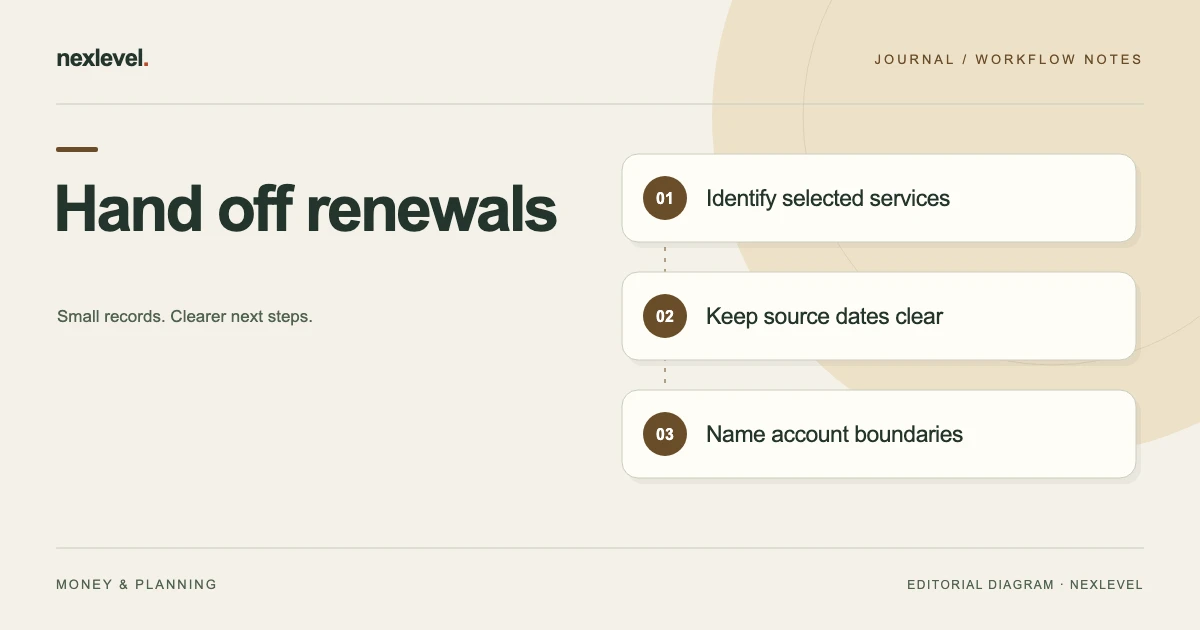
A subscription record handoff should explain the selected services, sources, dates and next administrative questions. Define the recipient's task and what remains with the account holder. Sharing a local reminder record does not transfer provider-account access or establish a cancellation outcome.
Define what the recipient will review and who will act
- Name the selected records, cutoff and recipient's actual responsibility.
- Retain service/plan identity, billing source and cycle/currency context.
- Separate reminder settings and cancellation requests from confirmed provider outcomes.
- Open the intended copy and ask the recipient to identify each source question and owner.
Working fields:
Service/plan | Source date/cycle/currency | Reminder role | Provider question | Recipient task | Account-holder action | Copy/cutoff
Useful next steps: Define the underlying renewal record, Preserve cancellation request stages, Keep historical source context.
Name the recipient’s actual responsibility
Reading upcoming renewal dates, maintaining the local tracker, and changing a provider subscription are different tasks. Write the intended responsibility before preparing a copy. A person can help check a reminder list without receiving authority or technical access to make account changes.
A useful scope statement identifies the selected records, review cutoff, recipient, and expected next question. For example, the recipient may report missing source dates to the account holder. That is narrower than “take care of all subscriptions” and easier to verify.
Do not infer permission from a record being shared. Use the actual authorized account arrangement for any provider action. The worksheet should identify where responsibility remains rather than attempting to solve access by putting passwords, recovery codes, or payment details into notes.
Distinguish local records from provider state
DueNudge’s current listing describes manually entered services, billing cycles, renewal dates, cancellation links, contact details, and notes. It requires no DueNudge account or bank connection. Those qualities support a local tracker; they do not establish live synchronization with each service provider.
A stored renewal date is entered planning information. Its accuracy depends on the actual source and later changes. A provider confirmation, current account page, and older receipt may describe different moments, so keep their roles identifiable when preparing the packet.
The app cannot cancel third-party subscriptions. A local entry, reminder, or saved link should not be presented as cancellation completion or a promise that billing has stopped. The handoff can preserve the exact question the account holder still needs to resolve.
Use a responsibility and source worksheet
Keep one row per selected subscription relationship. If two subscriptions have the same display name, retain enough account-holder and service context to distinguish them without exposing unnecessary private information.
| Field | What to preserve |
|---|---|
| Record identity | Which selected service relationship is meant |
| Billing context | Entered cycle, amount, currency, and source occasion |
| Renewal source | The actual basis for the entered date |
| Reminder | A chosen local prompt, not provider confirmation |
| Responsibility | What the recipient may review and what remains elsewhere |
| Open question | The next specific source check |
These are independent companion fields. The current listing does not establish a multiuser assignment module or a shared account-management service. A clear worksheet convention should not be described as a native collaboration feature.
Work through a fictional two-service handoff
Imagine records S12 and S13. S12 is a recurring service with a source-established renewal date. S13 is marked as a trial, and its next date remains unclear in the available source. The recipient’s task is to review the packet and return questions, not change provider accounts.
The first row preserves S12’s actual source reference and entered cycle. It identifies which person will recheck provider information if a change is reported. A current-looking dashboard does not remove the need to retain that source relationship.
The second row preserves S13’s uncertainty. The reviewer does not copy S12’s date merely because the two service names are similar. Nor do they replace the unknown date with the day the handoff was prepared. The missing source remains an explicit question for the account holder.
A separate note records a cancellation request associated with S13. That request is not treated as completion. The packet names the actual evidence still needed to establish the provider outcome and keeps the entered tracker state distinct from the external account state.
Finally, the outgoing person opens the intended copy. The recipient should find S12, distinguish S13, name the unclear date, and identify who owns the provider check. No actual spending, cancellation, or account transfer occurs in this fictional exercise.
Keep currency and summary scope visible
DueNudge’s current description includes monthly and annualized totals while keeping currencies separate. Preserve the selected currency and period in any companion summary. A number without those labels can lose meaning when copied into a household or business note.
Do not combine amounts across currencies simply to create one tidy handoff total. This guide supplies no exchange rate or financial recommendation. If an independent scenario uses a conversion, it needs its own stated source and assumptions rather than being presented as the app’s observed billing result.
A summary also may exclude inactive or unselected records according to the actual workflow. Inspect what the intended view represents. Do not describe one dashboard snapshot as a complete reconciliation of bank charges when the product explicitly operates without a bank connection.
Give reminders their own handoff treatment
A configured day offset answers when a local prompt is intended to appear. It does not establish the actual provider renewal date, a cancellation deadline, or that the recipient received the same notification. Those claims need their own actual source context.
The current listing supports local reminders and configurable offsets. It does not establish that exporting a record creates equivalent reminders on another person’s device. Preserve the intended arrangement rather than promising automatic cross-device or multiuser notification delivery.
A useful recipient task is “inspect the selected local reminder context and report any missing source.” It is not “assume the alert will prevent renewal.” The account holder’s external responsibility remains visible even when the tracker is carefully maintained.
Prepare cancellation context without claiming an outcome
A saved cancellation link or contact detail can help the authorized person find the appropriate route. Check that the selected record identifies its source occasion and actual purpose. An old link may not explain a current provider process by itself.
Keep requested, acknowledged, and completed concepts distinguishable where the actual sources establish them. Do not upgrade one state to another to make the handoff look finished. A source limitation is useful information for the next responsible reviewer.
For this specific issue, use the cancellation-request record guide. It complements the handoff without changing the provider’s policy or making DueNudge an account-control tool.
Choose a portable copy with a defined purpose
DueNudge Pro currently includes unlimited active subscriptions and CSV export. Check actual plan access and open the intended export. A portable table can support review without being a complete editable copy of the app or a general import mechanism.
Inspect service identity, cycle, currency, renewal context, and the fields the recipient actually needs. An independent responsibility note may remain outside the exported columns. Do not assume every worksheet prompt becomes a native record field or travels automatically.
Keep the copy within the intended private arrangement. A handoff does not require distributing unrelated subscriptions, payment instruments, or credentials. A smaller reviewed packet is easier to understand and reduces the number of copies that later corrections must explain.
Test the recipient’s reconstruction
Ask the recipient to identify the selected service, distinguish entered date from source evidence, and name the next responsible person. Then ask what the packet does not authorize them to do. Clear boundaries are part of a usable handoff, not an optional footer.
If they assume the tracker can stop a provider renewal, clarify the app’s role. If they infer a complete spending reconciliation from the snapshot, identify its selected scope. If they cannot distinguish S12 and S13, improve record identity before forwarding more material.
A successful read-through establishes that the packet is understandable. It does not prove a provider action, delivery of future reminders, or that every external charge has been checked. Keep the receipt limited to the actual demonstrated task.
Handle corrections after the handoff
If a later source clarifies S13’s date, record that source and its occasion through the actual supported workflow. Identify which intended copy now carries the clarification. A previous static export remains an earlier representation rather than updating itself.
If only the companion summary was wrong, correct that layer. Do not alter an accurate provider-source note to make it match a mistaken cover message. Distinguish a documentation correction from an actual provider account change.
The monthly subscription review guide can support later maintenance. A recurring review and a responsibility handoff are related tasks, but neither automatically establishes the other’s outcome.
Write a handoff cover note with explicit boundaries
For the fictional S12/S13 packet, begin with the task: “Review these two tracker records and return source questions to the account holder.” That wording is narrower than “manage these services.” It identifies a practical recipient action without implying provider-account authority.
The next line can identify S12’s established renewal source and S13’s unresolved date. Keep the two records separate even if their display names resemble each other. The recipient should not have to infer which one is a trial from a color, list position, or private abbreviation.
Give the cancellation note its own line: a request has been recorded, while the selected provider outcome has not been established in this packet. This makes the gap visible without supplying a provider-specific process or telling the recipient to perform an account change.
Add a responsibility line for each source question. One question may belong to the account holder, while another concerns an administrative summary the recipient can correct. A single owner label for the whole packet can hide this distinction and lead someone to assume responsibility they were never given.
Keep a source-cutoff line too. If the packet was prepared before a later provider message, it can still be an accurate earlier copy. The later clarification should identify which selected record changed and which intended copy contains the new explanation.
Now test the packet from the recipient’s perspective. They should find the two records, identify the known and unknown dates, distinguish the cancellation request from its outcome, and state the next question. None of those tasks requires a password inside the worksheet.
If the recipient needs a different responsibility, clarify that actual arrangement separately. A readable export cannot itself grant permission, create provider access, or expand what the app can do. The local tracker remains an organizational source rather than the provider’s account-control surface.
Finally, ask the recipient to explain which material they will return or retain under the intended arrangement. This is a practical copy-management convention, not a promise that every exported file can be recalled or synchronized. Keep the packet small enough that a later source correction can be explained clearly.
A useful receipt can therefore state which copy was reviewed, which source questions were returned, and which responsibility remains with the account holder. It should not claim a completed cancellation, stopped billing, transferred account, or complete audit of spending from this bounded review alone.
Use DueNudge for clear local renewal planning
DueNudge organizes entered subscriptions, trials, billing cycles, local reminders, and source notes without a bank connection or a separate app account. Its current Pro description expands capacity and CSV portability. Use that structure to keep review questions visible while preserving provider-account boundaries.
Check the official DueNudge App Store listing for current features and plan details. A useful handoff leaves another person able to explain the selected records, their sources, and the next authorized review without mistaking a local note for an external account action.