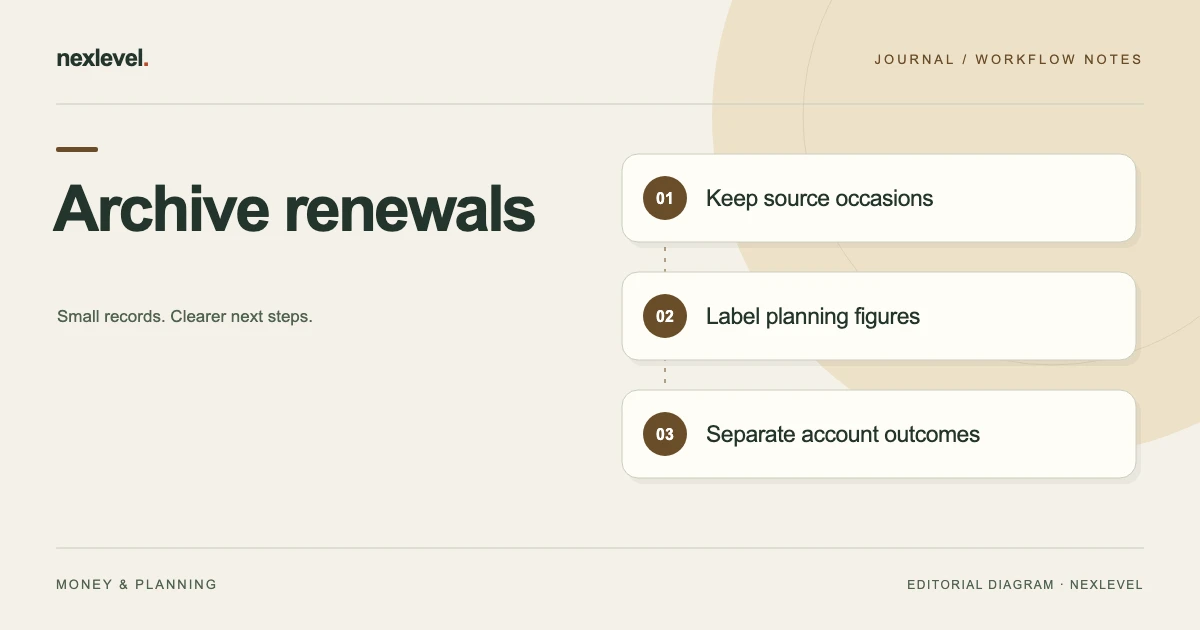
Archive subscription records so a later reader can identify the service, source occasion, billing cycle, currency and basis of each renewal date. Retain model assumptions and unresolved provider questions. A historical planning snapshot should not silently become a record of actual charges or cancellation.
Keep the historical source and the current entry distinguishable
- Define the selected services, historical question and source cutoff.
- Index amount/currency/cycle and renewal-date sources with their actual occasions.
- Preserve reminder roles and cancellation outcome evidence separately.
- Open the retained copy and test retrieval without relying on its filename.
Working fields:
Service/cutoff | Source occasion | Amount/currency/cycle | Renewal basis | Model assumptions | Outcome source | Retrieval limit
Useful next steps: Define the renewal tracker fields, Check a cancellation outcome source, Prepare a current responsibility handoff.
Choose the archive’s purpose
A historical planning snapshot, a current reminder review, and a reconciliation of actual charges are different tasks. State which one the retained packet supports before preparing a large export. One representation should not silently stand in for all three.
Write the selected service scope, source cutoff, intended reader, and next question. A packet covering a few entered subscriptions should not appear to represent every account, bank transaction, or later provider change.
This article recommends no legal retention period. Use the actual private arrangement for access, and keep credentials and unrelated financial information outside an ordinary source index. More copied material does not automatically make a record more useful.
Preserve service identity and account context
Two subscriptions can share a display name while belonging to different service relationships. Retain enough authorized context to distinguish the selected record without exposing provider passwords or payment details in a general archive.
DueNudge currently supports manually entered services, billing cycles, renewal dates, cancellation links, contact details, and notes. It requires no separate app account or bank connection. Those features organize entered information rather than verify external billing state.
If identity remains uncertain, preserve that question before copying a date or amount from a similarly named record. A complete-looking table should not be created by assigning the nearest familiar source.
Use a renewal-source archive index
One row should identify a selected service relationship and its source basis. Use separate rows when an older observation, later provider message, or cancellation question needs a different source occasion.
| Field | What to preserve |
|---|---|
| Service reference | The selected subscription relationship |
| Cycle and amount | The entered period, value, currency, and source context |
| Renewal source | The actual basis for the selected date |
| Reminder | A configured prompt rather than provider confirmation |
| Outcome source | What establishes a charge or cancellation result, if available |
| Copy and limitation | The intended output and unresolved question |
These are independent companion prompts. They do not establish a native historical price ledger or guarantee that every column is included automatically in an export.
Work through a fictional source snapshot
Imagine service S18 and retained planning snapshot R4. An older fictional source records a monthly amount of ten in one invented currency basis. A separate later source records twelve on that same stated basis. No real service or actual offer is supplied.
The archive keeps the two source occasions distinct. It does not silently replace the older value and then describe R4 as though it always used twelve. A current working record and a retained historical representation can answer different questions.
A separate note concerns a cancellation request. The packet identifies that request without treating it as completion. Another source would be needed to establish the actual provider outcome.
The final index row identifies the intended copy, source cutoff, and unresolved renewal question. The fictional exercise demonstrates record organization only; it establishes no actual charge, cancellation, saving, or account transfer.
Keep annualized planning separate from charges
Under the fictional assumption of an unchanged monthly amount across twelve periods, ten annualizes to 120 and twelve annualizes to 144. The difference is 24 on that explicitly stated model basis.
Those calculations do not establish actual annual cash spending. The exercise assumes no trial variation, taxes, fees, currency conversion, irregular cycle, or later price change. A precise total should not hide those assumptions.
DueNudge currently includes monthly and annualized totals while keeping currencies separate. Preserve the selected period and currency in any retained summary rather than merging unlike values into one unexplained number.
Preserve the renewal date’s actual source
An entered renewal date is planning information. Its source may be a selected provider page, confirmation, or other actual record. Keep that relationship and source occasion understandable in the archive.
A reminder date, record-entry time, provider renewal, and archive preparation can describe different moments. Do not give an older source a fresh date merely because the packet was prepared today.
If a source is incomplete, preserve its precision and limitation. Do not invent a clock time, billing rule, or deadline to make a table uniform. The actual account holder’s provider source determines those external questions.
Keep cancellation records within their source scope
A saved link or a recorded request can support a later review without establishing that a subscription ended. DueNudge’s current listing explicitly says the app cannot cancel third-party services.
For that narrower issue, use the cancellation-request record guide. The archive should carry the actual result or precise next source question rather than upgrade a request to completion.
Keep any later acknowledgement or outcome evidence at its own source occasion. A static planning file is not a current provider-account control surface or proof that billing has stopped.
Give reminders their actual role
A configured day offset is a chosen local prompt. It does not independently verify the renewal source, prove notification delivery to another person, or guarantee that a provider action happened before the selected date.
The current app supports local reminders and several billing cycles. Check actual feature access and selected record context rather than treating every cycle as an identical monthly arithmetic case.
This guide recommends no alert lead time or spending strategy. A retained reminder can explain the user’s planning setup without becoming a provider notice or a recommendation to keep or cancel a real service.
Inspect the intended portable output
DueNudge Pro currently includes unlimited active subscriptions and CSV export. Check actual plan access and open the selected output. A portable table can support a bounded review without being a complete editable copy of the app.
Inspect S18, cycle, amount, currency, renewal context, and source limitations. A companion explanation may be needed for the older-versus-later observation or cancellation question if the export does not represent it automatically.
The public description does not establish arbitrary CSV import, a universal restore process, or an automatic shared household database. Keep the archive arrangement within the actual supported capabilities.
Prepare a copy-ready cover note for R4
The cover note can identify S18/R4, its selected source cutoff, and the intended purpose as historical planning review. Then list the ten-unit and twelve-unit source observations separately with their actual occasions.
A calculation line can name the independent annualization assumption. It should say that the 120 and 144 figures are model outputs, not observed annual charges. Keep the stated currency basis beside the numbers.
A cancellation line can identify the recorded request and the exact outcome question still open. Another line can identify who continues that provider check through the actual authorized account arrangement.
For a responsibility transfer, use the subscription-record handoff guide. A retained archive does not itself grant provider access or permission to change an account.
Test the packet without the original writer
Ask an authorized reader to identify S18, distinguish R4 from the current working record, and explain which source occasion used each amount. They should reproduce the stated arithmetic while recognizing its assumptions.
Then ask what establishes an actual charge or cancellation outcome. If the reader answers only with the planning total or saved link, clarify the source roles. A neat file should not obscure an unresolved external question.
For current maintenance, use the monthly subscription review guide. The archive can support later work without automatically representing all present provider information.
Handle later clarification without rewriting history
A new provider source may clarify a date or supply another amount. Identify its source occasion and relationship to S18. Do not make R4 appear to have contained information that was unavailable at its cutoff.
If the working record is accurate while a cover summary has the wrong currency or period, repair the summary. A documentation correction is distinct from an actual account change or provider transaction.
A concise receipt names sources inspected, selected relationships established, independent assumptions, intended copy opened, and next question. It documents a bounded administrative review rather than a financial result.
Keep the archive proportional and usable
A smaller selected packet can be easier to understand and maintain than a broad collection of unrelated account material. Include what the intended task needs and identify where relevant source information remains elsewhere.
Do not delete a working register merely because a file exists. File preparation and reliable retrieval are separate results. Inspect the actual supported output and private arrangement before relying on it for the selected purpose.
The fictional references are teaching examples. Reuse the source-index method with actual authorized information rather than copying the invented prices or periods into genuine subscription history.
Complete the fictional source-and-model table
The first row identifies the older ten-unit monthly observation and its source occasion. The second identifies the later twelve-unit observation on the same stated currency basis. Keeping both rows does not claim that DueNudge provides an automatic historical price ledger.
The third row names the independent annualization assumption: an unchanged monthly amount across twelve periods. Under that model, the two results are 120 and 144, with a difference of 24. The assumption should travel with the numbers whenever they are copied.
The fourth row identifies R4’s cutoff. A retained snapshot using ten can remain accurate as history while the current working entry uses twelve. Match the occasions before describing one representation as wrong or silently replacing its source value.
The fifth row concerns the cancellation request and its separate outcome question. A saved route or recorded request should not become proof that billing ended. Keep the actual provider-source check beside the selected record.
The sixth row identifies the intended export or companion copy. Open it and inspect service identity, cycle, currency, source context, and limitation. A CSV may support the selected review without containing every independent explanatory field automatically.
Ask the reader to distinguish annualized planning from an actual charge record. Correct multiplication does not establish a provider’s current amount, a completed transaction, or total annual spending. The archive should make that limit visible rather than bury it in a filename.
A useful receipt can name the actual source observations, selected scenario, independent calculation, copy inspected, and next question. It does not need an invented saving or cancellation outcome to represent a completed administrative review.
The fictional figures remain teaching inputs. Reuse the source-index method with actual authorized records, preserving the applicable period and currency rather than adopting the example’s amounts as a recommendation or a claim about a real service.
Label the retained copy with a non-sensitive service reference and its actual source cutoff. Keep the currency and period explanation inside the packet too. A shortened filename should not become the only reason a reader interprets 120 as one scenario rather than a transaction total. This small retrieval check can expose a missing assumption before the planning figures are reused in another summary.
Use DueNudge for clear local planning context
DueNudge organizes entered service records, cycles, renewal dates, local prompts, and source notes without a bank connection. Keep its planning information distinguishable from external account evidence.
Check the official DueNudge App Store listing for current capabilities and Pro export access. A useful archive preserves what was known at the selected occasion while making the next provider-source question easy to identify.