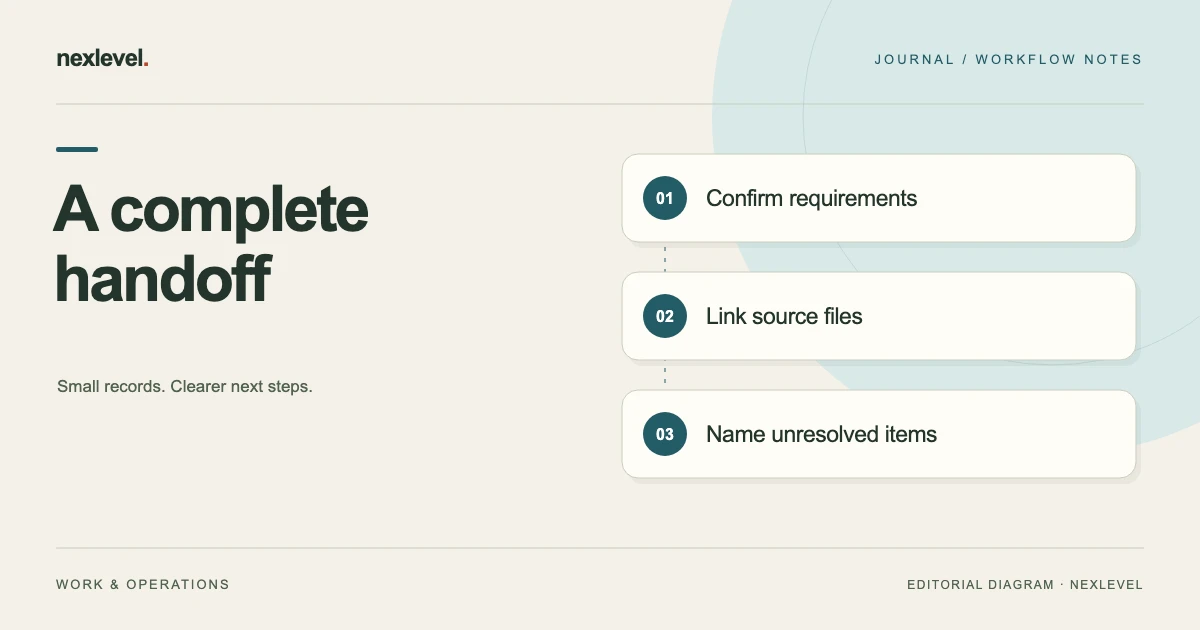
A client requirements handoff is complete when the next person can begin the right work, identify the source of each important requirement, and recognize what is still undecided. Sending a folder link and a message saying “everything is in here” does not establish that shared understanding.
This client requirements handoff checklist is for the transition from discovery or intake into delivery. It focuses on the information another designer, developer, consultant, or project lead needs at that moment. Use it after preparing a brief, rather than treating it as another questionnaire for the client to complete.
Choose the handoff boundary
State who is handing over what, to whom, and for which phase. A discovery lead might hand requirements to a delivery lead for estimating. An account manager might hand an approved content brief to a writer for production. Those recipients need different levels of detail and have different authority to begin work.
Write a one-sentence handoff purpose. For example: “This packet supports planning the first build of the agreed landing page; it does not authorize publication.” That sentence helps the recipient interpret every file without assuming the transfer itself grants permission for the next commercial or public action.
Identify the expected first action. Review feasibility, estimate effort, prepare a draft, or start an approved task are concrete instructions. “Take a look” is an invitation to inspect, not a clear transfer of responsibility. Name the sender and receiver so questions do not bounce around an anonymous team channel.
Freeze the brief version being handed over
The recipient needs an identifiable baseline. Include the brief title, version, date, and a readable copy of its content. A link to a document that anyone can keep editing may be convenient, but it does not explain which wording informed an estimate or production decision.
Keep the working brief and the handoff version visibly distinct. You can continue collecting ideas in a working copy while preserving the version used for this phase. Later corrections or changes should identify the baseline they affect. Avoid filenames such as final-final-new, which communicate frustration rather than sequence.
Record the actual review or acknowledgment state. “Client received link,” “client answered questions,” and “designated reviewer confirmed version 3 for planning” are different events. Do not turn a receipt, a version hash, or a casual positive reply into broader approval than the evidence supports.
If there is no settled baseline, say so. A handoff can be useful for discovery or investigation while remaining unsuitable for production. The honest status lets the receiving person choose the right next step instead of inheriting hidden assumptions.
Use this client requirements handoff checklist
Keep the packet short enough to review, with source material linked rather than pasted repeatedly. The following list is a working acceptance checklist for the handoff, not a claim that every project needs identical documentation.
- Purpose and phase: what the recipient is expected to do next and what authority they have.
- Baseline: exact brief version, date, readable content, and review state.
- Deliverables: named outputs, quantities, formats, and relevant boundaries.
- Acceptance: observable completion criteria and the person who will review them.
- Assets: files, locations, versions, usage context, and access verified for the recipient.
- Dependencies: inputs needed from others, their owners, and dates or sequencing constraints.
- Open questions: what is undecided, why it matters, and who can decide.
- Decision record: important choices, rejected alternatives when relevant, and their source references.
- Change route: where later requests go and how their effects will be reviewed.
- Receipt check: the receiving person confirms what they can start and what still blocks them.
Give unresolved items identifiers so they can be discussed precisely. Question Q4 is easier to follow than “the other thing from the call.” Do not hide these questions in a long appendix behind an apparently complete checklist.
Describe deliverables with boundaries and acceptance
A deliverable name alone often leaves practical questions unanswered. “Landing page” might refer to design files, implemented code, published content, or all three. Describe the output and the boundary relevant to this phase. Include quantities and formats when they influence work.
Pair each deliverable with an observable acceptance statement. “Uses the supplied approved copy and includes the agreed sections in the specified order” is reviewable. “Looks professional” expresses a preference without telling the recipient what evidence will support completion.
Keep rationale beside criteria where it prevents misinterpretation. If a section order reflects a particular campaign sequence, say so. The recipient can then distinguish a purposeful requirement from an incidental detail. A brief should help people make good decisions when small uncertainties arise, not merely list restrictions.
Separate exclusions, deferred ideas, and unresolved questions. An excluded integration is outside this phase. A deferred integration may be planned later. An undecided integration needs clarification before anyone assumes its status. Combining them in one “not now” list creates avoidable confusion.
A fictional worked handoff: a campaign landing page
Imagine a small studio transferring a landing-page brief from intake to a delivery lead. The handoff names Campaign Page, brief version 3, and states that the lead should prepare the build plan. The agreed output includes one responsive page using supplied copy and a contact link. Public launch remains a separate decision.
The asset index lists the approved logo file, copy document version 2, and selected photographs. The receiving lead verifies that each file opens with their own access. A missing image license confirmation is recorded as Q2, owned by the client’s marketing contact, rather than assumed from the fact that the image was supplied.
A dependency says the contact destination must be confirmed before the final link check. A design preference about motion is unresolved but does not prevent the lead from organizing the supplied content. The packet distinguishes work that can begin from work that needs the missing decision.
The receiving lead replies: “I can prepare the structure from version 3. I need Q2 resolved before using the selected images and the contact destination before final verification.” The sender records those limits. That response is far more informative than a thumbs-up on the folder link.
Make asset access a verified fact
Test access as the actual recipient, or ask them to confirm access directly. A sender seeing a file in their own account does not establish that a contractor can open it. Record the correct location, version, and owner rather than scattering duplicate files across messages.
Keep credentials outside the brief. The handoff can identify that access is required and name the approved channel for obtaining it without copying passwords or private keys into a document that may be forwarded. Give only the access needed for the next task.
For a supplied asset, distinguish possession from permission to use. Record the source of any usage instruction or confirmation and flag missing information for the appropriate person. Do not resolve uncertain rights by adding a casual note that the file “should be fine.”
When an asset changes after the handoff, identify the replacement explicitly. The delivery lead should not discover it by noticing that a file behind the same link now looks different. A short change entry can prevent an entire round of work on the wrong material.
Preserve the reasoning behind important decisions
Capture decisions that affect how the recipient should act. A useful decision entry states the question, the choice, the date, the decision owner, and a source reference. Add a short reason when it helps explain the tradeoff. You do not need a transcript of every conversation.
Label assumptions as assumptions. If the team expects supplied copy to remain stable, say that this is a planning assumption and identify how a later change will be assessed. An unstated assumption can become an accidental commitment when it crosses team boundaries.
Carry forward contradictions rather than smoothing them into a neat summary. If an email requests one audience and the intake form names another, show the conflict and ask the designated owner to resolve it. The receiving person should not have to guess which source outranks the other.
Our meeting decision log template offers a structure for preserving wording, outcomes, and actions. Link the relevant decision entry into the handoff instead of rewriting it differently in every document.
Make open questions actionable
For each open question, explain its impact. “Which contact destination should the page use?” is more useful when paired with “Final link verification cannot finish until this is confirmed.” That relationship lets the receiver proceed safely with unaffected work.
Assign a decision owner and a requested response date. If nobody has agreed to the date, label it as requested rather than promised. Record where the answer will be captured, so an important response does not remain isolated in a private message.
Define what happens if the answer does not arrive. The next step might be to pause the affected task, propose a reduced scope, or escalate the question to the project lead. It should not be to quietly invent an answer and hope the client agrees later.
Use unresolved questions to guide the receiving conversation. Start with the questions that change what work can begin. Cosmetic preferences and document-format improvements can wait when an unknown deliverable boundary is still blocking the plan.
Close the handoff with a receiving check
Ask the receiver to state the baseline they will use, the first action they will take, and any remaining blockers. This checks understanding without requiring them to recite the whole brief. It can reveal a mismatched assumption more quickly than another long written summary.
Record corrections in the packet and communicate them to the people using it. If the receiving discussion changes a deliverable, that change belongs in a new identifiable version or a clearly linked decision. A meeting memory should not silently overrule the written baseline.
Keep later requests on a defined path. The sender can collect them, assess their effect, and bring them to the appropriate decision owner. The delivery team should not have to interpret every new message as an instruction to start additional work immediately.
For the brief itself, use our client project brief template. For later additions, the project revision request template helps keep the request, effects, and decision separate.
Run a five-minute handoff rehearsal
Before the formal transfer, open the packet as if you were receiving it for the first time. Try to find the exact deliverable, the baseline version, the first usable asset, and the highest-impact open question without searching a message history. Missing links and conflicting filenames become obvious quickly in this small exercise.
Check that the packet works in the recipient’s context. A document built around a large monitor may be awkward for someone reviewing on a phone. A screenshot full of tiny annotations may conceal the most important instruction. Provide readable text for decisions rather than relying entirely on visual marks.
Remove copies that create uncertainty about the authoritative version. Keep historical sources available, but identify which record currently governs the next task. If the receiver can explain both what they will do and what still requires a decision, the handoff has a practical starting point.
Use Brievra to preserve the intake baseline
Brievra supports local client briefs, service templates, and on-device gap checks. Its official listing describes optional Pro features for encrypted client links, response import, frozen version evidence, and Markdown export. Those tools can support the baseline and source record used in a handoff.
View Brievra on the App Store for current compatibility and access. Version evidence helps identify what was preserved; it does not determine whether every requirement is correct or provide a legal signature. The receiving conversation still matters because people must understand what the next phase actually requires.
Sources and example scope
App features were checked against the official Brievra listing and product page. The campaign, brief versions, questions, and receiving response are fictional. The checklist and examples are original workflow guidance, with no claim that the document establishes contractual authority or guarantees complete requirements.