A dance eight-count sheet connects the routine’s structure to the music and gives people a common reference during rehearsal. “Start again near the middle” is vague. “Start at eight-count 9, with the transition cue on 5” identifies a place the team can find, discuss, and revise.
This guide shows how to make a readable eight-count sheet with section labels, count-specific cues, music references, and a simple handoff. The examples describe documentation and timing, rather than teaching movement technique. Use the counting convention that fits your music and explain it consistently to everyone using the sheet.
Define what an eight-count means in this routine
An eight-count groups counts 1 through 8 into a reference unit. Label each group so the routine has both a local count and a position in the larger sequence. “Eight-count 4, count 3” is more precise than “the third count” when several sections use similar phrasing.
Do not assume that every count sheet maps to music in exactly the same way. State whether you are using one count per beat, how subdivisions are written, and how pickups or uncounted introductions are handled. Your convention should make the routine easier to follow, not force the music into an unexplained grid.
Keep count numbering stable within an issued version. If you later insert material, update the references deliberately and communicate the new version. Otherwise, a coach, performer, and music collaborator may all say “eight-count 12” while referring to different moments.
Identify the music version and the first counted moment
Record the track filename or mix version, its date if useful, and the exact starting reference for count 1. Track time zero and the first counted moment are not always the same. An introduction or lead-in can come before the routine’s first numbered count.
Listen through the relevant section and confirm the starting point against a recognizable musical reference. A timing number alone may be difficult to recover in rehearsal. A short note such as “first counted downbeat after the introduction” can help, provided everyone agrees which musical moment it identifies.
When the mix changes, check the sheet again. An added pause, removed introduction, or revised transition can shift later references even if the early counts still appear correct. Keep the old music version associated with its old sheet so the earlier record remains understandable.
Use music through the permissions and channels appropriate to your work. A count sheet can identify an audio file without redistributing it to everyone who receives a document. Share only what the handoff actually requires.
Copy this eight-count sheet template
At the top, record the routine name, sheet version, preparer, music reference, counting convention, and first-count reference. Then use one row per eight-count, or another consistent grouping that remains readable when printed.
- Eight-count number: the group’s position in the routine.
- Section: a short named block, such as opening, phrase A, transition, or ending.
- Count positions: 1 through 8, with subdivisions labeled explicitly where used.
- Cues: brief notes attached to the exact count, rather than floating between rows.
- Music reference: a useful track time or recognizable sound where needed.
- Review state: confirmed, proposed, or awaiting clarification.
- Notes: essential context that does not belong inside the count cells.
Use the smallest amount of notation that conveys the intended reference. Long paragraphs in narrow cells are hard to scan across a rehearsal space. Put detailed explanation in a linked note and keep the count-specific cue concise.
Explain abbreviations once in a key. A familiar term within one team may be unclear to a substitute coach or music collaborator. The sheet should remain understandable outside the conversation in which it was created.
A fictional example: four eight-counts at a steady tempo
Imagine a short planning example with a constant tempo of 120 beats per minute, one count per beat, and the first counted beat at track time 0:00. One beat lasts 60 ÷ 120 = 0.5 seconds. Eight counts therefore span 4 seconds under these specific assumptions.
The group start times are 0:00, 0:04, 0:08, and 0:12. A cue on count 5 of the first group occurs 2 seconds after its count 1. These figures illustrate the arithmetic; they are not a promise that any imported song has a constant tempo or starts on the same counted moment.
| Eight-count | Section | Start | Example cue |
|---|---|---|---|
| 1 | Opening | 0:00 | Count 1: opening cue; count 5: visual accent |
| 2 | Phrase A | 0:04 | Count 1: phrase label |
| 3 | Transition | 0:08 | Count 5: next-section cue |
| 4 | Ending | 0:12 | Count 8: final accent |
Count 8 in the last group is at 0:15.5 in this example, while the next group would begin at 0:16. The distinction between the instant of a count and the duration of the whole group matters when you compare a cue with a track timestamp.
Block the sections before adding every cue
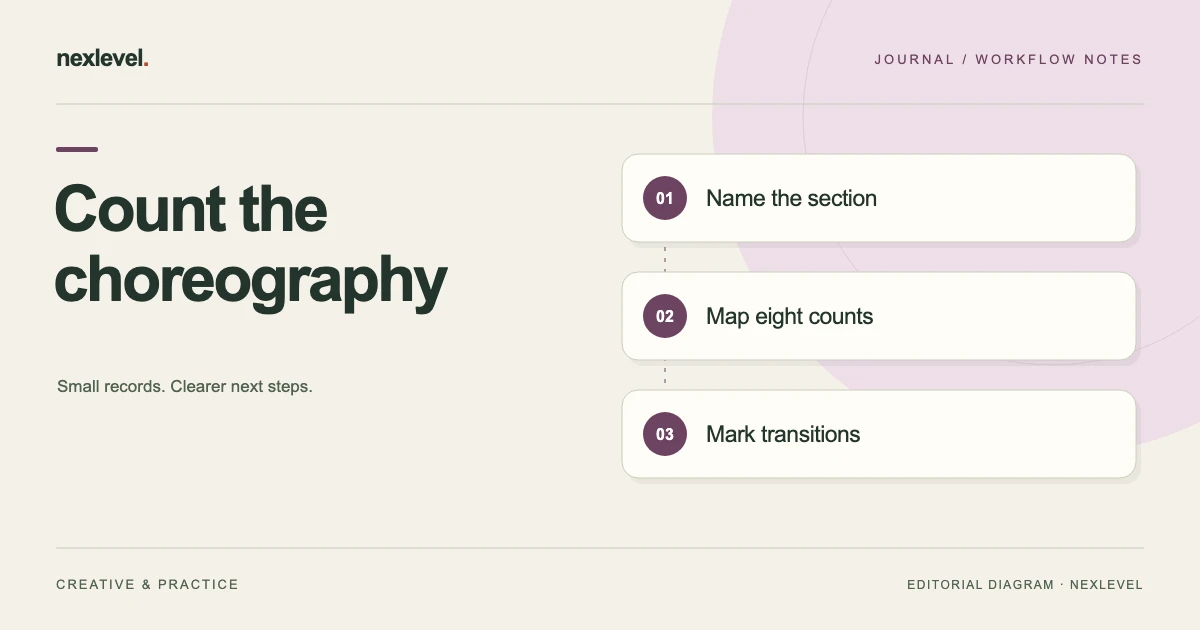
First mark the broad structure. Decide which eight-counts belong to the opening, each main phrase, transitions, and ending. Use names that help people find their place. A named transition can be easier to locate than a continuous list of similar movement descriptions.
Check the boundaries against the music. A section may start at a count other than 1, so record that explicitly rather than adjusting the numbering to hide the overlap. The document should reflect your chosen structure accurately.
Once the section map is coherent, add the cues that matter most for rehearsal and coordination. These may include an accent, a change of facing reference, a voice-over position, or another agreed marker. Keep instructional detail appropriate to the people using the sheet.
Do not fill every cell merely because it exists. Empty counts can be intentional. If a blank could be confused with unfinished planning, label the row’s review state or add a note that the unmarked counts contain no additional cue.
Place cues precisely and label subdivisions
Attach a cue to a specific count and, where needed, a subdivision. If your team uses “and” counts, explain the notation in the key. “3-and” should not be confused with a note applying to the whole span from 3 to 4.
Distinguish a cue’s start from its duration. A note beginning on count 2 may continue through several counts. If duration matters to the recipient, show the span or add a clear end reference instead of repeating the same label in several cells without explanation.
Separate performance cues from production requests. “Accent on 5” and “request a sound hit on 5” are different states. A proposed audio change should not appear to be present in the current track until the music version actually includes it.
Keep voice-over wording and timing connected when the sheet serves as a music handoff. Identify whether the text is final, proposed, or awaiting review. A timestamp helps locate the request, but it does not settle the wording or authorize production.
Check timing at the beginning, middle, and end
Confirm more than the first eight-count. A starting offset error can shift every cue by roughly the same amount. A tempo mismatch can grow over time. A changed edit or tempo variation can create a more localized problem. Listen and inspect the relevant points before deciding which explanation fits.
Check a recognizable cue near the beginning, another in the middle, and one near the ending. If they do not align, revisit the counting convention, starting reference, track version, and tempo assumptions. Do not keep moving individual cues merely to conceal a broader alignment problem.
For music that does not fit a single steady grid, document the relevant timing changes or manual references in the workflow you use. A simple constant-tempo calculation is not a substitute for listening to the actual track.
When practicing at reduced playback speed, keep clear whether displayed times refer to the original track or the practice playback. The handoff should use a shared reference so a slower rehearsal setting does not silently change production timestamps.
Make the rehearsal copy readable
Test the sheet at the size and distance where it will be used. A detailed desk document may be unsuitable as a quick reference on the floor. Use clear group numbers, section names, and short cue labels so the reader can recover their place quickly.
When printing, check that rows stay together and notes are not clipped. A cue separated from its count heading by a page break is easy to misread. If the document includes a dense section, give that row enough space rather than shrinking all the text.
Use text labels as well as color when distinguishing proposed and confirmed cues. Color may disappear in a photocopy or be difficult for some readers to distinguish. The meaning should survive a basic black-and-white copy.
Record the issued version on every page when practical. Loose sheets from different revisions can otherwise look compatible while containing different group references. Retire older rehearsal copies once the new version is issued.
Use rehearsal feedback to update the right record
Capture feedback with the eight-count number, local count, and current sheet version. “The cue is late” needs a location and a reference. Ask whether the concern is the written position, audio alignment, or execution before changing the sheet.
Keep a small change log for meaningful updates. State which cue moved, which section boundary changed, or which music version was adopted. The log does not need to list every spelling correction, but it should explain changes that affect coordination.
After an update, check later references that may have shifted. Inserting one group can change every subsequent group number. A revision is not complete until the issued sheet and relevant handoff references agree.
Confirm changes with the people who use them. A file saved on one device is not necessarily the version everyone has seen. Record the shared reference and remove ambiguity about which sheet guides the next rehearsal.
Prepare a focused handoff for the music collaborator
If the count sheet supports music production, send a concise hit list with the exact track version, group and count references, relevant track times, and proposed sound or voice-over text. State which cues are confirmed and which still need a decision. A rehearsal shorthand may be insufficient for someone editing audio away from the team.
Check a sample cue together before preparing a long list. Confirm that both people mean the same instant when they refer to count 1 and that timestamps use the same reference file. This small alignment check can reveal an offset before it affects every requested cue.
When a revised mix returns, verify the requested changes against the issued hit list and then check the routine alignment again. Keep the new mix and sheet versions associated. A production request marked complete should identify what was supplied and reviewed, rather than merely record that an audio file arrived.
Use Eightwise for count planning and rehearsal
Eightwise is a cheer and dance routine count-sheet app. Its official listing describes music import, tap tempo, marking count 1, section blocks, count-specific cues, and rehearsal with a spoken count-in. Optional Studio features include count-sheet PDFs with producer hit lists, section loops, and reduced practice speeds.
View Eightwise on the App Store for current features and compatibility. The listing describes local routine and music storage without an account. Use the app to support the shared reference, and verify alignment with the actual track whenever the routine or mix changes.
Sources and example scope
App capabilities were checked against the official Eightwise listing and product page. The four-group routine and cues are fictional. Timing arithmetic assumes constant 120 BPM, one count per beat, and a first counted beat at 0:00; it does not assert a universal relationship between musical phrases and eight-count sheets.