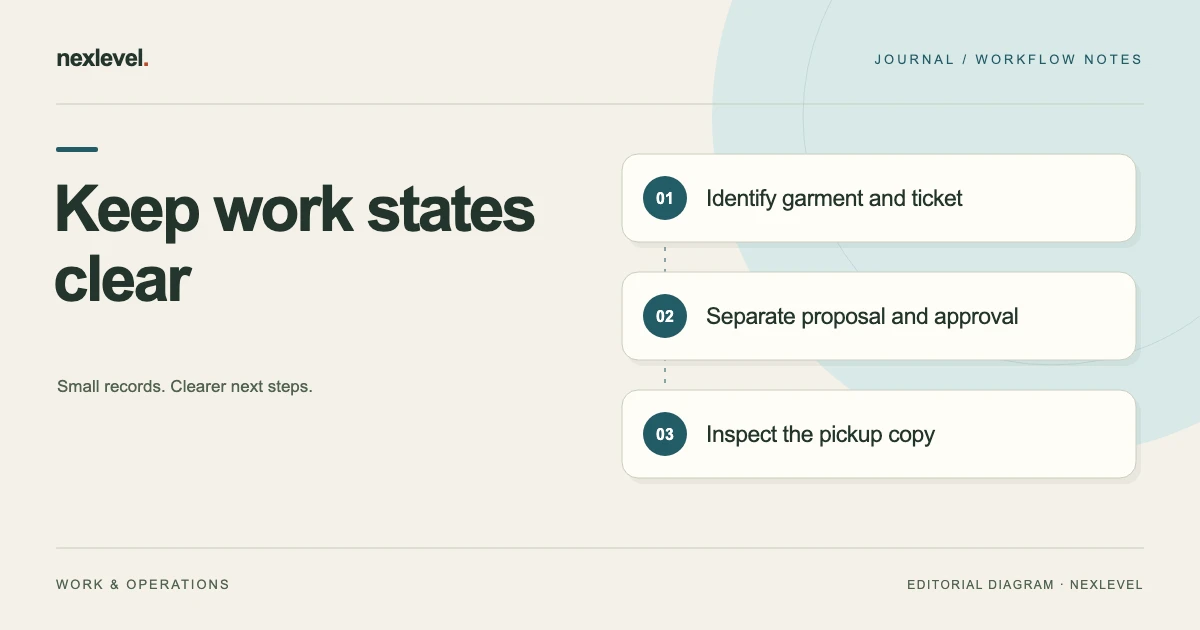
An alteration estimate records proposed work; the approval source records the version accepted through the studio’s customer process. Keep a later fitting proposal separate until its relationship to that approved scope is confirmed. A payment entry alone does not answer the scope question.
Check the version before changing scope
- Select the exact ticket and garment being reviewed.
- Compare the estimate, later fitting note and actual approval source.
- Mark unresolved differences as questions with an owner.
- Review totals and payments separately from whether the proposed work was approved.
Working fields:
Ticket | Estimate version | Fitting note | Approval source | Difference | Clarification owner
Useful next steps: Use the alteration ticket structure, Pass the current scope to the next person.
Start with the garment and the current question
Match the actual customer, garment, and ticket before reviewing a price or instruction. Two garments from the same customer can have similar descriptions and different requested changes. A fitting conversation that mentions “the jacket” may become ambiguous after the customer leaves. Keep the actual visual and written context available through the intended private studio process.
Write the review question narrowly. “Does this later note change the selected approved work?” is more useful than “check ticket.” It identifies the relationship that needs clarification without presuming the answer. If the note concerns another garment or a future visit, the appropriate correction may belong only in the companion summary.
AlterationTicket’s current listing describes customer and garment context, visual alteration points, measurements, fitting history, payments, approval snapshots, and pickup receipts. Those features organize entered information. The source still needs to establish which garment and occasion a note concerns.
Separate the record roles before editing
An estimate proposes a scope or price. A fitting note records the selected fitting context. An approval snapshot preserves a version through the supported workflow. A payment entry records an entered financial event. A pickup receipt concerns the later handoff. Do not use one role as automatic proof of another.
| Role | Question to preserve |
|---|---|
| Estimate | What work and price were proposed? |
| Fitting note | What was recorded for this garment and occasion? |
| Approval | Which selected version does the actual record preserve? |
| Pickup | Which later handoff was recorded? |
A deposit does not by itself establish the meaning of every scope note. Likewise, a ready label should not be treated as proof that a particular version was accepted by the customer. Use the actual source and responsible process rather than inventing a general acceptance rule.
Use an estimate-to-approval worksheet
Suggested fields are ticket reference, garment identity, estimate source, proposed work, entered amount, fitting-note reference, selected approval version, later question, next owner, and recipient copy. These are proposed companion fields, not a claim that the app has a separate contract-review module.
Keep the original wording available while reviewing a change. A short summary such as “same as discussed” can be useful conversationally and still be too vague for a later reader. Replace ambiguity with a source reference or a specific unresolved question. Do not supply a measurement or work instruction from memory merely to complete the row.
The worksheet should explain the ticket rather than duplicate the working workflow. Reviewing an approval record is not another customer approval event. Preparing a corrected summary is not evidence that the customer received or agreed to it.
Work through a fictional scope change
Imagine ticket T16 for garment G4 in a fictional studio. Estimate E1 contains one proposed work description. A later fitting note F2 records a different proposed detail. The ticket also has approval snapshot A1, whose actual source needs to be inspected before deciding whether F2 belongs to that approved version.
The reviewer first matches all three references to G4. They then compare the actual approved source with the later note. If F2 is only a proposal, it remains a proposal. If the actual customer process establishes a revised accepted scope, record that through the supported workflow and inspect the resulting source.
The example provides no technical alteration dimensions or legal acceptance standard. Its purpose is to prevent a later typed note from silently rewriting what the earlier source established. The result can honestly remain “scope question awaiting clarification” while the next owner and source are identified.
Keep visual pins and measurements tied to their occasion
A pin on garment imagery can identify where an entered alteration note applies. It should remain associated with the correct garment and actual fitting context. A reused image or similar garment view is not automatically evidence for a new ticket.
When a measurement changes, distinguish an entry correction from a newly recorded fitting observation. Those are different explanations. Do not give an older observation a fresh date merely because someone copied it into the latest summary. Use the actual supported workflow and retain enough context for the next person to understand the selected source.
This guide does not tell the studio which measurement or method is appropriate. It asks whether the record makes its role clear. A recipient should know which value was entered for which occasion and which proposed change still requires the responsible studio process.
Review money separately from scope
For a simple fictional arithmetic check, suppose a ticket’s entered total is 120 units in one currency and an established recorded deposit is 30. Under that stated payment-only example, the remaining amount is 90. That calculation does not establish that every proposed work note was approved.
AlterationTicket’s current listing describes deposits, payments, and balances exact to the cent. Keep their actual sources and scope clear. This example excludes refunds, adjustments, tax treatment, and other financial questions. It does not decide what a real customer owes under an agreement.
If a later proposed estimate changes the amount, identify the proposed source separately from the selected actual ticket basis. A familiar balance display cannot resolve an unclear work description or establish an external payment by itself.
Inspect the approval source and the pickup copy
The current product description includes freezing a versioned approval snapshot before pickup. Inspect the actual selected version rather than assuming the most recently edited note is the one that source preserves. Do not invent a legal certification or qualified-signature claim from a versioned record feature.
Before preparing the intended pickup receipt, compare its garment identity, selected scope, entered payment context, and relevant limitations with the working ticket. A portable receipt may serve a different purpose from the full interactive fitting history. Open the actual output instead of assuming every worksheet field appears automatically.
If the receipt is clear but an independent cover note is wrong, correct the cover note. If the working record needs a supported change, inspect the result there. Editing one copy does not automatically update every retained image or message elsewhere.
Keep ready, approved, and collected distinct
A ready queue helps organize the studio’s next handoff. An approval record preserves its selected source. A recorded pickup concerns another event. Do not collapse all three into a single phrase such as “finished” when the recipient needs to distinguish them.
The current listing describes an optional local pickup reminder and a Watch view with pickup confirmation. Use the actual supported result as the source. A reminder appearing is not a customer visit, and a companion glance alone should not be treated as a complete review of the approval context.
For the broader transition from fitting to pickup, use the separate alteration handoff guide. The current worksheet focuses on whether proposal, approval, and later notes retain their own meanings.
Prepare an explanation for the next studio review
A useful T16 note can say: “G4 identity confirmed against the selected ticket. E1 proposal, F2 later note, and A1 approval source compared. Actual accepted scope established or a specific question retained. Payment context reviewed separately.” Replace the alternatives with the actual result before using the note.
Name the next source check where needed. “Clarify whether F2 belongs to the selected approval version” is better than “customer issue.” Keep the responsibility in the real studio process; the article does not send messages or claim that a prepared note was delivered.
At the next review, begin with that question. Do not erase the earlier proposal merely because the selected scope later changed. The history can remain useful when it explains what was known at each occasion.
Test one ticket before standardizing the habit
Ask an authorized reader to reconstruct T16/G4 from the intended copy. They should distinguish the original estimate, fitting note, selected approval source, payment record, and pickup context. The answer should not require the original writer’s memory.
If the reader infers approval from a deposit, improve the role labels. If they treat a later proposal as completed work, clarify its state. If they cannot find the relevant garment image or source, improve the private reference. This is a documentation test, not an evaluation of sewing technique or legal enforceability.
Use the weekly alteration review to carry an unresolved question into the appropriate queue. A small check at entry can be easier to maintain than reconstructing several ambiguous tickets later.
Prepare a complete fictional decision note
For T16/G4, the companion row can identify a jacket and preserve E1 as the selected earlier estimate. F2 might say, in this fictional example, “review sleeve length at the next fitting.” That wording describes a future check. It should not become a recorded measurement or completed alteration merely because it is the newest note.
Open A1 through the actual supported record and compare its scope. The reviewer should be able to say whether the future-check note belongs to the selected approved context or remains a separate proposal. If the source does not establish that relationship, the row should name the question rather than infer agreement from the customer having paid a deposit.
Next, compare a second garment G5 from the same fictional customer. A shortened message saying “the jacket” may refer to G4, G5, or another occasion. The solution is to establish the actual subject through the responsible process. Do not copy F2 across both tickets merely to ensure the note is visible somewhere.
The money row can remain separate: entered total 120, established recorded deposit 30, simplified remainder 90. The scope row should not point to that calculation as its approval source. Keeping two rows makes the limitation readable even when another person reviews the ticket after the original conversation is forgotten.
Finally, inspect the intended pickup copy. It should identify which garment and source context it represents and retain any limitation relevant to that handoff. If the actual supported output does not carry the companion question, provide an appropriate explanation through the intended private arrangement. Do not claim the file includes information that exists only in another note.
A complete review can finish with a short result: “G4 identity and selected sources compared; future-check wording retained as a proposal where that is the actual result; approval relationship established or specifically unresolved; payment basis reviewed independently; intended copy inspected.” Replace the alternatives with the real source-backed outcome. This gives the next person a concrete stopping point without inventing a technical measurement, customer response, or completed work event.
Use AlterationTicket for a clear studio record
AlterationTicket connects garment details, visual notes, fitting history, entered balances, approval snapshots, and pickup receipts. Its current Pro description expands ticket, pin, reminder, template, and insight capacity.
Check the official AlterationTicket App Store listing for current capabilities and plan details. Keep proposed work, selected approval, and actual handoff records distinguishable so the ticket explains the work the studio actually recorded.