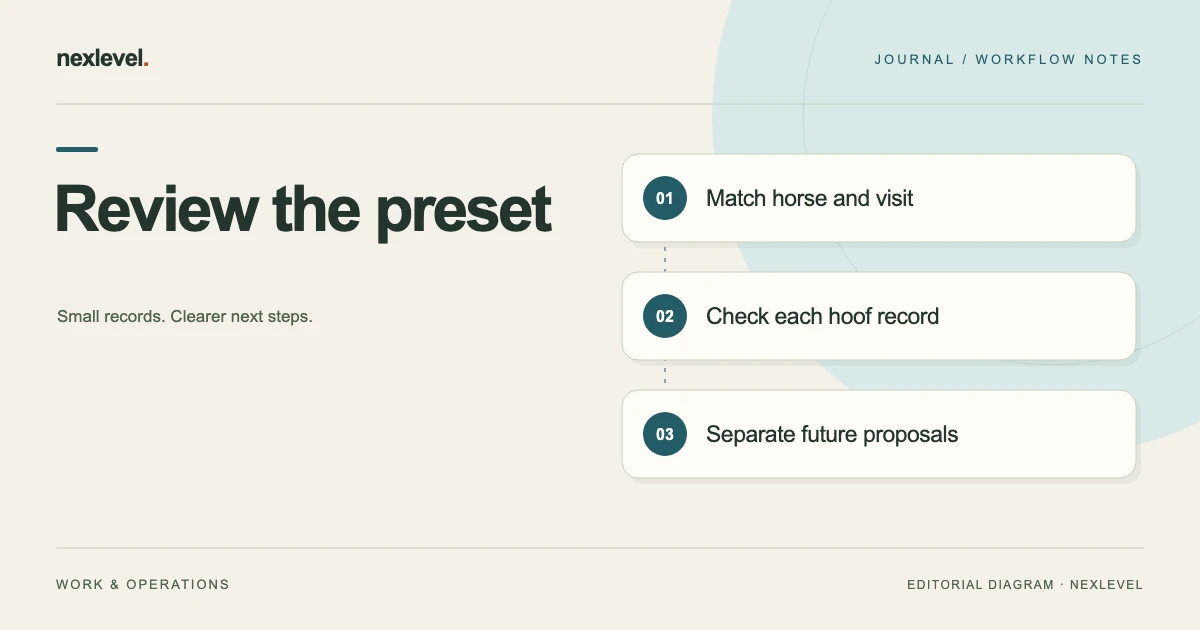
A farrier preset supplies reusable entry values; the visit records what was actually entered for a particular horse and occasion. Check every copied value against that visit's source and keep future proposals separate from completed work.
Use the preset as a starting point, then check the visit
- Match the horse and visit before reviewing the selected preset.
- Compare each hoof's copied value with the actual visit source.
- Choose whether the intended change concerns the preset, the visit or only a summary.
- Inspect the resulting target and keep proposed future work labeled as a plan.
Working fields:
Horse/visit | Preset | Hoof | Copied value | Visit source/value | Intended target | Correction or open question
Useful next steps: Record hoof-specific visit history, Check the horse profile before the visit, Explain the selected history in a handoff.
Define the role of a preset
A preset is a reusable starting structure. A visit record concerns one horse and occasion. A note about proposed future work concerns another planning question.
These can be related without being the same record. A familiar preset name should not cause the writer to assume every copied value describes the current work.
FarrierForge’s current listing describes shoeing presets kept close to the working record. That convenience does not independently observe what happened during a visit.
The administrative review should preserve the actual recorded outcome rather than make the visit conform to the preset for visual consistency.
Identify the horse and visit first
Match the selected horse and current visit before inspecting copied values. Similar horse names or recent visits can make a retained reference ambiguous.
Use the actual available identity context and source date. Do not make an old visit look current simply because its preset or note was opened today.
An independent worksheet can use references such as H31 for the horse and V6 for the visit. Those are proposed review labels, not a claim that the app requires custom ID fields.
Keep private owner information appropriate to the task. A reusable preset should not become an uncontrolled copy of unrelated client details.
Use a preset-to-visit worksheet
Suggested fields are horse reference, visit reference, selected preset, per-hoof source detail, copied value, actual recorded value, proposed future note, uncertainty, and supported correction result.
| Record role | What to keep distinct |
|---|---|
| Preset | Reusable starting configuration |
| Visit | Recorded work for the selected occasion |
| Photo | Evidence associated with its actual source occasion |
| Future note | Proposal rather than completed history |
Use actual app fields for the working record. The companion worksheet explains the review rather than claiming a native preset-audit module.
A missing source should remain an open question. Do not fill it from the preset merely because that value is available.
Work through a fictional four-hoof review
Imagine horse H31, visit V6, and reusable preset P2. The preset supplies a starting configuration across four hoof records. The independent example labels them H1 through H4 solely for discussion.
The farrier’s actual source for V6 establishes that two of the entered details need to differ from the reusable starting point. The reviewer checks those selected records instead of assuming the preset proves a uniform outcome.
The final visit should reflect the actual supported recordkeeping result for each hoof. It need not be made identical across the map merely because P2 began that way.
No actual shoe type, size, material, or modification is recommended in this fictional exercise. It illustrates how copied structure and recorded work remain different kinds of information.
Keep per-hoof history readable
FarrierForge’s listing describes individual hoof tracking for work and related entered setup details. A broad visit summary can be useful while still omitting distinctions the professional needs.
Review the actual per-hoof source before shortening the history. Do not let an owner-facing phrase make all four records appear identical if the source establishes differences.
Likewise, a missing per-hoof detail should not be inferred from a neighboring hoof solely because the preset used a common starting value.
The guide does not determine which work should be performed. It asks whether the entered history accurately identifies what the farrier recorded for the selected occasion.
Review a preset edit separately from a visit edit
A change to a reusable setup concerns future or repeated entry. A correction to V6 concerns the selected visit. Identify which action is intended before using the supported controls.
Do not assume a preset edit retroactively changes every historical visit. Equally, do not assume a visit correction updates the reusable preset. Check the actual current behavior rather than inventing a relationship.
After a supported action, inspect the intended target. If the goal was to correct V6, open V6. If the goal was to revise P2, inspect the reusable setup and keep the historical source context intact.
The independent review note should say which record changed and why. “Updated setup” is too broad for another person to reconstruct the result.
Separate a plan from completed work
A next-visit note or entered cycle organizes future work. It should not be summarized as though that future visit already occurred.
FarrierForge’s current description includes per-horse service-cycle tracking and local reminders. Those are scheduling features, not a professional recommendation of an appropriate interval for any horse.
This guide deliberately supplies no cycle length. Actual scheduling and care decisions belong to the responsible professionals and their relevant sources.
For H31, a proposed future change should remain a proposal until an actual later source establishes the work recorded at that occasion.
Use photos with their actual occasion
The current listing describes before-and-after photos kept close to the working record. A photo should remain attached to the horse and visit context it actually represents.
Do not treat a photo as proof of every entered technical detail or an unseen condition. Review what the image and source note actually establish.
A reused illustrative photo should not silently become evidence for V6. Open the selected source and confirm its relationship before citing it in a summary.
When the source relationship is unclear, retain the question rather than choosing the image whose appearance seems to fit the preset best.
Check queued companion actions
FarrierForge’s description says Watch actions queue until iPhone confirms they were saved. A queued visit action should remain distinguishable from confirmed working history during review.
Inspect the actual supported state before creating another entry solely to make a retained view agree. Repeated entry can create a new administrative ambiguity.
The presence of a preset on the phone does not establish that a queued visit action has completed. These are different records and source states.
Keep the remaining source check explicit if the confirmed record is unavailable. This guide gives no synchronization timing guarantee.
Prepare a summary without losing copied-value context
An owner-ready summary should describe the selected visit and actual recorded work. It should not imply that a preset is itself a professional assessment of the horse.
The current listing places owner-ready summaries under Pro and describes CSV export as available for records. Check the actual selected output and its contents.
A portable copy may not reproduce every interactive hoof-map relationship. If the recipient needs a distinction, verify it remains readable or provide an appropriate source route.
For a transfer to a different professional, use the separate farrier visit handoff guide. A preset review should not substitute for a complete transition packet.
Correct the summary when the source is right
Sometimes the underlying V6 record is accurate, while a short independent note says only “P2 applied.” That wording can hide later reviewed differences.
Repair the independent explanation rather than altering accurate visit history to match the shortened phrase. Identify the selected preset as a starting point and the visit as the actual record.
If the summary was already shared, identify the intended correction through the actual arrangement. A static copy does not automatically change when a working note is revised.
Keep the explanation proportionate. The recipient needs the relevant horse, visit, and record relationship rather than every internal preset detail.
Test one hoof-to-visit relationship
Ask an authorized reader to reconstruct one selected hoof record for H31/V6. They should identify the actual visit detail and distinguish it from P2’s reusable starting value.
If the reader assumes all four records must match, improve the per-hoof explanation. If they treat a future note as completed work, improve the planning-state label.
A short fictional receipt can identify H31, V6, P2, the selected source details reviewed, actual supported corrections, and any remaining question. Replace placeholders with source-backed results.
The test checks administrative clarity. It does not evaluate farriery technique, diagnose a horse, or determine future work.
Keep a small review habit at the point of entry
Review copied values while the selected visit context is available. That can be more practical than reconstructing a long series of ambiguous summaries later.
Choose the smallest check that resolves the recurring problem: horse and visit identity, per-hoof differences, or future-note labeling. Do not add a larger checklist simply to make the workflow look thorough.
Keep a reusable structure useful without letting it become a substitute for actual source facts. A preset’s convenience depends on the professional’s review of the selected occasion.
When a source remains unavailable, retain the limitation and next owner. A complete-looking visit created from assumptions is less useful than an honestly bounded record.
Compare the preset and visit without prescribing a setup
For fictional H31/V6, the independent worksheet can show P2 as the reusable source and list which selected hoof records were reviewed against the actual visit note. Use neutral references rather than inserting a technical recommendation into the example.
Suppose H1 and H2 match the reviewed starting values while H3 and H4 have established visit-specific differences. The administrative result is not that one pair is more correct or that every horse should receive a uniform configuration. It is that the current recorded source distinguishes those entries.
A short summary saying “same preset on all four” would lose that distinction. Correct the summary if the underlying visit already preserves it. If an actual record mistake is established, use the supported workflow and inspect the resulting visit.
Next, imagine P2 is revised for future convenience. Keep that template action separate from V6’s historical source. This guide does not assume whether a particular edit propagates anywhere; the actual current behavior must establish that relationship.
The review can therefore close with two explicit statements: which visit records were checked, and which reusable source was edited if any. A later reader should not have to guess whether “updated” means the professional changed the work, corrected an entry, or adjusted a future starting point.
Finally, compare the intended owner-facing copy with the working record. If it abbreviates details, retain the source route appropriate to the recipient. A concise summary can be useful without claiming to reproduce every interactive hoof-map field. The stopping point is an accurate explanation of the selected visit and its limitations, not a technical conclusion about the horse. Any actual care or service decision belongs to the responsible professional process rather than this recordkeeping exercise.
Use the review reference to prevent a copied future note from becoming another visit. If the source says a detail is to be considered at a later occasion, retain that planning role. Do not create a completed-looking entry simply to keep it near the current preset. The recipient should be able to distinguish a professional proposal from work actually recorded for V6.
Use FarrierForge for hoof-specific working records
FarrierForge connects horse histories, per-hoof details, entered visit cycles, and portable records. Its current description includes shoeing presets, local reminders, and before-and-after photos. Pro separately adds unlimited active horses and sharing individual owner summaries.
Check the official FarrierForge App Store listing for current features and plan details. Use presets as reviewed starting points while keeping completed visit history tied to what was actually recorded.