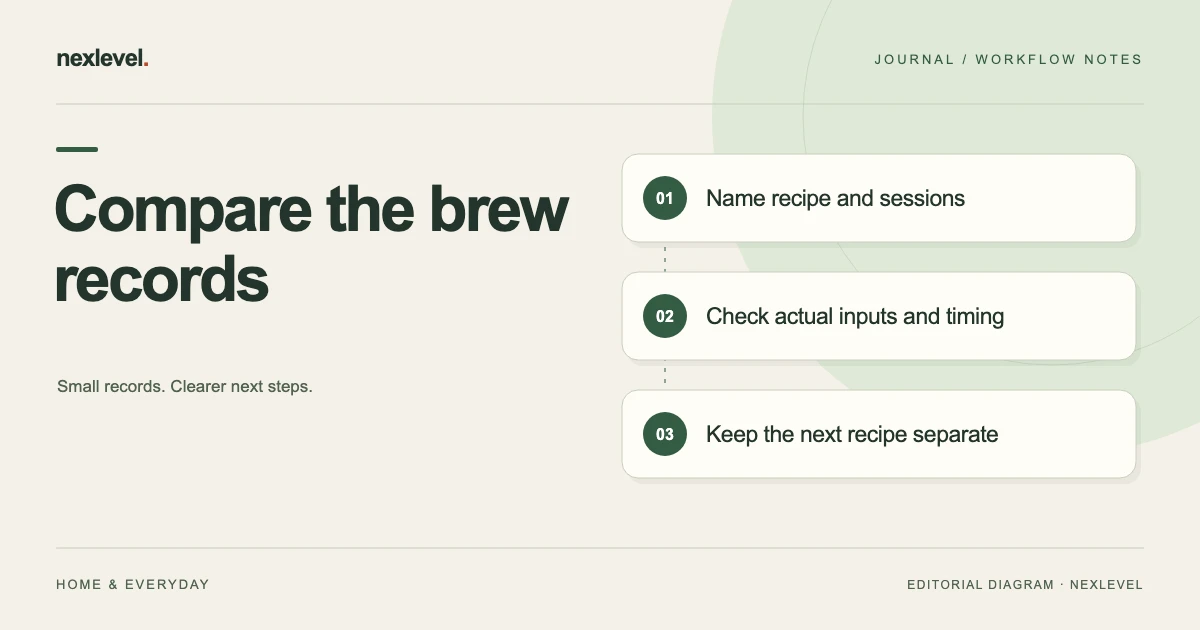
Compare brew sessions by choosing a question, identifying each session's intended recipe and checking the actual quantities, timing boundaries and events. Preserve the baseline recipe while recording differences. Two totals or ratings can describe a difference without explaining its cause.
Compare one question against the recorded sessions
- Choose the timing, quantity or observation question you want the records to answer.
- Identify each session and its recipe version, coffee and equipment.
- Compare actual entries only after checking units, clock start and finish markers.
- Keep missing context visible and record the proposed next recipe outside completed-session rows.
Working fields:
Question | Recipe/session | Planned vs actual quantities | Clock boundary | Event/deviation | Personal observation | Limitation | Next proposal
Useful next steps: Set up separate recipe and session fields, Check the record before editing phases, Archive recipe and session context.
Identify the recipe and each session
Record the recipe identifier and version alongside distinct session references. A saved recipe describes an intended plan; the session describes the particular attempt.
Keep the relevant coffee, equipment, and date context with each session. A broad title such as “morning brew” may not distinguish several different conditions.
Use the actual tool’s supported history workflow. A later edit to a reusable recipe should not make an older observation appear to have followed values selected afterward.
Choose one comparison question
You might want to inspect whether the intended quantities were used, whether timing changed, or how a personal observation differed after a deliberate recipe revision. State that question before comparing every field.
Keep the question within what the records can establish. A pair of sessions can show entered differences without proving that one variable caused a particular sensory outcome.
Record missing information as a limitation. A concise comparison can remain useful when it makes clear which conditions were observed and which were not retained.
Separate intended values from actual entries
Write the intended coffee and water quantities, phase plan, and relevant equipment context. Then identify the actual values recorded for each attempt.
If an amount was estimated or reconstructed later, preserve that basis. A precise-looking number should not imply it was measured during the session.
Use source notes or the actual app record to explain an early stop, pause, missed target, or other event. These observations can be useful without rewriting the recipe to pretend the session followed it exactly.
Keep quantity labels explicit
Identify what each amount measures and which units it uses. Added water, coffee input, and another measured quantity should not occupy one unlabeled field.
For a fictional ratio example,20 grams of coffee and 320 grams of added water produce a 1:16 relationship. An 18-gram and 288-gram pair has the same relationship.
The matching arithmetic does not establish identical brewing conditions or outcomes. Preserve the different batch quantities and the actual method context when comparing the sessions.
Use a session-comparison worksheet
Useful fields include comparison question, recipe version, session IDs, coffee context, equipment, intended quantities, actual quantities, timing convention, actual events, personal observations, limitations, and next proposed change.
Keep the proposed next recipe separate from both completed sessions. The worksheet should show what was planned, what happened, and what is being considered next.
Include a readable source reference for each session. Another person should be able to find the entries behind a summary rather than treating the summary as a complete replacement.
Work through a fictional timing pair
Imagine sessions S1 and S2 using the same recorded 20-gram and 320-gram recipe reference. S1 records a total elapsed time of 150 seconds; S2 records 165 seconds.
The recorded difference is 15 seconds. The reviewer checks what the clock measures and whether any pause, early stop, or other event changes the meaning of the totals.
The comparison can accurately state that the recorded durations differ. It cannot establish a universal explanation for the difference or guarantee that the longer session tastes a particular way.
Keep elapsed time and phase duration distinct
A timestamp from the brew start and the duration of one phase are different quantities. Label them so another reader can reconstruct the sequence.
If a phase begins at 40 seconds and ends at 75 seconds, its duration is 35 seconds. Recording 75 as an additional phase duration would describe a different timeline.
Inspect the actual timer or phase setup through the supported workflow. Do not assume that copying visible numbers between tools preserves their meaning.
Record equipment and grinder context
Keep the grinder and relevant setting source identifiable. A setting number from one setup should not be treated as an equivalent instruction for every other grinder.
If equipment changes between sessions, record it as a difference. The same quantity ratio does not make that context disappear.
Use the actual equipment guidance and responsible brewing process for operation. This comparison method records observations; it does not prescribe technical adjustments for an unfamiliar brewer.
Keep coffee identity and personal notes readable
Record the relevant coffee or bag reference and any source details you deliberately track. If a different coffee is used, keep that substitution visible.
Describe sensory notes as the person’s observations. A rating or descriptor records an experience, not a promise that every other person will perceive the same result.
Keep incomplete notes honest. An empty observation field should not be filled with the result expected from a recipe name or a prior session.
Compare a deliberate revision separately
If the next recipe changes a quantity or phase, identify the new version and reason. Keep the prior recipe and sessions retrievable.
Record all meaningful changes rather than describing the attempt as isolating one variable when several inputs changed. The comparison can still be useful when its limitations are explicit.
After the new session, compare actual entries with its own intended plan. A revised recipe is not evidence that the execution followed it.
Handle a missing or uncertain session field
If the actual amount or timing was not recorded, identify that gap and decide whether the comparison question can still be answered.
A remembered estimate can be stored as such where the workflow permits. Do not present it as a contemporaneous measurement merely to make the worksheet complete.
Choose a specific improvement for the next record, such as a clearer quantity label or a note about the clock convention. That is more actionable than treating the incomplete session as useless.
Inspect a shared or exported copy
Open the actual file or summary intended for another person. Check recipe and session IDs, units, timing labels, observations, and any relevant limitations.
State what the copy includes versus what remains in the working app. A structured export is not automatically importable into every other tool.
Share only the notes you deliberately intend to share. Keep the original session record and its context appropriately rather than treating a temporary share copy as the only archive.
Test reconstruction of one session
Ask a reader to identify the intended recipe, actual quantities, and relevant timing for S1. Then ask what differs in S2.
They should distinguish the 15-second recorded difference from an explanation of its cause. If they infer that the duration alone proves a flavor outcome, improve the summary.
Use the question to clarify the labels or source references. This tests the comparison’s usability, not a scientific claim about every brew.
Inspect a clock-convention mismatch
Imagine S2’s note reveals that its timer started after an initial action, while S1’s clock was measured from the beginning of the recorded brew. The two displayed totals still exist, but they no longer establish the same elapsed-time boundary. Keep that limitation with the comparison rather than treating the numbers as directly equivalent.
Record what is known about the start event and what remains uncertain. If the offset was not measured, do not invent a precise adjustment just to make the totals comparable. A remembered approximation can be labeled as such under the chosen method, while the original recorded value remains identifiable.
The next useful action may be to use a consistent clock convention for another session. This is a recordkeeping improvement, not a conclusion about which brew was better or why its taste differed. The worksheet can preserve both sessions and explain why the timing question remains limited.
When sharing the comparison, include that limitation in the summary rather than burying it in an inaccessible note. A reader who sees only 150 and 165 may infer a simple 15-second difference in the same process. The source context determines whether that inference is supported by the actual records.
Inspect a scaled-quantity pair
Now compare fictional S1 at 20 grams and 320 grams with S3 at 18 grams and 288 grams. Both entered ratios are 1:16. S3 uses 90 percent of each of those S1 quantities: 18 divided by 20 and 288 divided by 320 both equal 0.9.
The matching ratio and scale relationship do not establish matching equipment conditions or results. Keep brewer, grinder, coffee identity, sequence, and actual events visible. If one of those differs, record it directly instead of treating the two sessions as identical apart from their size.
A useful summary might state that the quantities were proportionally scaled while other conditions were recorded separately. It should not say the recipe transferred perfectly unless the relevant evidence supports the particular statement being made. Even then, the statement concerns those sessions, not every future brew.
Keep the proposed next attempt distinct. You may choose to retain a quantity relationship while reviewing another part of the process through the appropriate equipment guidance. The comparison record organizes that choice without prescribing a universal grind, temperature, or timing adjustment.
Preserve a recipe edit’s relationship to older sessions
If a recipe is edited after S1, identify the version or other supported reference that explains S1’s intended plan. A currently visible recipe may represent a later choice. The older session’s observations should remain associated with the context actually recorded for it.
Use the tool’s real history behavior and a deliberate note or reference where needed. Do not assume an export or a reusable recipe automatically preserves every earlier field exactly as it appeared at the time. Inspect the actual record before describing it as a frozen snapshot.
A fictional comparison note can say: “S1 refers to R4 as recorded for that session; S2 refers to the same stated plan but has a clock-boundary question; S3 records a scaled quantity pair. Later R5 is a separate proposed revision.” Add the actual source locations behind that summary.
This makes the comparison useful to someone returning later. They can tell which plan, event, and observation each statement concerns, while the next recipe remains a distinct proposal. A tidy single recipe screen should not erase the reasoning that led from one attempt to another.
A compact fictional comparison can state: “Question: inspect recorded timing under recipe R4. S1: 20 grams coffee, 320 grams added water, 150-second recorded total from the stated start. S2: same entered quantity pair, 165-second recorded total, start-boundary question retained. S3: 18 and 288 quantity pair, separate scaled-session context. No causal taste conclusion established by this worksheet.” Add readable units, source locations, and the actual limitations in your own record. Keep a proposed R5 revision outside the completed-session rows so another person can reconstruct the sequence rather than treating all numbers as one current recipe.
Use BrewRatio for a local brew history
BrewRatio calculates quantities and ratios, guides phases, and records session observations. Its current listing describes Pro recipe choreography, grinder profiles, history, and JSON or CSV export.
Keep intended recipes and actual session records distinguishable, and check current capabilities and plan details in the official BrewRatio App Store listing. Use your own observations to decide what to test next.