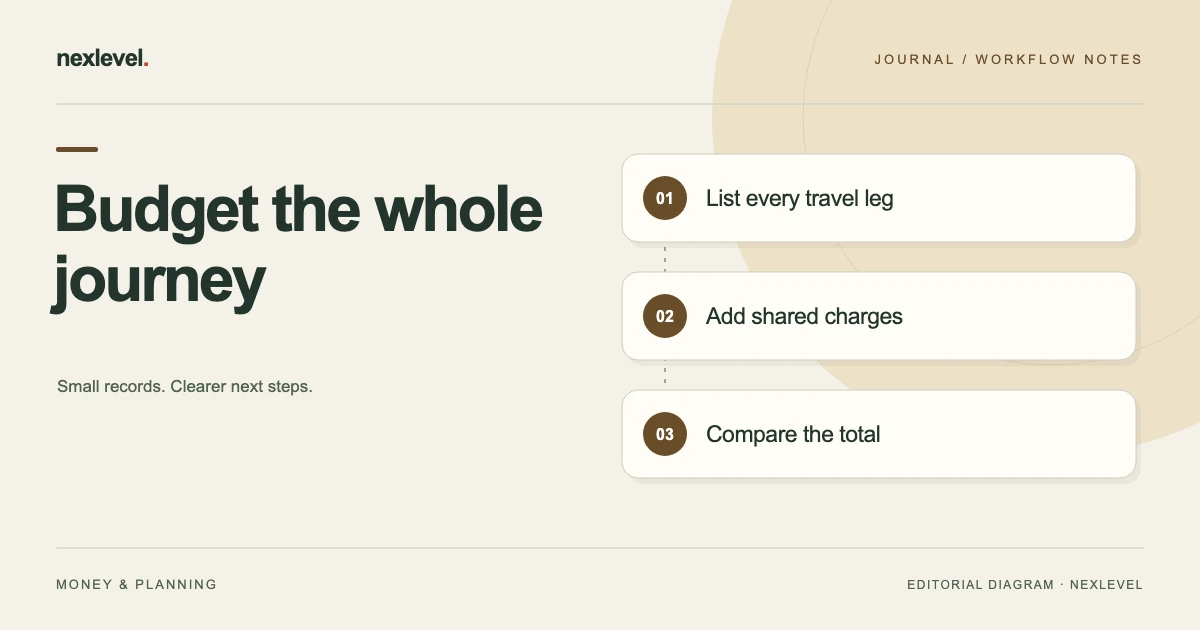
A door-to-door travel budget should compare the trip you will actually make, not just the headline fare. Baggage, transfers, parking, an additional night, or a different arrival point can change which option costs less under your assumptions.
This template organizes prospective booking options with a common cost basis and a fictional two-traveler example. It does not fetch live prices, recommend a provider, guarantee availability, or decide whether a particular itinerary meets your travel requirements.
Define the trip before collecting options
Record the origin and destination at the level relevant to the decision, travelers, dates, and actual arrival requirement. Two fares are not equivalent if one reaches a different place or arrives too late for the trip’s purpose.
State the comparison boundary. Door-to-door might include transport from home, the main journey, arrival transfers, and necessary associated lodging. Write down what you include and what remains outside the model.
Keep feasibility separate from price. An option can have a low total while failing a required arrival time or another essential condition.
Use a common currency and traveler count for the main comparison. Preserve the original source amounts if you convert them, with the conversion basis clearly labeled.
Copy this travel budget template
Use one record per option and one row per cost component. The same structure across options makes differences easier to inspect.
- Option: provider, route or itinerary reference, dates, and capture time.
- Fare: source amount, currency, traveler count, and inclusions.
- Extras: bags, seats, payment charges, or other relevant booked components.
- Access: departure and arrival transfers, parking, or local transport.
- Linked costs: lodging, meals, or custom items within the defined scope.
- Charge basis: per traveler, per vehicle, per booking, per night, or another explicit unit.
- Time: door-to-door duration and its assumptions, kept separate from cash.
- Evidence: quote, source, capture date, estimate status, and open questions.
Label a cost as included only when the source supports that treatment. Unknown is not zero, and a possible discount should not appear as a confirmed reduction.
Use charge bases that match the actual component
A fare may be per traveler, while a transfer is per vehicle. Multiplying every line by the number of travelers can double a shared cost. Leaving every line unmultiplied can omit a second fare.
Record quantity and unit beside each amount. A bag charge for one traveler is not necessarily a bag charge for everyone. A hotel amount per night needs the relevant number of nights.
Keep the source inclusion visible. If a fare already contains a selected component, do not add it again as an extra merely because it appears on a separate checklist.
When a component is shared by only part of the group, record that scope. An average cost per traveler can summarize the total without establishing how the group will actually divide payment.
A fictional two-traveler comparison
Imagine Option A has a fare of 140 per traveler, baggage of 20 per traveler, and a shared transfer of 45. For two travelers, the modeled total is (140 × 2) + (20 × 2) + 45 = 365.
Option B has a lower fare of 125 per traveler, baggage of 30 per traveler, a shared transfer of 90, and an entered additional lodging cost of 60. Its modeled total is 250 + 60 + 90 + 60 = 460.
| Component | Option A | Option B |
|---|---|---|
| Two fares | 280 | 250 |
| Baggage | 40 | 60 |
| Shared transfer | 45 | 90 |
| Additional lodging | 0 | 60 |
| Modeled cash total | 365 | 460 |
Option B’s fares are 30 lower, but its modeled trip total is 95 higher. These fictional figures illustrate the importance of the cost boundary, not a claim about current routes or providers.
Keep estimated and confirmed amounts distinct
A live quote, a provider’s published fee, and your own planning estimate can all inform a budget. They should not look like equally confirmed charges.
Record when each amount was captured and what it covers. A transfer quote for a different pickup time or number of passengers may not apply to the option being compared.
Use an explicit unknown state for unresolved components. A comparison with a missing payment fee can still show a known-cost subtotal, provided the limit remains visible.
Before acting, recheck the relevant booking source. A saved comparison preserves a decision basis; it does not hold the price or guarantee that the component remains available.
Add door-to-door time without hiding its assumptions
Use the full duration relevant to your decision rather than only the main flight or train segment. Access, waiting, connections, and arrival travel may matter.
Keep the source of each timing assumption. A scheduled segment and an estimated local transfer have different bases. The total should not imply certainty beyond those inputs.
For the fictional example, suppose the entered durations are six hours for A and eight for B. Those are illustrative planning values, not measured or guaranteed journey times.
Record feasibility constraints alongside duration. A shorter journey can still arrive at an unsuitable time, while a longer option may fit the actual requirement. The budget should expose those differences.
Keep time valuation separate from money payable
You can optionally assign a personal value to travel time for comparison. State whether it is per traveler-hour or another basis. This is a preference input, not a charge from a provider.
At a fictional 10 per traveler-hour, two travelers over six hours produce 120 of modeled time value. Eight hours produce 160. Adding those to the example cash totals gives comparison scores of 485 and 620.
Keep the actual cash totals of 365 and 460 visible. The time-weighted scores do not mean you will pay those larger amounts.
Different travelers may value time differently. A single score can support a conversation without pretending that the preference is objective or universally shared.
Convert currencies with a recorded basis
Preserve the original currency, amount, rate, source, and capture time. A converted budget value is only as current and applicable as the basis you entered.
For pure arithmetic, a fictional amount of 120 in Currency Y at an assumed 1.10 units of Currency X per Y converts to 132 X. This is not an exchange-rate quote.
Keep card charges, conversion costs, and final settlement separate if relevant. A planning conversion does not establish what a payment method ultimately charges.
Use the same stated basis across options where appropriate, or explain why the sources differ. Otherwise, an apparent option difference can come from inconsistent conversions.
Use ranking criteria transparently
Lowest modeled cash, shortest entered duration, and least hassle answer different questions. Decide which criterion you are using and keep essential feasibility conditions visible.
Explain subjective labels. An option considered simpler may involve fewer changes under your definition, but that does not make it the best choice for everyone.
Do not let a sorted list hide missing information. A low subtotal with an unresolved major component should not look fully comparable to an option with all components entered.
For a trip already booked, the change-cost comparison guide handles a different decision: new cash, refunds, credits, and lost value after plans change.
Freeze the decision basis
Save the selected option, source amounts, charge bases, assumptions, timing, and open questions. Keep the version used for the decision even if quotes later change.
Record the actual decision owner and action. Selecting a preferred option in a worksheet is not the same as completing the booking.
Review the final provider confirmation and charges after action. Preserve the outcome separately from the original estimate so differences remain explainable.
If another person books, give them the current version and unresolved checks. The deadline tracker can keep the relevant provider event and decision time clear.
Share a summary that can be checked
A useful summary shows the trip scope, traveler count, option totals, major differences, source times, and unknowns. The reader should not need every working note to understand the comparison.
Keep private traveler and account details out of a broad planning document. Share booking access through the appropriate secure route rather than embedding credentials.
If the group divides costs differently from an equal average, record that separate agreement. The shared-bill guide illustrates transparent assignment and reconciliation, though travel arrangements may use another method.
Inspect exported files for units, currency, charge bases, and included items. A total detached from those labels loses much of its meaning.
Review actual differences after booking
Compare the final amounts with the frozen model on the same scope. A new inclusion or changed traveler count can explain a difference without indicating an arithmetic error.
Record supported reasons rather than guessing. A provider confirmation, payment record, or revised quote can help identify what changed.
Use one useful improvement for the next budget, such as checking a transfer basis or capturing a fee earlier. One unusual itinerary does not establish a universal allowance.
Keep historical comparisons understandable when profiles or templates change. Reusing a structure should not rewrite earlier decisions.
Test one changed charge basis
Return to fictional Option A. If only one traveler needs the entered 20 baggage charge, the baggage line becomes 20 rather than 40. The modeled cash total becomes 280 + 20 + 45 = 345. The average across two travelers is 172.50, although their actual payment arrangement may differ.
This is a different scenario, so preserve which travelers and components it includes. Do not quietly change the line while leaving the summary labeled as the original two-bag comparison.
Now consider a separate correction: suppose the transfer source actually quotes 45 per traveler rather than 45 per vehicle. With the original two baggage charges, Option A becomes 280 + 40 + 90 = 410. The difference comes from the source basis, not a more expensive fare.
These examples show why each row needs a unit and scope. A total can be mathematically correct while representing the wrong purchase. Verify the source before interpreting a ranking change.
Run a small completeness review before choosing
Ask another traveler to identify the departure access cost, arrival access cost, included extras, any required additional night, and major unknowns. They should be able to find those components without guessing what the headline fare includes.
Then review what changes if one assumption is wrong. A shared transfer cost and a per-person fare can affect the group total differently. Keep scenarios labeled rather than inflating every line with an unexplained buffer.
Check the latest capture time for the components most likely to change before action. A budget is a snapshot, and separate providers can revise their offers independently. Confirm the actual booking components through their appropriate source.
Save the final decision basis and record the subsequent booking outcome separately. If another person executes the booking, ask them to confirm the selected option and unresolved checks. This preserves the useful comparison without making a worksheet selection look like a completed transaction or a guaranteed price.
A concise fictional receiving summary can state: “Two travelers, one currency, Option A modeled at 365 with two bags and a shared transfer. Fare and extra sources are saved. The final provider quote still needs checking before booking.” That gives the receiver a clear basis without implying a reservation exists.
If the receiver discovers that a component was quoted per person, update the identified row and version. Keep the earlier summary available where it explains the decision history. A changed total should have a traceable reason rather than appearing as an unexplained new ranking.
Use TripCost Guard for complete-option comparison
TripCost Guard compares entered fares, extras, transfers, lodging, and custom costs with per-traveler or whole-trip bases. Its official listing describes duration, optional time valuation, recorded exchange-rate sources, rankings, and frozen decisions. It does not scrape fares or sell tickets.
View TripCost on the App Store for current features and access. Keep the complete cost model visible, then verify the actual quote before booking.
Sources and example scope
App features were checked against the official TripCost listing and product page. All fares, fees, durations, currencies, and time values are fictional. No live offer, provider recommendation, exchange rate, or guaranteed total is supplied.