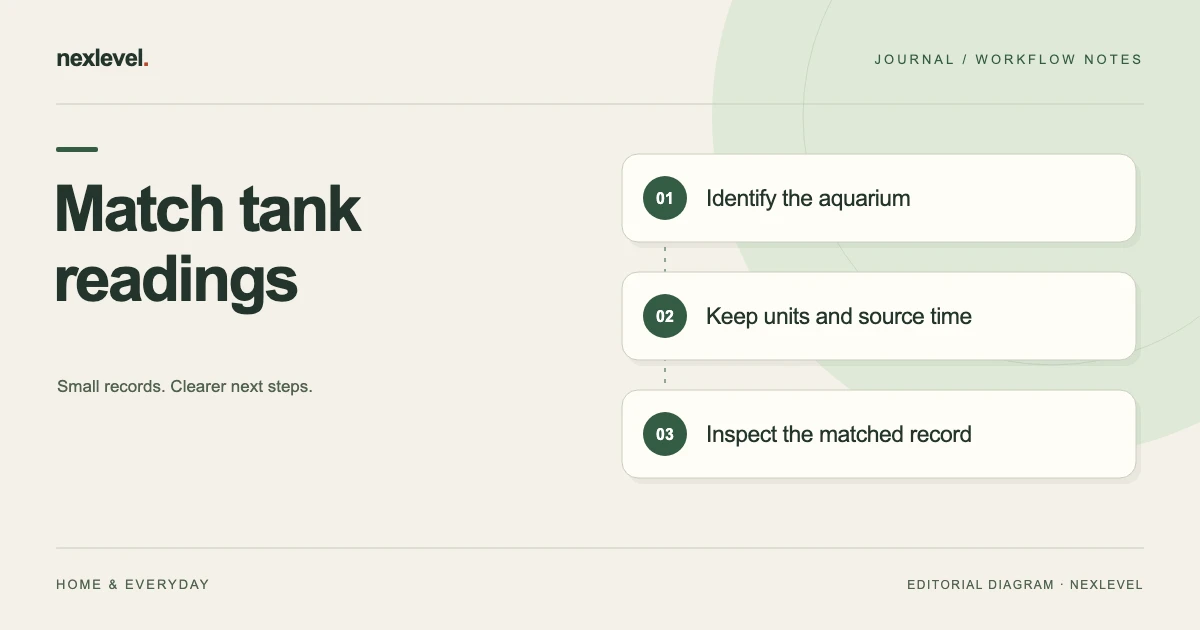
Match an aquarium reading to its tank before comparing trends. Keep the parameter, unit, observation occasion and source together; a similar nickname, nearby photo or plausible chart shape cannot establish the relationship. Correct a copied summary separately from a genuine log-entry error.
Establish the reading’s source identity first
- Identify the selected aquarium, source reading and history period.
- Check parameter, value, unit and observation time against the original source.
- Review related photos or events for their actual relationship rather than proximity.
- Record the confirmed match, supported correction or unresolved source question, then inspect the intended copy.
Working fields:
Reading/source | Tank | Parameter/value/unit | Observation time | Candidate record | Supporting context | Match/question | Copy checked
Useful next steps: Use the aquarium log structure, Check the initial tank and equipment context.
Begin with a stable aquarium reference
A descriptive name such as “desk tank” can change when an aquarium moves. Two aquariums can also have similar names. In your independent review, pair the visible name with an established reference that distinguishes the actual setup.
Record the source location and selected history period. If the same physical aquarium has been renamed, clarify that relationship using the actual records. Do not assume a name change means a new aquarium or that two matching names establish one continuous history.
These are proposed worksheet practices, not a claim that TankLedger includes custom permanent-ID fields. Use the app’s actual aquarium organization and supported controls for the working record.
Keep the complete observation together
A usable observation includes the aquarium, parameter, value, unit, and source timestamp where established. Notes about how the record was obtained can help explain a later discrepancy. A number alone cannot establish its own meaning.
Retain the unit actually supplied by the source. If a unit is missing, trace it to the original test record rather than inferring it from the magnitude or from what another aquarium uses.
Preserve the source date’s actual precision. A known day should not become an invented exact clock time just to fill a worksheet cell. Mark a missing detail explicitly and identify who can establish it.
Separate observation time from entry and review time
A reading may be entered after it was observed. A photograph may be added later. An export has its own preparation time. These dates describe different events, even when they happen to be close together.
When a retained note says “this morning,” establish its original context before assigning a calendar date. The current review date does not automatically supply that context, especially for an old message.
Where device or time-zone context actually matters, preserve what is known and leave what is unknown explicit. This worksheet is not a reason to invent precision or to silently shift a reading across days for a neater chart.
Use a tank-matching worksheet
Suggested fields are review question, aquarium reference, source reading, parameter, source unit, observation date, source location, candidate destination record, ambiguity, owner, and established outcome.
Add separate references for relevant photos or maintenance events. Describe why they are related. A maintenance event appearing near a reading in the timeline does not prove it caused the reading or that the two belong to the same occasion.
Use explicit outcomes such as correct aquarium confirmed, mistaken record corrected through the supported workflow, or source relationship unresolved. A bare “checked” does not tell the recipient what the review established.
Compare two fictional aquariums
Imagine aquariums A17 and A18 in a fictional keeper’s independent worksheet. Their informal names are similar. A retained note contains a parameter and a source date, but the copied heading has been shortened so far that the reviewer cannot identify the destination aquarium.
The reviewer first locates the original source, rather than choosing the aquarium whose recent chart looks most plausible. They inspect the actual tank context, source test session, and any established identifying information retained with it.
Suppose those sources establish that the reading belongs to A18. If the working record is already in A18, the review only needs to clarify the independent note. If the working entry is genuinely wrong, use the actual supported correction process and check the resulting record.
If the source does not establish the aquarium, retain the unresolved identity question. A plausible destination is not a verified destination. This example deliberately contains no numerical chemistry target from which to guess.
Do not match a reading by appearance alone
A photograph can provide context when its relationship to the aquarium and occasion is established. An image of similar decor does not independently prove which tank produced a reading. The same equipment or background may appear in more than one setup.
Keep the photo reference, capture context, and claimed relationship readable in the independent worksheet. If a photo only illustrates the aquarium, describe it that way. Do not convert it into proof of an unseen test result.
Likewise, a filename can help locate a source without establishing its contents. Open the actual file. Check whether it identifies the aquarium and occasion or whether the reviewer still needs another source to complete the match.
When a source image is ambiguous, preserve the question instead of repeatedly relabeling it until it fits the intended timeline.
Check the configured panel without inventing equivalence
TankLedger’s current listing describes test panels for each aquarium and exact readings with notes and timestamps. Different aquariums can have independently configured parameters. A similar position in two panels does not establish the same measurement.
Compare the actual parameter names and units. Do not treat “third row” or a shared abbreviation as sufficient identity when the source meaning is unclear. Keep the original source wording available for review.
If a parameter definition changed, identify the actual relationship between old and current records before comparing them. This article does not prescribe a universal naming scheme or claim that every differently named measurement can be converted into another.
Keep target bands distinct from measured readings
The app’s current description identifies target bands as keeper-defined. A band is configured context. A measured observation is a recorded result. They should remain distinguishable in the independent review.
Changing a band does not establish that a historical measurement changed, and a color against a band is not a substitute for the underlying value, parameter, unit, and source time.
When preparing a recipient summary, state the actual context needed for the task. Do not turn a keeper’s selected band into a universal species recommendation or imply that a chart supplies a diagnosis. Use appropriate species research and qualified advice for questions outside record identity.
Match maintenance events on their own evidence
A water-change, dosing, observation, or equipment event can help a reader understand the timeline. Each should still be matched to its actual aquarium, source date, and recorded action. Chronological proximity alone does not establish a causal explanation.
For A18, imagine an equipment note near the source reading. The worksheet can say that the two appear in the selected period and identify their sources. It should not say that the equipment event explains the reading unless an appropriate source establishes that claim.
A recurring task also differs from a completed event. A due or overdue label describes the task’s recorded schedule state, not independent proof of what physically happened. Clarify actual completion through the responsible recordkeeping process.
Handle duplicate-looking copies carefully
The same observation may appear in the working timeline, a CSV, and a retained image. Those are three representations, not automatically three tests. Compare their relationship before removing anything from the working record.
In the fictional A18 case, the reviewer might establish that two source lines represent one saved observation. The independent worksheet then links them to that observation rather than creating another entry.
If the sources establish an actual mistaken repeat, use the supported correction workflow and inspect the resulting record. If two separate tests are established, retain both. Do not delete a legitimate observation merely to make the chart appear smoother.
Review current and retained sources separately
TankLedger works locally and offers optional Pro private iCloud synchronization. That does not make every retained export or disconnected view continuously current. Identify the exact source being reviewed.
A missing row in an older copy can reflect the copy’s scope or preparation time. Check those relationships before re-entering an observation. Repeated entry can create the very duplication the review was intended to resolve.
Keep unresolved device-state questions distinct from the physical test. This worksheet makes no promise about synchronization timing. Record the source available now and which later comparison is still needed.
Inspect a portable record as the recipient
Open the actual CSV or supported report prepared for the handoff. Check aquarium identity, selected period, parameter names, units, dates, and relevant source notes. Do not assume every interactive chart setting or independent worksheet field appears in the file.
TankLedger’s listing describes local CSV export and Pro PDF reports. Choose the actual available output and verify what it contains. A portable file should not be described as the full editable app.
Test one observation by tracing it from the summary back to its source. If the recipient needs the original writer’s memory to choose between A17 and A18, the source relationship is not yet clear enough.
Write a review result that survives the handoff
A fictional receipt can state: “Selected A17/A18 records compared with identified sources. Ambiguous reading matched to its established aquarium or retained as an open question. Units and observation dates preserved. Related events and target-band context kept distinct. Recipient copy inspected.”
Replace the alternatives with actual results. Identify any supported correction and remaining question owner. A review receipt should describe what was established in this review, not provide an all-purpose assurance that every aquarium record is accurate.
Keep source locations accessible through the intended private arrangement. There is no need to distribute unrelated household details merely to demonstrate a test-to-tank match.
Improve the next capture at the smallest useful point
If ambiguous names repeatedly cause trouble, improve how the aquarium is identified when preparing the note. If units disappear during copying, retain them with the parameter and value. If photos lose context, preserve their actual relationship to the source occasion.
Choose one recurring problem and check whether the improvement survives into the recipient copy. Adding more fields is useful only when someone can maintain them and a reader can use them.
Keep the result in proportion: clearer records support a better-informed review, but the worksheet does not diagnose animals, explain every trend, or replace actual care guidance.
Check the source after a supported correction
A correction should have a concrete review target. Open the actual resulting aquarium record and inspect the parameter, unit, date, and related context. Do not treat having selected an edit control as proof that the intended result was saved.
If the problem concerned the independent summary alone, inspect that summary instead. Keep the accurate underlying observation intact. This avoids making a second error while trying to repair a copied heading.
For the fictional A18 case, the final check should let a reader trace the corrected relationship back to the established source. A retained older copy can still exist; identify the current intended copy through the actual sharing arrangement rather than pretending every representation has been rewritten.
Use TankLedger as the aquarium’s working timeline
TankLedger organizes per-aquarium readings, test panels, notes, photos, maintenance tasks, and event histories. Its current listing describes Pro multiple-aquarium features, advanced trends, PDF reports, and optional private iCloud synchronization.
Check the official TankLedger App Store listing for current capabilities and plan details. Keep exact observations attached to their actual aquarium and use the independent worksheet to explain source questions that a handoff needs to preserve.