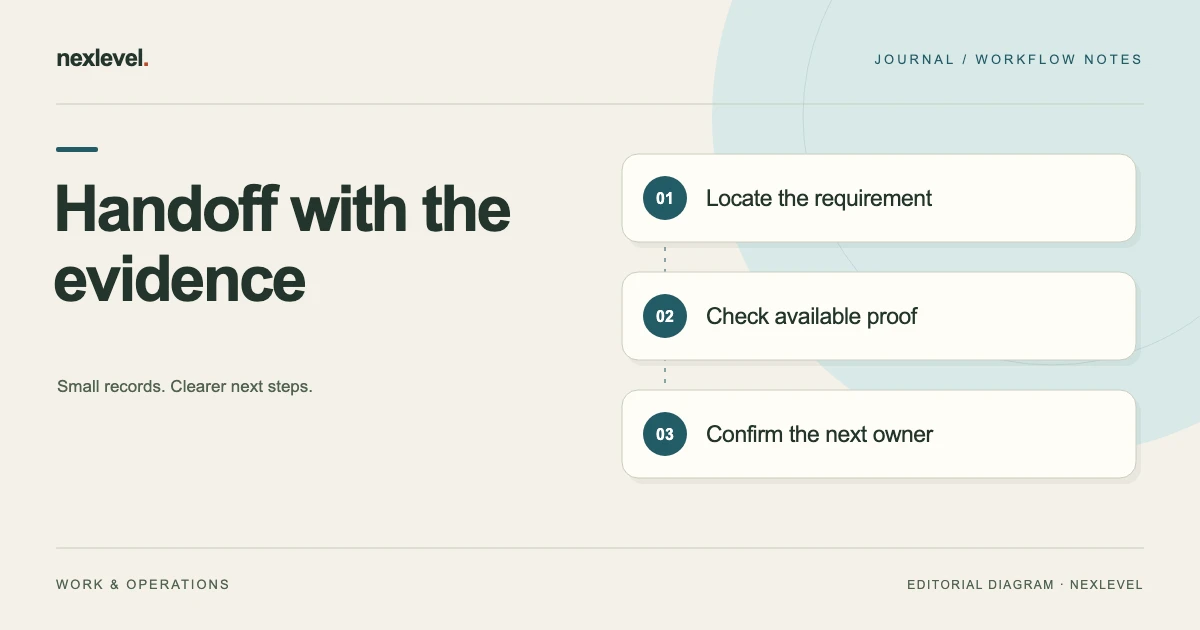
Handing an obligation to a new owner requires more than changing a name in a tracker. The new owner needs to know what must happen, where that requirement came from, what has already been done, and which evidence will support closing the record.
A useful handoff connects the source requirement to the current state and the next action. It also distinguishes accepting responsibility for the work from confirming that the work is complete. Those events should remain separate even when the same person records both.
This guide offers an original handoff worksheet and a fictional project-report example. It concerns organizing records, not interpreting an agreement or certifying compliance. Use the project obligation tracker template if you first need to establish the basic obligation record.
Identify the obligation being transferred
Record the obligation identifier, agreement or project reference, current owner, intended successor, due event, and preparation date where relevant. Use a stable identifier so the handoff can be connected to the same record after a name or schedule changes.
Check whether responsibility is actually transferring or whether the successor is providing temporary cover. A person collecting evidence during a colleague’s absence may not be taking over every responsibility associated with the agreement. Describe the intended arrangement explicitly.
Set a handoff cutoff. State which actions and evidence are included up to that point, and how later developments will be added. Without a cutoff, both people can work from slightly different assumptions about whether the last message, file, or update was included.
Keep the source requirement close to the task
Include the relevant source document edition and location. Record the requirement as entered in the tracker, with enough context to locate the original. If the source is unclear, identify the question and the person responsible for resolving it rather than silently rewriting the requirement.
Keep the required action, timing, dependencies, and evidence expectation distinct. They answer different questions. A task can be described accurately while its due date remains uncertain, or it can have a clear deadline but an incomplete definition of the required proof.
Do not let the handoff summary become a new unofficial source of obligations. It should point back to the relevant agreement or established project instruction. If the source has changed, record the new version and arrange the appropriate review before relying on an older interpretation.
Describe the current state in observable terms
Replace broad summaries such as “mostly done” with the work actually completed and what remains. State which draft exists, which review occurred, which submission happened, and which evidence is still missing. Link each important statement to a file or recorded event where possible.
Distinguish completed work from work someone intends to do. “Report drafted” and “report scheduled for review” can both be true, but neither establishes that the report was delivered. A handoff should not compress several future steps into a single optimistic status.
Include known blockers and dependencies with an owner. If a colleague must supply a figure before the report can be finalized, identify that input and the latest useful time for receiving it. The successor needs a next action, not just an explanation of why progress stopped.
Build a small evidence index
List the evidence item, what it supports, its version or date, location, and any access restriction. Keep the index readable. The new owner should be able to tell whether a file is the actual deliverable, proof of delivery, a review note, or background material.
For each item, note whether it is final, provisional, superseded, or still expected. A draft PDF and a final PDF can look similar in a file list. If both remain necessary for the history, label them clearly instead of relying on modification times to explain their status.
Check that links or attachments can be opened through the intended working arrangement. An evidence index that points entirely into the former owner’s private folders may preserve filenames without providing a usable handoff. Resolve access deliberately while sharing only the material the successor needs.
Use a complete handoff worksheet
A practical worksheet contains: obligation ID; source and edition; required action; due event and preparation lead time; current owner; successor or cover owner; handoff cutoff; current state; next action; dependencies; evidence required; evidence available; evidence missing; and review or escalation contact.
Add receipt fields for the handoff itself: who checked the packet, when it was checked, what could be opened, what was understood, and which gaps remain. This records the transfer of context without making the handoff receipt look like evidence that the underlying obligation is complete.
Finally, include closure fields: required completion conditions, supporting items, final reviewer if applicable, completion event, and unresolved exceptions. Use the source requirement and your actual process to determine those conditions. Do not invent a generic proof standard and assume it applies to every obligation.
Work through a fictional monthly report handoff
Imagine obligation O17 in a fictional project arrangement: prepare a monthly site-progress summary, deliver it through the agreed project folder by the fifteenth day, and keep the final summary plus a delivery record. The current owner has prepared report revision 2 but has not yet uploaded it.
The handoff packet identifies the source instruction, the relevant reporting period, the revision 2 file, and the outstanding upload. It also includes a screenshot of an earlier draft review, labeled as background review evidence. That screenshot does not become proof of delivery merely because it is the only image in the folder.
The successor opens the draft, confirms the remaining step, and records receipt of the handoff. O17 stays open. After the actual delivery, the owner adds the final file reference and delivery record, then checks them against the stated completion conditions. Responsibility transfer and obligation closure have been recorded as separate events.
Check what each proof item actually establishes
Ask a narrow question of each evidence item. A final document supports what was prepared. A delivery record may support what was submitted and when. An acknowledgment may show that a particular recipient responded. None should automatically be treated as establishing every part of the requirement.
For fictional O17, compare the delivery record’s filename or reference with the final summary. A receipt for revision 1 would not explain the delivery of revision 2. If the record is ambiguous, preserve the uncertainty and obtain the missing information through the normal project process.
Check the relevant period and destination as well. A genuine delivery record for last month’s report is not the requested evidence for this month’s task. The successor should verify those details before using an inherited attachment to support a completion decision.
Separate missing evidence from incomplete work
Sometimes the work happened but its evidence is missing. Sometimes the evidence is absent because the work never happened. Record which situation is known, and which parts remain uncertain. Do not silently repeat the work or close the record based only on a colleague’s recollection.
If delivery is believed to have occurred, identify the place where its record could be checked and assign that check. If the final report itself cannot be found, identify whether an earlier version is available and what review is needed before relying on it.
A tracker status should reflect the available information and your process. Avoid using a “complete” label to mean “probably finished” if other people will interpret it as verified closure. A short uncertainty note can prevent the next owner from inheriting an apparently settled but unsupported record.
Handle the deadline during the transfer
Compare the remaining work with the time before the due event. Include preparation, review, access, and delivery steps. The handoff itself consumes attention, so do not assume that changing the owner creates additional time or removes a dependency.
If the successor cannot meet the existing plan, make the issue visible promptly through the agreed escalation route. Record the blocker, the next action, and any proposed revised arrangement. Keep a proposal distinguishable from a change that has actually been confirmed.
For O17, an inaccessible project folder is a real delivery dependency. The successor can prepare the report while the responsible person resolves access, but should not mark delivery complete because the file is ready locally. The two facts belong in separate fields.
Control duplicates and overlapping ownership
During a transition, two people may both believe they should finish the same task. Record who owns the next action and when the transfer takes effect. Keep the existing obligation identifier rather than creating a second active record that appears to represent different work.
If temporary cover ends, perform a short return handoff. Summarize actions taken, evidence added, remaining questions, and any changed dates or dependencies. The returning owner should not need to infer progress from a collection of newly modified files.
Where several people contribute, distinguish contributors from the person coordinating closure. This avoids a situation in which everyone supplied their own piece but nobody checked whether the complete evidence set supports the recorded outcome.
Share the minimum useful packet
Include the information needed to perform and verify the obligation. Separate unrelated agreement material, private correspondence, and other project records that the successor does not need for the task. Use your organization’s actual access and confidentiality arrangements.
When a summary is sufficient, keep a reliable reference to the fuller source in an appropriate location. When the source itself must be inspected, arrange suitable access instead of copying sensitive material into an uncontrolled convenience file.
After export or sharing, check the packet that was actually prepared. Verify the obligation identifier, evidence references, filenames, and any visible notes. An internal record can be accurate while an older exported copy still contains a previous owner or incomplete evidence list.
Test the handoff with a short reconstruction
Ask the successor to explain the required action, the next step, the deadline basis, and the evidence needed for closure. Then ask them to open one supporting item. This tests whether the packet carries usable context without requiring a lengthy rehearsal of the entire project.
For O17, the answer should distinguish report preparation from upload and should identify the final summary plus delivery record. If the successor points to the draft-review screenshot as delivery evidence, clarify the index and the required next action.
Record any gaps found in the reconstruction and who will resolve them. A handoff can proceed with known open questions when the arrangement is explicit, but those questions should not disappear simply because the new owner has accepted responsibility.
A compact receipt for fictional O17 could say: “Cover owner has opened source instruction S2 and report revision 2. Report upload remains outstanding. Final deliverable and delivery record are required for the closure review. Project-folder access is being checked by the coordinator. Cover owner accepts the next-action responsibility from the stated cutoff; no completion decision has been recorded.” This gives the transfer a clear operational meaning. Adapt the fields to the actual requirement, then keep the receipt with the obligation record so a later reviewer can distinguish taking ownership from verifying delivery.
Before the cover period ends, schedule the return check and name who will maintain the record afterward. This small step prevents a temporary arrangement from becoming an indefinite gap in ownership, especially when the obligation recurs and the next reporting period begins before the former owner has returned.
Use obligation software without overstating closure
ObligationRadar keeps obligation details, owners, source references, dates, dependencies, and evidence records together. Its current listing distinguishes free evidence notes from Pro file evidence and completion-blocking prerequisites. The worksheet above remains a practical method for deciding what context the new owner needs.
The app organizes information entered by the user; it does not interpret agreements or certify compliance. Check current features and plan details in the official ObligationRadar App Store listing. Keep responsibility, observable progress, available evidence, and the final closure decision separately understandable.