A brand review becomes difficult to hand off when its conclusions travel separately from the asset and rules that produced them. A note saying “fix the footer” might refer to an older export, an uncertain text-extraction result, or a finding already resolved in a later revision.
Prepare the handoff so the next person can identify the exact asset, inspect the relevant evidence, understand the human decisions, and act on the remaining issues. Keep a review summary connected to its source material rather than asking the recipient to reconstruct the whole conversation.
This guide provides an original handoff worksheet and a fictional campaign example. It concerns review records, not certification of an asset’s legal or commercial suitability. Use the brand review checklist for the initial inspection.
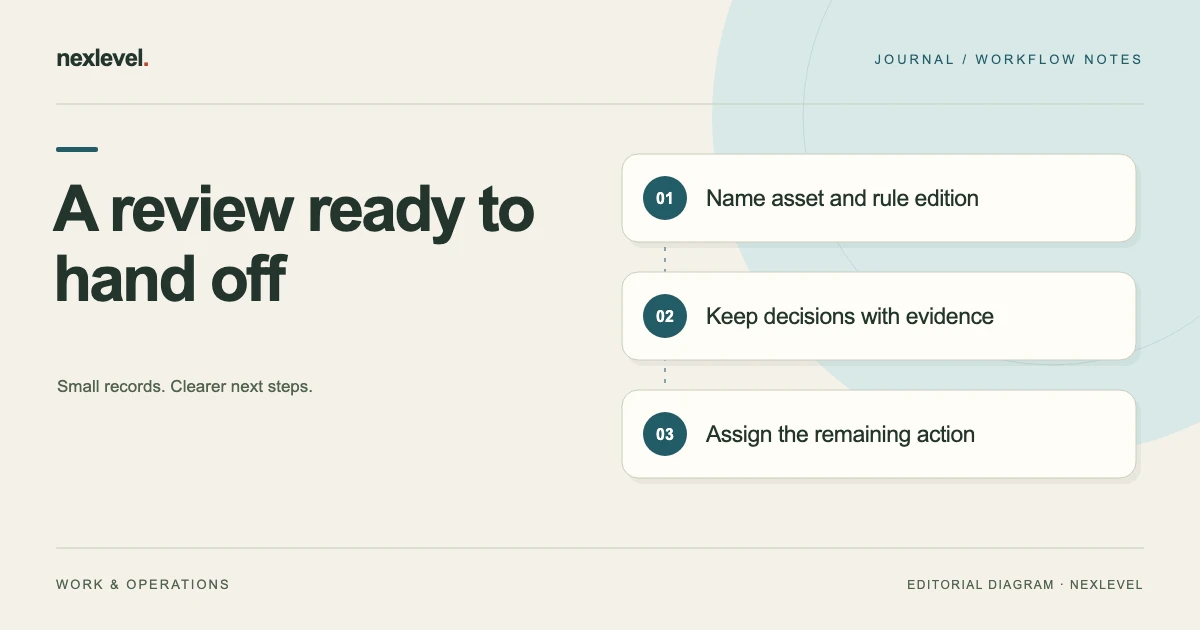
State what is being handed over
Identify the review, asset filename and revision, brand kit edition, campaign, and intended placement. Include the current review state and the purpose of the handoff. Taking over an unresolved review is different from receiving a completed report for reference.
Name the current owner and the person expected to handle the next action. If the recipient is only providing a design correction, state that limitation. Do not imply that receiving the file transfers every review or release responsibility.
Record a cutoff for the packet. Later comments or asset revisions need a clear way to enter the working record. Without that boundary, two people may believe they are discussing the same review while one is already using newer material.
Freeze the reference asset for the handoff
Keep the exact reviewed export identifiable. Record its filename, revision, format, and location. A live design file that continues to change can be useful for production, but it should not be the only reference for what the review actually examined.
Distinguish the reviewed export from source artwork and later corrected files. The next reviewer may need all three, yet they serve different purposes. Clear labels prevent a correction from appearing in the evidence before the earlier finding has been explained.
If your process uses a content identifier or file fingerprint, retain it with the readable filename. That can help distinguish files, but it does not explain the review’s meaning or establish that a person accepted the asset. Keep the human decision separate.
Keep the applicable rule edition visible
Record the brand kit or rule set used and the location of each relevant rule. A finding against an earlier kit may require a different interpretation after a policy change. The handoff should establish which edition governed the actual review.
Include short accurate excerpts or clear references where useful. Avoid copying an entire policy collection into every comment if a reliable source reference is available. The recipient needs enough context to inspect the issue without confusing the summary with the underlying rule.
If applicability is unresolved, state the question. A packaging rule may not govern a social asset in the same way. Do not ask the designer to correct a confirmed violation when the actual open task is deciding whether the rule applies.
Separate findings from decisions
A finding records an observation or potential issue. A human disposition records what the reviewer decided to do with it. Keep those fields distinct so a tentative observation does not turn into an apparent instruction through shorthand.
Useful dispositions depend on your tool and process, but may include changes requested, accepted after review, not applicable, or unresolved. Explain the reason for each consequential decision and identify the relevant evidence. A status alone rarely carries enough context for a handoff.
Keep report-level approval separate from individual findings. Resolving one item does not necessarily complete the review, and receiving a report does not automatically authorize release. State the actual current outcome without extending it beyond what was recorded.
Use a compact finding handoff row
A practical row contains: finding ID; asset revision; rule reference; observed issue; source location; extraction or observation limitation; human disposition; rationale; requested action; action owner; and evidence needed for recheck.
Add a related-finding reference when one design change affects several items. A replacement footer could address a required phrase while changing the surrounding layout. Keeping the relationship visible helps the next reviewer understand what needs another inspection.
Use plain-language action descriptions. “Update text per R12 and submit a new export” is more useful than “resolve branding.” The row should tell the designer what is being requested and tell the reviewer what evidence will demonstrate the proposed correction.
Work through a fictional poster review
Imagine campaign poster F12, revision 2, reviewed against fictional brand kit BK-4. Finding G01 says the required support line was not found by text extraction. G02 concerns an incorrectly spelled campaign phrase. G03 asks whether a compact-format rule applies to this placement.
The reviewer opens the source poster and discovers that the support line is present but difficult to inspect in the extracted text. G01 receives a human note explaining the observation limitation. G02 remains a requested correction. G03 remains an applicability question for the responsible brand reviewer.
The handoff to the designer names revision 2 and asks for the phrase correction without presenting G01 as a missing-footer instruction or G03 as an established violation. The recipient receives three distinct issue states instead of one vague instruction to fix the branding.
Preserve uncertainty about automated observations
When a finding involves extracted text, geometry, or artwork observations, keep the limitation beside the evidence. An extraction confidence value describes the observation process, not whether a campaign message is appropriate or a brand rule should be waived.
Ask the next person to inspect the original where the observation is unclear. A low-resolution preview or cropped screenshot may hide information needed to assess the item. Preserve the source location so the reviewer can find the same area again.
Do not erase the original observation after a human resolves it. Keep the disposition and rationale understandable, while making the current action clear. This avoids a later reviewer treating the original automated flag as a new unresolved defect.
Distinguish corrections from exception requests
A correction changes the asset to address an issue. An exception request asks the responsible person to consider a deliberate departure from an applicable rule. Those paths need different next actions and evidence.
If the designer believes the requested correction cannot fit the placement, record the constraint and route the question through the actual review process. Do not convert a design comment into an accepted exception simply because the handoff deadline is close.
Use the brand asset exception request template when that narrower decision is needed. Keep any eventual exception linked to the exact asset and placement it covers, rather than treating it as a general permission for future exports.
Prepare a readable summary of remaining work
Summarize what is ready, what needs a correction, what needs a decision, and what remains uncertain. Keep the detailed finding records behind the summary. The next person should be able to begin work without reading every historical comment first.
For fictional F12, the summary could read: “G01 inspected and explained; no missing-footer correction requested from that observation. G02: correct the campaign phrase and return a new export. G03: brand reviewer to resolve compact-format applicability.”
Check that the summary agrees with the actual dispositions. If a row remains unresolved, do not summarize it as accepted. If a correction has already been rechecked, avoid sending it back to the designer as an outstanding task.
Check the files the recipient can actually open
Prepare the packet or deliberate share copy, then inspect its contents. Confirm that the reviewed asset, relevant rules or references, findings, decisions, and next actions are available in a useful form. Do not assume every export contains the full original source bundle.
Check access to linked locations through the intended working arrangement. A reference into the former reviewer’s private workspace may be meaningful to that reviewer but unusable for the recipient. Arrange appropriate access or provide an intentional copy where the process permits it.
Share only the material needed for the review task. Remove unrelated working notes and check whether internal comments belong in the handoff. Keep required evidence available without turning a convenience packet into an uncontrolled copy of every campaign file.
Handle a new export as a new review input
When the designer returns revision 3, identify what changed and which findings the change was intended to address. Preserve revision 2 as the reference for the earlier review. The recipient should be able to compare the correction with the requested action.
Recheck the affected evidence and any related areas. A corrected phrase can alter wrapping, spacing, or nearby text. The earlier disposition of an unrelated item may remain useful context, but it does not make every changed area acceptable automatically.
Record the result against revision 3. Avoid closing the original finding with a note that points only to a continually changing source design. The handoff history should explain which export was checked and what the reviewer observed there.
Run a reconstruction check before closing the handoff
Ask the recipient to identify the exact asset, rule edition, unresolved items, and next action for one finding. Then ask them to locate its source evidence. This checks whether the packet carries the context needed to continue the work.
For F12, the recipient should explain why G01 does not currently request a missing-footer correction. If they infer that every extraction failure means absent text, improve the finding note and summary before the issue returns as unnecessary design work.
Record any access or interpretation gaps found during the check. Receiving a packet is not the same as resolving every review item. Keep the actual remaining task and owner visible after the handoff is acknowledged.
Maintain a clear archive of the review sequence
Keep the earlier asset reference, finding decisions, returned export, and recheck outcome connected. Use identifiers that let someone understand the sequence without relying on file modification times or a chat thread’s order.
Label superseded exports and completed review stages clearly. A folder full of nearly identical reports can make an old unresolved state look current. A short index can identify the current asset and the record of earlier decisions.
Use the organization’s actual retention and access arrangements. This guide does not prescribe a universal archive duration. The practical requirement is that the records you retain remain distinguishable, accessible to the appropriate people, and clear about what was reviewed.
Agree when the next response is needed
Record the useful response time for each remaining action and the production event it affects. A designer may need to return a corrected export before the final review slot, while an applicability question may need an earlier answer to avoid unnecessary rework.
Keep those planning times distinct from a recorded approval. If the requested response does not arrive, the item remains in its actual state. Do not turn silence into acceptance merely because the asset is scheduled to publish the following morning.
For fictional F12, the handoff can name a design-return time for G02 and a separate decision time for G03. If either is missed, the review owner can make the scheduling consequence visible through the established project process. The packet then supports coordination as well as evidence retrieval, without inventing a release decision.
Use MotifGuard as a human review workspace
MotifGuard supports campaign PDF, image, and text review against versioned brand rules, with source-linked findings and explicit human decisions. Its current listing describes report approval and Pro PDF or JSON evidence export.
Inspect the actual export and its scope before using it as a handoff packet. Check current capabilities and plan details in the official MotifGuard App Store listing. Keep the evidence, interpretation, requested correction, and final human outcome separately understandable.