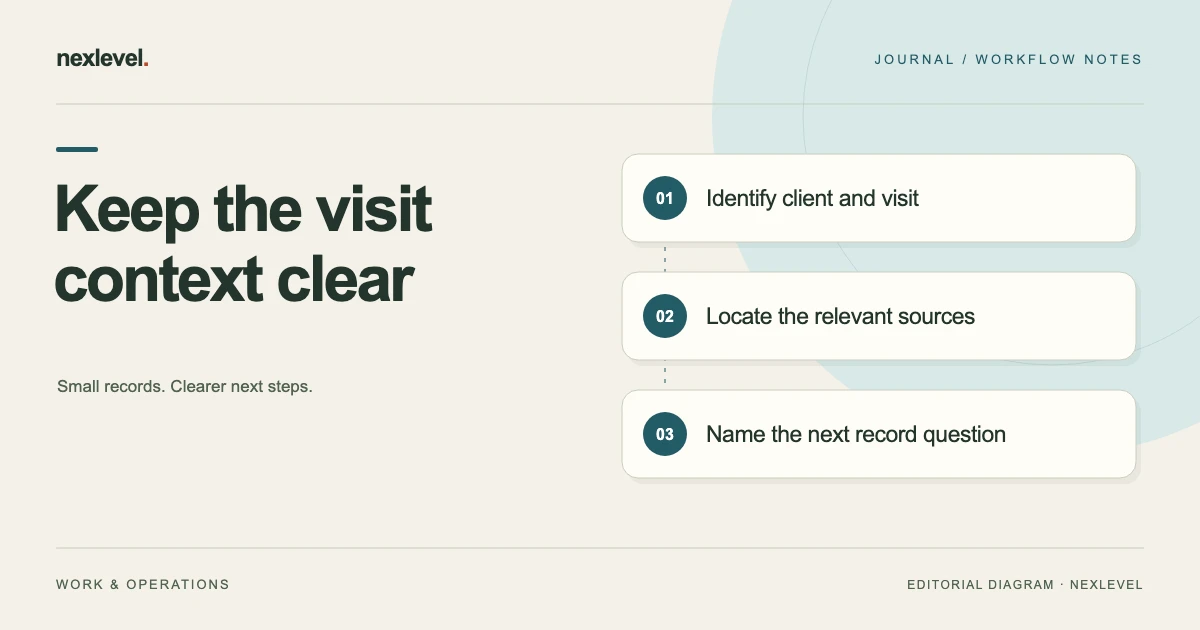
Hand off client color history by identifying the exact visit, its formula and zone references, recorded results and open questions. Give the receiving professional a route to the source record, and keep later consultation proposals distinct from the completed service history.
Prepare the selected visit for another reader
- State the client, visit, handoff purpose, recipient and cutoff.
- Locate formula and zone references with their original product and unit context.
- Separate completed-service observations from later proposals and client-reported preferences.
- Check photo identity and permission context in the intended copy, then ask the recipient to identify the history and next question.
Working fields:
Client/visit | Purpose/recipient | Formula/zones | Values/units | Result source | Later proposal | Photo/permission | Open question/owner
Useful next steps: Use the visit-record template, Check the selected export.
Identify the client and visit
Record the client reference, visit identifier, service description, and date context. A returning client can have several visits with similar notes while the relevant source details differ.
Use the actual privacy and access arrangement for the handoff. A readable reference can identify the record without putting unnecessary client details in every share copy.
Keep a later consultation or service distinguishable from the earlier visit. The record should not rely only on a familiar face or a broad formula title to establish the context.
State the handoff purpose
Identify whether the recipient is reviewing history, preparing for a consultation, completing administrative notes, or receiving a deliberate visit summary. Those purposes can require different details.
Name the outgoing and next responsible person and the cutoff. New information after that point should be identifiable as later context.
The handoff does not establish what treatment should be performed. Use the relevant product guidance, professional judgment, tests, and actual client process for those decisions.
Keep the formula reference with its visit
Identify the recorded formula or zone information and the visit it belongs to. A reusable template and a particular client’s historical service record serve different roles.
Preserve the recorded values and units as source information. If a field is unclear, identify the question rather than filling it with an assumed standard value.
This worksheet does not interpret the technical suitability of a formula or establish that a past service should be repeated. The receiving professional needs the actual record and relevant guidance.
Separate observations from future proposals
A result note describes an observation from the recorded visit. A next-visit adjustment is a proposal or professional planning note with its own context.
Keep client statements identifiable as such. A description of preference or experience can be useful without becoming an independently verified technical finding.
When a later note clarifies an earlier one, preserve the relationship through the supported workflow. Avoid making a future proposal appear to have been part of the original service.
Use a visit handoff worksheet
Useful fields include client reference, visit ID, service description, formula reference, zone context, recorded units, source notes, result observations, photo references and consent context, open questions, next action, and cutoff.
Keep the summary readable and link to details. The receiving professional should be able to find the actual record rather than relying on a compressed paraphrase of consequential values.
Add a receipt check showing what was located and understood. Receiving a summary is separate from deciding or performing a later service.
Work through a fictional history review
Imagine client C8 with visits V12 and V13. V12 has a recorded formula and result note. V13 contains a consultation note and a proposed next step, but no completed service record for that proposal.
The handoff names V12 as the relevant completed visit source and V13 as later consultation context. The recipient can inspect each without inferring that the V13 proposal was already performed.
No technical values are supplied by this example. Its purpose is to show how visit identity and note role help a professional reconstruct the administrative history.
Keep units and field meanings explicit
Read the actual unit and meaning of each recorded value. A quantity, ratio, timing note, or batch-size field should not be copied into another role without understanding its source context.
If the original record is incomplete, preserve that limitation. A precise-looking invented value can create more confusion than an explicit question for the responsible professional.
Use the actual product and professional process to determine any later formula or service. The handoff worksheet is not a calculation or treatment recommendation.
Check photo identity and consent context
Connect each relevant image with its client, visit, and evidence role. Similar images can come from different occasions or have different intended uses.
Review the actual consent record and sharing arrangement through the supported workflow. An image in the local history should not automatically become part of an external report or broader presentation.
Record any limitation in the view. A photo can show a particular appearance under its capture conditions without establishing every technical fact about a service.
Distinguish templates from client history
A reusable template can help prepare a future record, while a historical visit describes what was recorded for a specific client and occasion. Keep those roles clear.
If a prior record is used as a starting point, inspect every relevant field for the new context. Do not assume a copied value remains appropriate.
ColorFolio’s current listing describes templates without copying client information. Use the actual supported behavior and inspect the resulting record before relying on it.
Prepare a deliberate portable copy
If a visit PDF, structured export, or other supported output is needed, open the actual file and check client and visit references, field labels, notes, and intended images.
State what is included versus held separately in the working vault. A report does not automatically recreate the editable app or every source relationship.
Share only the information appropriate to the intended recipient and actual consent arrangement. Keep unrelated notes and client records in their proper location.
Handle missing context as an action
A vague note or unmatched photo should have a specific question and responsible person. The recipient needs a route to clarification, not a confident summary made from guesses.
For C8, a question may concern whether a note belongs to V12 or the later consultation. Preserve both sources while the relationship is checked.
Record the actual clarification and update the working reference through the supported method. The new explanation should make the history clearer without pretending the ambiguity never existed.
Inspect backup and restore claims accurately
If a backup is part of the handoff arrangement, use the actual tool’s supported workflow and inspect what operation was performed. Keep a readable report and a restorable backup distinguishable.
Opening a PDF is a retrieval check, not a complete workspace restoration. Describe the evidence of any test accurately.
Use the appropriate access and privacy controls for retained copies. A convenient transfer should not create unnecessary uncontrolled versions of client information.
Test the handoff through one visit
Ask the recipient to locate V12, identify its formula reference, explain the result note’s source, and distinguish the later V13 proposal. They should be able to use the record without a verbal reconstruction.
If they infer that the proposal was already performed, improve the visit and state labels before the history guides a future consultation.
This checks record usability rather than technical correctness or treatment suitability. Keep professional decisions with the actual responsible process.
Prepare a complete C8 visit packet
A fictional packet can begin with client reference C8, completed visit V12, later consultation V13, the relevant formula-record references, and the handoff cutoff. It states that V12 is the completed-service source and V13 contains later consultation context. The summary should not make the proposed next step look performed.
The packet’s index identifies the actual source records, their roles, and the route through which the authorized recipient can inspect them. A readable visit summary can lead to more detailed fields without copying unrelated client history into every handoff. Keep the recipient’s purpose explicit so the selected material is appropriate to that purpose.
For photos, record the client and visit relationship, intended evidence role, and relevant consent context through the actual workflow. A selected image can help explain the history while its use remains limited by the actual arrangement. The administrative worksheet does not determine technical condition or override professional and privacy responsibilities.
The next-action row names the specific question and responsible professional. For example, it may ask which note concerns the completed visit and which concerns the later consultation. It does not prescribe a formula adjustment. Keep technical decisions in the relevant consultation, product-guidance, and professional process rather than encoding them as an assumed consequence of a handoff.
Resolve an ambiguous photograph reference
Imagine a photo exported with a generic filename appears beside both V12 and V13. The recipient checks the actual source relationship before deciding which occasion it represents. A familiar client and similar appearance do not establish the event on their own.
Preserve the original source label or supported identifier and record the question. If the relationship can be established through the retained visit record, update the working reference using the actual tool. If it cannot, keep the limitation visible instead of assigning the image to whichever visit makes the timeline look complete.
Keep the consent and sharing check connected to the intended use after the identity question is resolved. Knowing which visit an image belongs to is useful, but it is a different question from whether the intended recipient should receive that image. The packet should not collapse those two checks into one broad “photo approved” statement.
Inspect the actual report copy after correction if it will be used for the handoff. A corrected local index does not change an older PDF already prepared. Make the current copy identifiable, and preserve earlier retained material according to the actual records process.
Write the handoff receipt accurately
A useful receipt can state that the recipient located V12, identified its relevant formula reference, read the result note in context, and recognized V13 as a later consultation. It can also identify which sources were opened and which question remains pending.
If a field or source was unavailable, record that fact. A visible filename or a familiar formula title should not be described as a completed source review. The handoff can remain useful with an explicit limitation and a named next action.
After clarification, record the actual result and the source used. Keep a later service as its own event rather than editing the earlier history until it appears to contain the new work. This preserves the distinction between remembered context, retained evidence, and a newly performed service.
Use recurring questions to improve the next visit record. A clearer photo label, an explicit unit field, or a better distinction between outcome and proposal can reduce future reconstruction. Those improvements concern documentation. They do not replace the professional’s responsibility to assess the client, follow manufacturer instructions, perform appropriate tests, and make the actual service decision.
Close the handoff by checking the actual starting point the recipient will use. Confirm the client reference, visit sequence, intended report, relevant photo context, and unresolved question. Record which sources were available at the cutoff and who owns the next clarification. A complete administrative handoff can honestly leave a professional decision open. Its value is that the receiving person can locate the right history and understand its limits without treating an old formula title or a general note as a new service instruction.
Use ColorFolio as a professional record
ColorFolio connects client profiles, visit timelines, zone-based formula records, notes, outcomes, and photos with consent records. Its current listing describes Pro visit exports, templates, and encrypted backup features.
Follow manufacturer instructions and professional judgment for technical work. Check current capabilities and plan details in the official ColorFolio App Store listing, and keep the handoff’s administrative scope clear.