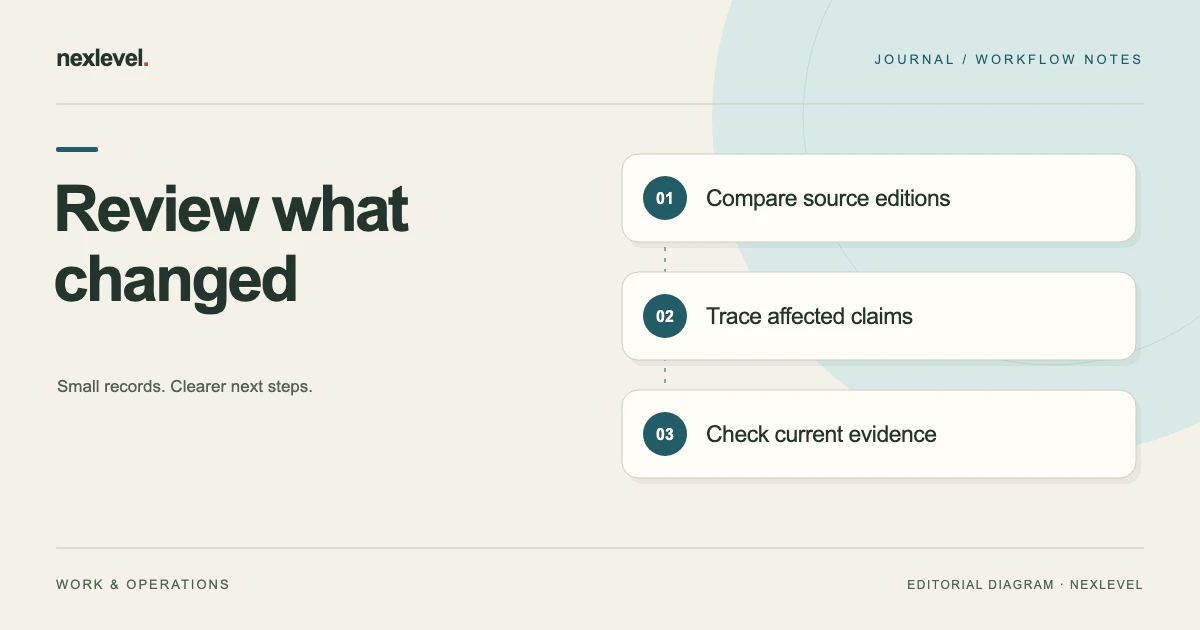
A revised manual does not necessarily require every sentence to be reviewed from the beginning. It does require you to establish what changed, whether the supporting sources still apply, and which earlier decisions remain relevant. Those are different questions from whether a paragraph looks familiar.
A practical revision review follows the connections between instructions and evidence. A wording change can affect one instruction, while a new product variant can affect an entire chapter even when its sentences are unchanged. Begin with those dependencies, then concentrate human review where the current evidence demands it.
This guide describes a review method, not an automatic approval transfer. Use your publishing tool’s actual readiness rules. The fictional label-printer example below illustrates document control; it is not an operating instruction for a real device. Start with the manual source register if the source collection itself is unclear.
Identify the exact editions being compared
Record the existing manual edition, proposed successor, product identifier, language, audience, and source set for each. “The latest manual” is too ambiguous when a supplier folder contains several similarly named PDFs. Give the review a concrete starting point that another reviewer can reproduce.
Keep an unchanged copy of the earlier edition. Work on a separate draft and record which edition it succeeds. If the earlier file is edited in place, later reviewers cannot reliably distinguish what was previously published from what is now being proposed.
Include the review boundary. A change to the installation chapter may appear narrow, but navigation, diagrams, troubleshooting references, and product applicability can depend on that chapter. List the areas being checked and the parts deliberately outside the current revision, along with the reason for that boundary.
Compare sources before comparing polished paragraphs
Review the input sources as well as the manual text. A supplier may have changed a specification, replaced a screenshot, or withdrawn an earlier statement. A draft paragraph can remain word-for-word identical while losing its evidential support.
For each source, note its identifier, edition, date if available, location, and intended product or configuration. Distinguish a replacement source from an additional source. The distinction matters when two documents disagree: adding a new file does not, by itself, establish which statement should govern the instruction.
Keep withdrawn sources available as historical references where appropriate to your process, but clearly separate them from the current source set. Reviewers need to know why an earlier approval existed without accidentally treating that old evidence as current authority.
Break the review into meaningful claims
A claim is a statement that needs support: the name of a control, a procedural step, a compatibility statement, or a description of a displayed result. A long paragraph may contain several claims with different sources. Reviewing only at paragraph level can conceal which part changed.
Use stable claim identifiers in your review worksheet. An identifier should remain useful when the paragraph moves to another page. Keep the instruction text, supporting source location, and human decision in separate fields so that a layout edit does not become confused with an evidence change.
Do not split every connective phrase into a separate approval task. Choose units that let someone answer a real question: what does this instruction assert, what supports it, and what decision is required? The goal is traceability that helps the reviewer, rather than an inflated claim count.
Use four tests before calling a claim unchanged
Check wording, evidence, applicability, and context. Identical words satisfy only the first test. The evidence must still support the statement; the same product or configuration must be covered; and surrounding instructions must not change its meaning.
For example, “Select the small label layout” could remain textually identical after a software update. If the menu was renamed or the small layout moved to a different workflow, the earlier instruction still needs review. A familiar sentence is not proof of a familiar user journey.
Record which tests were performed. “Unchanged after checking source edition B, section 3, for model L2” is more useful than “same as before.” Where a source cannot be checked, mark the dependency unresolved instead of inferring continued support from silence.
Build a revision impact worksheet
Use columns for claim ID, earlier text, proposed text, earlier citation, current citation, applicability change, impact category, reviewer, and decision. Add a short rationale and a reference to the earlier decision when it remains useful. Keep the worksheet linked to the actual draft.
Useful impact categories include wording only, source relocation, changed evidence, changed applicability, new claim, removed claim, and unresolved. A category is a triage aid. It should not automatically decide whether an instruction is approved or whether a final package may be exported.
Record dependencies between rows. A changed menu name can affect several steps and a screenshot caption. One corrected sentence does not close the entire issue unless those related references have also been checked. Give the shared issue an identifier so it can be reviewed coherently.
Work through a fictional label-printer revision
Imagine a manual for the fictional L2 desktop label printer. Edition 1 cites product guide A. The proposed edition cites guide B. Guide B changes the menu label “Layouts” to “Templates,” moves a supported paper-size table to another page, and adds a new product variant called L2 Plus.
The reviewer records claim C01, the menu-selection instruction, as changed evidence because its visible control name changed. C02, the paper-size statement, has identical wording but a relocated citation; the reviewer checks the actual table before recording that the evidence still supports the statement. C03, the model applicability line, needs revision because the draft now mentions L2 Plus without a source establishing equivalent behavior.
A formatting-only change to a chapter heading is recorded separately. It does not make C01 acceptable, and C01’s correction does not establish C03. The review can retain the earlier C02 decision as context while documenting the current citation check. Any approval state required by the publishing tool still has to be satisfied explicitly.
Separate a citation move from a changed assertion
Page numbers and section labels often change during document revision. If an excerpt remains the same, verify its new location and surrounding qualifications. A moved table may have acquired a footnote that narrows its meaning, even when the main row looks unchanged.
Capture enough context to identify the assertion accurately. A cropped screenshot or isolated excerpt should not hide the product variant, units, limitations, or conditions that determine whether it applies. When the source is a structured file, retain a useful row or field reference as well as the filename.
Record relocation as a specific review result. This lets a later reviewer distinguish “the instruction changed” from “the evidence reference changed.” Both can require work, but the work is different and should remain visible in the revision record.
Recheck instructions with broader dependencies
Some changes deserve a wider review boundary. Product identity, operating conditions, sequence dependencies, warnings, and safety-sensitive instructions can affect content beyond the sentence that was edited. Escalate those areas to the appropriate responsible reviewer rather than treating them as a routine text comparison.
Do not use a low number of changed words as a proxy for low consequence. Replacing one model identifier or changing a negative statement can alter the applicability of an entire procedure. Look at the meaning and dependencies, including diagrams and cross-references.
If you cannot establish the impact, keep the instruction unresolved and identify the missing source or expertise. A review system should make that gap visible. A polished draft, an earlier release, or a paid export feature cannot supply the absent evidence.
Keep removed claims visible in the change record
Deleting an instruction can affect readers who relied on it in an earlier edition. Record what was removed and why. Distinguish a duplicate sentence removed for clarity from an assertion withdrawn because its support could not be established.
Check links and references to the removed content. A troubleshooting paragraph might still send the reader to a step that no longer exists. A contents page, appendix, screenshot label, or translated section can carry the old reference even after the main text is corrected.
Do not leave a removed claim appearing approved in the active review list. Preserve its earlier decision as history, while making its current disposition unambiguous. A successor edition should show which statements it actually contains, rather than inheriting the apparent completeness of the earlier edition.
Use disagreement to define the next evidence task
When reviewers disagree, separate the source question from the writing preference. One reviewer may prefer a shorter sentence while another doubts whether the underlying feature exists. Rewriting the sentence cannot resolve the second issue without suitable evidence.
Write a precise unresolved question: “Does guide B’s table apply to L2 Plus, or only L2?” Assign an owner to obtain the answer and identify the source or responsible contact that could establish it. Keep a proposed wording available, but do not promote it to an approved instruction while the question remains open.
Once resolved, connect the answer to every affected claim. If the source establishes only L2 behavior, narrow the manual’s applicability or obtain additional evidence. Avoid closing the review merely because the team agreed that the broader wording would be convenient.
Check the exported revision as a reader would
After claim review, inspect the actual output. Verify the edition identifier, product scope, headings, citations, diagrams, contents links, and any review markings. The document people receive is the deliverable, so a correct internal worksheet is not sufficient by itself.
Choose several instructions affected by the revision and follow their references through the exported package. Check that citation text remains readable and that page references point to the intended source or section. Include at least one unchanged instruction whose source moved.
Record the exported filename and the review result. If the export is corrected, create a clearly identified replacement and preserve the earlier publication record according to your own document-control process. Avoid distributing several different files with an indistinguishable “final” label.
Test whether another reviewer can reconstruct one decision
Before closing the revision, give a colleague one claim identifier and the proposed package. Ask them to find the current wording, its supporting source, the earlier decision, and the reason for the current disposition. This is a practical retrieval check, rather than another full review of every sentence.
In the fictional printer example, choose C02 because its words did not change. The colleague should be able to locate the relocated table, confirm its product scope, and see that the citation was checked against guide B. If they find only the old page number, the record has not preserved enough context to support the claim’s current status.
Fix the navigation or missing reference before release. Record which claim was tested and what was corrected. A successful retrieval check does not establish that every other claim is correct, but it can reveal whether the review trail is usable by someone who did not create it.
Choose a tool that keeps claims and sources connected
VeriManual connects source material, observed facts, proposed claims, human decisions, and exported manual packages. Its current listing describes claim-level citations and review-derived export readiness; Pro includes revision comparison. Those capabilities can support the method above, but you should not assume that earlier approvals automatically transfer to changed material.
Core intake, review, approval, and PDF creation are described as local workflows. Optional assisted tasks require approval of a bounded source excerpt and task. Check the current features and plan details in the official VeriManual App Store listing. Keep the revision decision grounded in the current evidence and the actual published edition.