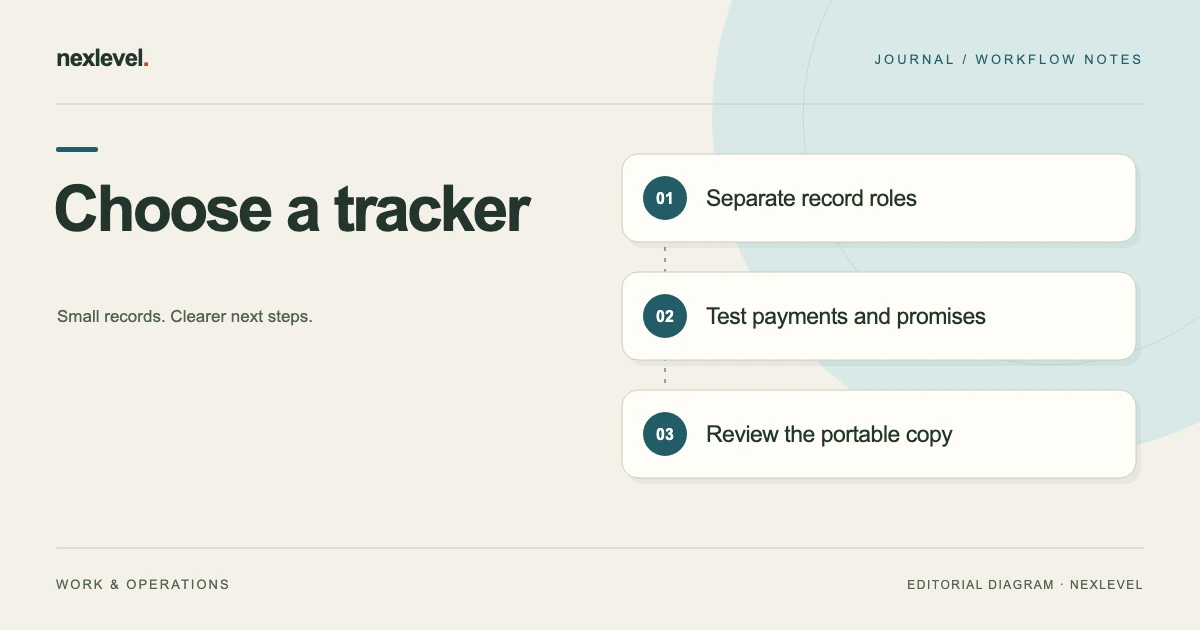
Choose an invoice follow-up method by following the same invoice, payment events, promise and unsent draft in each option. Check whether another person can reconstruct the balance and next action from a retained copy. Include manual formulas, source access and plan limits in the comparison.
Test the same invoice events in each option
- Define the invoice, payment, promise, draft and next-action records you need.
- Use the same fictional case in paper, a spreadsheet and the app being considered.
- Add a second payment and test whether the current total and unsent draft stay clear.
- Inspect the actual export, access conditions and maintenance before choosing.
Working fields:
Method | Payment/promise distinction | Balance basis | Draft state | Next action | Export/access | Manual maintenance | Open question
Useful next steps: Define the underlying tracker fields, Test partial payments and duplicate sources, Check the selected CSV output.
Define the task the tracker must support
A solo professional preparing the next message may value quick retrieval of the last action. Another reviewer may need a dated portable copy or a clear outstanding balance. List the actual requirements in priority order before comparing appearance or subscription tiers.
Keep invoice identity, client identity, source amount, currency, relevant dates, payment events, promise context, and message history distinguishable. A tool that stores all those words in one note may still require a disciplined convention to make their roles readable.
Use fictional records during evaluation. There is no need to distribute actual client billing history across several candidate systems merely to compare row layouts. The same test case makes differences in retrieval and maintenance easier to assess.
Use one comparison worksheet
For each candidate, write demonstrated behavior, manual convention, actual limitation, and next question. A maintained spreadsheet formula is a dependency, not a universal feature of every sheet. A note that a function was not tested is more useful than an invented score.
| Task | What to demonstrate |
|---|---|
| Identify | Retrieve the intended invoice and client |
| Record | Separate payments from promises and notes |
| Calculate | Explain the outstanding amount from stated inputs |
| Prepare | Review a message before any external action |
| Continue | Find the next step and previous source |
| Export | Understand the scope of the intended portable copy |
The worksheet is independent. It does not claim that every candidate has these as named screens or that choosing a tool authorizes communication with a client.
Set up a fictional invoice case
Imagine invoice I23 for client C8, with an entered amount of 1,000 fictional currency units. A source-established partial payment P1 is 250. Under these simplified assumptions, the outstanding amount is 750. There are no taxes, fees, credits, currency conversions, or disputed adjustments in this exercise.
A separate note records a promise about a future payment. That note is not another received payment and does not reduce the stated outstanding amount. The tool should let the reviewer distinguish the promise from P1 without remembering the original conversation.
A draft follow-up message M2 has been prepared but not sent. The evaluation asks whether the selected arrangement preserves that role. A saved draft should not be described as a delivered message, and a follow-up reminder should not be mistaken for evidence that the client was contacted.
Test a paper follow-up log
A paper log can use a separate invoice heading, event rows, and an action column. Demonstrate how the reader finds I23, identifies P1, calculates the remaining amount, and sees that M2 is a draft. The convention needs to remain understandable when another person reads it later.
Check what happens after a correction. If a summary line says 1,000 outstanding while the event rows correctly show P1, decide which layer needs repair. Do not erase a valid payment event merely to make it match an older cover total.
Also inspect a retained photo or scan of the page. A cropped image can omit invoice identity or currency. The readable original does not prove every copy carries the same context. Record that actual output limitation in the comparison.
Test the spreadsheet’s row model
Decide whether a row represents an invoice, payment, promise, or message event. Mixing those roles can make filters and totals difficult to interpret. A repeated invoice reference may be a valid event relationship rather than a duplicate invoice to delete.
For the fictional case, demonstrate that only the 250 received payment reduces the 1,000 starting amount. A promise row and the draft M2 should not reduce it again. Inspect the actual formulas or manual convention rather than assuming the displayed result proves the model is correct.
Test retrieval after sorting or filtering. The selected invoice, currency, source occasion, and next action should remain attached to the relevant rows. A workbook can be useful while still depending on someone maintaining references and preserving the meaning of copied summaries.
Test PaidCue against its current description
PaidCue’s current listing describes a queue organized by overdue age, payment promises, and the next follow-up step. It supports partial and full payments, concise follow-up history, reports, and CSV portability. These are product capabilities to evaluate against the selected task, not proof that a particular invoice is correct.
The app can prepare stage-shaped message text, but the user reviews it before copying or sharing. PaidCue never contacts a client automatically. Preserve that boundary in the comparison: message preparation and external delivery are different results.
The current promise workflow pauses the normal sequence and resumes after the promise date. That is an organizational behavior, not verification that the promise will be fulfilled. Inspect the entered context and actual source rather than treating a paused queue as evidence of payment.
Repeat the test after another partial payment
In a separate continuation of the fictional case, a second source-established payment P2 is 250. The simplified outstanding amount becomes 500. Keep P1 and P2 distinguishable rather than replacing the first payment with an unexplained cumulative note.
Now ask each candidate to identify which event changed the amount and which note remains a promise. Correct arithmetic alone is insufficient if the reader cannot find the source relationship. The worksheet should record both the calculation and its traceable input roles.
Use the partial-payment record guide for that narrower task. This comparison supplies no payment-processing instruction or conclusion about a real invoice’s enforceability.
Compare next-action and reminder behavior
A next action can be an entered administrative plan. A notification can prompt its review. Neither establishes that a message was sent or that a payment was received. Make the comparison question specific: can the reader tell what still needs a deliberate action?
PaidCue currently describes optional local warnings for follow-ups and promises. Its listing says full payment, archive, or deletion cancels the warning. Check the actual selected record and supported behavior rather than assuming another candidate implements the same lifecycle.
Do not recommend arbitrary follow-up frequency or increasingly forceful wording from an aging label alone. Actual source accuracy, terms, tone, and relevant requirements remain outside this organizational test. A calm queue should make the next review clearer without inventing authority to contact someone.
Inspect the actual plan and portable copy
PaidCue Free currently supports up to three active invoices, with existing CSV and PDF exports carrying the PaidCue Free footer available without ads. An optional completed video can unlock a clean PDF for selected frozen report content; a changed invoice or new report date needs new access. Pro adds unlimited active invoices, complete follow-up sequences, and clean CSV and PDF exports without videos. Identify the actual access used in the comparison.
Open the intended output and inspect I23, C8, currency, the payment events, and the source limitations needed by the recipient. A static CSV is not a live shared workspace or the whole editable app. The public description does not establish arbitrary spreadsheet import or a multiuser cloud service.
For paper and spreadsheets, perform the same output test. The comparison should explain which fields and manual notes travel, which remain elsewhere, and how a later correction will be identified. A plausible file name does not prove a useful handoff.
Make a conditional choice
Paper may fit a small, consistently maintained log when identity and retrieval are clear. A spreadsheet may fit an explicit row model and maintained calculations. PaidCue may fit when its invoice, promise, history, and message-preparation structure matches the demonstrated needs.
Write the decision with its assumptions: selected record scope, actual plan, manual conventions, output need, and remaining limitation. More features are useful when they support the task. An untested export or ambiguous event model should remain an open question rather than a marketing conclusion.
For another person continuing the work, use the invoice follow-up handoff guide. Tool selection alone does not establish responsibility or prevent duplicate communications.
Compare the same correction across all three candidates
Add one deliberate fictional cover-summary error to the exercise: the summary says 750 outstanding even after both P1 and P2 have been established. The event sources still show the original 1,000 and two payments of 250. The correct simplified remaining amount is 500.
For paper, ask where the current amount is stated and how the reader knows which figure was corrected. The goal is an understandable record convention. It is not to erase the first payment or rewrite the original invoice so that the old summary appears correct.
For the spreadsheet, inspect whether the displayed summary depends on the intended event rows. A manually typed cover amount can become stale while a maintained calculation remains right. Record that actual dependency rather than declaring all spreadsheets unreliable because one independent cell was wrong.
For PaidCue, evaluate the actual supported payment and history workflow on the selected record. Its advertised payment functions are a capability source. Do not assume an app total independently verifies external receipts or automatically reconciles a bank account, which the product does not advertise.
Next, keep M2 as a draft while correcting its stated amount through the intended preparation process. A revised draft remains unsent. The evaluation should reveal whether the selected arrangement helps the user review accuracy before choosing any external communication.
Keep the promise note in view too. A received payment and a promise can both be relevant without having the same effect on the outstanding amount. If a candidate makes the distinction depend on a private color code, test whether another reader can explain it without the original writer.
Now inspect a copy prepared before P2. Its 750 amount may accurately represent that earlier cutoff. Do not describe every different total as an error until the source periods match. The comparison should distinguish a stale current summary from an intentionally retained historical snapshot.
Give each candidate a short result statement: which record roles were clear, which manual convention was required, which output was inspected, and which question remained. Avoid a point score that hides why a method succeeded or failed the selected task.
This exercise can support a conditional choice without predicting collection speed or client behavior. A method that makes I23, P1, P2, the promise, and M2 readable has demonstrated a narrow organizational fit. It has not established that the original invoice is valid or that the remaining amount will be paid.
Retain the comparison worksheet with its fictional scope. It can be reused as an evaluation method by substituting an authorized real record later, while the invented amounts and events should never be imported as actual client history. The reusable part is the test, not the fictional transaction.
Use PaidCue for a readable follow-up history
PaidCue organizes local invoice records, payment promises, deliberate message preparation, and follow-up history without a separate app account. Check the official PaidCue App Store listing for current capabilities and plan details.
The useful comparison result is a method that preserves I23, P1, P2, M2, and the next source question without confusing their roles. It is not a claim of faster collection, guaranteed payment, or professional validation of the entered invoice.