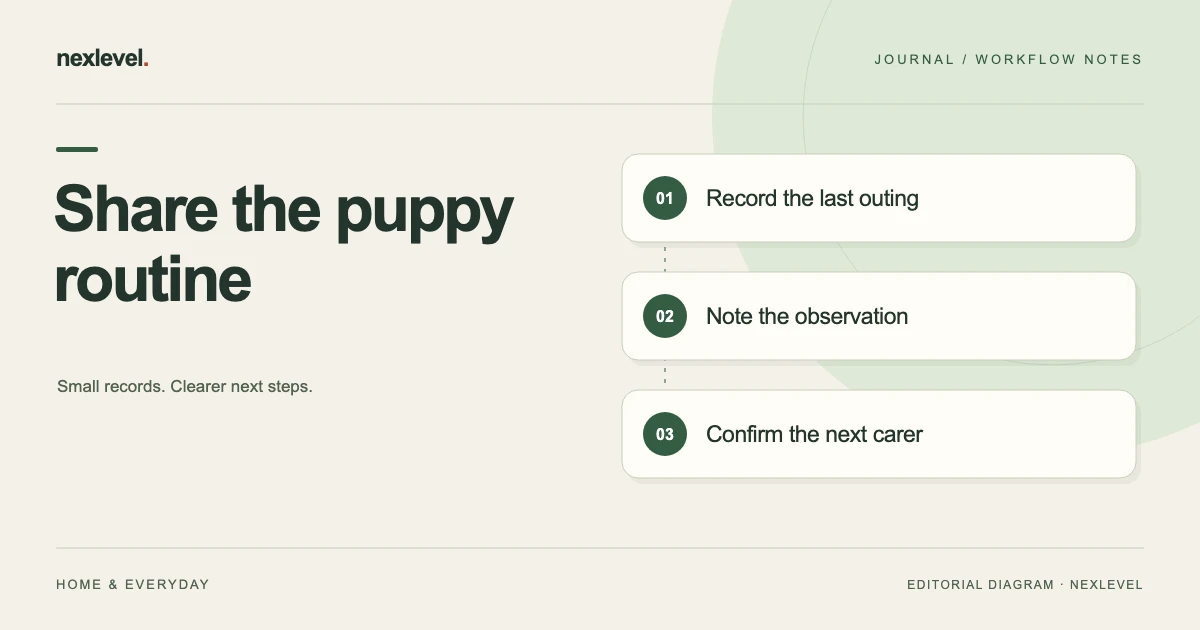
A puppy potty handoff log should tell the next caregiver what was recorded, what remains uncertain, and who owns the next agreed action. A message saying “all done” can leave the receiver unsure whether an outing happened, whether there was a result, or whether somebody else is already taking over.
This template organizes household events and a clear handoff. It includes a fictional day without prescribing training intervals, withholding water, treatment, or a veterinary assessment. A likely-time cue is a planning aid rather than a guarantee about a puppy’s next event.
Identify the puppy and the current care arrangement
Use a readable puppy reference and confirm which caregivers are part of the current routine. Several people seeing the same record does not establish who is responsible for the next action.
Keep the actual care plan separate from the event history. The log describes what happened; the plan records the agreed future actions through the household’s appropriate guidance.
Record meaningful changes in responsibility. A temporary helper should know the relevant current information without receiving an unnecessary archive of private household details.
If a concern requires a veterinarian or qualified professional, use that route. The record can preserve observations and questions without providing a diagnosis.
Copy this potty handoff template
Use a simple event timeline and a short current handoff note. These fields can support a manual worksheet or a suitable shared workflow.
- Identity: puppy, date, and active caregiver arrangement.
- Event: actual time, event type, recorder, and whether any detail is approximate.
- Outing result: pee, poop, both, no result, or another faithfully recorded state.
- Other context: recorded food, water, sleep, wake, or relevant event without invented precision.
- Correction: duplicate or mistaken entry and the actual change made.
- Current handoff: latest meaningful event, uncertainty, and next agreed action.
- Ownership: person responsible and the receiving acknowledgment.
- Shared state: which record is current and whether updates are confirmed available.
Do not treat an empty row as proof that nothing happened. It can also mean an event was not logged or the shared view has not updated.
Distinguish an outing from its result
An outing happened even if there was no recorded result. Keep the trip and its outcome interpretable rather than using one ambiguous success marker.
Record the event type that matches what was actually observed. A guess made later to complete the chart can distort the history used by the next caregiver.
Use neutral language. A factual record of an accident or no-result outing is more useful for a handoff than a judgment about the puppy or the person who was present.
The log should not infer a training conclusion from one event. Its immediate purpose is to give the next caregiver accurate context.
A fictional two-caregiver handoff
Imagine Casey records an outing with no result, then later records a separate observed event. The two entries keep their own times and types rather than turning the earlier outing into a result after the fact.
Jordan takes over later and reviews the latest meaningful entries. Casey states the next agreed household action and confirms that Jordan is now responsible. A general message to several people is not used as a substitute for that handoff.
One event’s time is approximate, so the handoff preserves the uncertainty. Jordan does not treat a precise-looking app window as proof that the next event will occur at an exact minute.
The example gives no recommended frequency or training method. It shows how event identity, uncertainty, and clear ownership prevent the record from becoming a guessing game.
Record other routine events without making causal claims
Food, water, sleep, and wake entries can provide context. Keep their actual recorded times and types rather than adding them automatically because the daily pattern usually includes them.
Do not assume every earlier event caused a later one. A timeline can show sequence without establishing a complete explanation of behavior.
Keep estimates honest. If an amount or time was not measured, do not invent precision merely to improve a chart. Use the supported note or handoff process to preserve the limit.
Actual care decisions belong to the appropriate plan and professional guidance. This guide does not recommend changing food, water, or health care from a logged pattern.
Treat a likely-time window as a cue
A range can communicate uncertainty more honestly than one exact prediction. It still depends on the available entered history and the tool’s method.
Keep the explanation visible where the app provides one. A wider range after fewer relevant logs should not be mistaken for a hidden guarantee or a personal failure.
Do not delay an appropriate response merely because a displayed cue points later. The actual situation and care guidance matter more than a forecast label.
Use the cue to support attention and coordination, not to claim that a puppy has a perfectly predictable schedule.
Correct mistakes before they affect the handoff
A duplicate tap, wrong event type, or mistaken time can change the recent history. Use the supported correction or undo process and check the resulting record.
Keep a corrected entry distinct from a new event. Fixing a typo should not create the appearance that another outing occurred.
If a shared record was already used by another caregiver, communicate a meaningful correction through the agreed route. Do not assume every person noticed the changed row.
When the actual event cannot be reconstructed, preserve the uncertainty. A truthful gap is better than a fabricated sequence that looks complete.
Keep offline work and shared availability distinct
A local entry can be saved while another device has not received it. The receiving caregiver needs a way to confirm the current state rather than assume every view is instantly identical.
When optional sharing is used, check the supported synchronization state and latest entries. A pending update is not the same as a lost event, and repeatedly re-entering it can create duplicates.
Keep a practical direct handoff when connectivity is unavailable. A concise statement of the latest event and next owner can support coordination while the digital view catches up.
Sharing should remain deliberate. The core local record and a family-sharing feature can serve different needs and may have different access requirements.
Use one owner for the next action
State who is taking over and what they have agreed to do. A household group chat can provide awareness while still leaving responsibility ambiguous.
Ask the receiver to confirm the current event context and next action. This is a short understanding check, not a demand to repeat the whole day.
If the arrangement changes, record the actual new owner. An old calendar label should not be treated as confirmation that a person remains available.
Our pet-care handoff checklist provides a broader structure for responsibilities, event history, and open questions. The puppy log focuses more narrowly on the routine timeline.
Review patterns without rewriting history
Use summaries to identify questions worth reviewing, such as missing entries, inconsistent time labels, or a handoff that repeatedly lacks an owner.
A small set of logged events is not a clinical or statistical guarantee. Keep the recording method and gaps in mind before interpreting a trend.
Do not delete inconvenient events simply to make a success chart look better. A useful history preserves what was observed and what remains uncertain.
If another caregiver uses different event labels, agree on their meaning. Consistent vocabulary improves the handoff more than adding another unstructured note field.
Make a temporary-helper packet
Provide the relevant puppy identity, current care instructions through their actual source, latest meaningful events, contact route, and next responsibility.
Keep the packet scoped. The helper needs enough information for the task without automatically receiving every household record or private photo.
Explain how to record an event and how to report uncertainty. A helper should not have to guess which label means an outing with no result.
Confirm the receiving person’s access and understanding before relying on a shared view. A link or invitation sent is not proof that the helper can use it.
Export an honest timeline
Check dates, times, event labels, corrections, and puppy identity in a sample export. The record should remain understandable outside the original app.
If you share it with a qualified professional, describe how the events were entered and any gaps. A manually maintained timeline should not look like continuous monitoring.
Keep a private archive and deliberate sharing destination. The relevant summary may be much smaller than the full household history.
Know what the supported recovery and deletion controls preserve or remove. A portable table and a complete working record can serve different purposes.
Resolve two entries that might describe one event
Two caregivers can record similar events around the same time. Do not assume they are duplicates from the timestamps alone. They may describe the same observed event, two distinct outings, or an approximate time entered after the fact.
Check the people who recorded them and the available context through the household’s agreed process. If the same event was entered twice, correct the duplicate using the supported workflow. If two events actually occurred, preserve both.
Keep an unresolved case visibly uncertain rather than choosing whichever version makes the timeline look smoother. The next caregiver benefits more from an honest limit than an apparently exact but invented sequence.
After correction, review the current shared view and handoff. A person who already relied on the earlier record may need a concise update. Do not assume that a changed row was noticed instantly on every device.
Use a six-prompt receiving note
A practical handoff can answer six prompts: which puppy, latest relevant event, actual result, important uncertainty, next agreed action, and person taking over. Keep the note short enough to use during a normal change of caregiver.
The receiving person can state the next action in their own words. This checks understanding without asking them to recite the complete history. A generic acknowledgment of a group message can leave responsibility unresolved.
Explain what is known locally and what is waiting to appear in a shared view. A saved local record should not be re-entered automatically just because another device has not received it yet.
At the next review, ask whether the note prevented a specific confusion: a duplicate outing entry, a missing result, or an unassigned task. Improve that part of the handoff rather than adding more unrelated fields. The worksheet supports coordination; it does not prescribe a training method, calculate a guaranteed interval, or replace appropriate professional care.
A fictional receiving note could say: “The latest outing is recorded as no result. The later observed event has its own entry. One time remains approximate. Jordan is taking over the next agreed household task and will check the current record before adding another event.” This is a communication example, not a training timetable.
Keep three states distinguishable during that review: an observed event, an outing with no observed result, and a period with no record. They should not collapse into the same assumption. A short handoff that preserves those differences can be more useful than a longer summary that sounds certain about an incomplete day.
Use PupRelay for the household event trail
PupRelay records potty outcomes, no-result trips, accidents, and other daily events, with confirmations and correction tools. Its official listing describes an explainable likely-time range, widgets, Watch access, exports, and optional Pro private iCloud family sharing.
View PupRelay on the App Store for current features and access. Use it to keep the event trail and handoff clear without treating a cue as a veterinary assessment or a guaranteed timetable.
Sources and example scope
App features were checked against the official PupRelay listing and product page. Casey, Jordan, and their events are fictional. No training interval, dietary change, medical conclusion, or guaranteed behavior outcome is supplied.