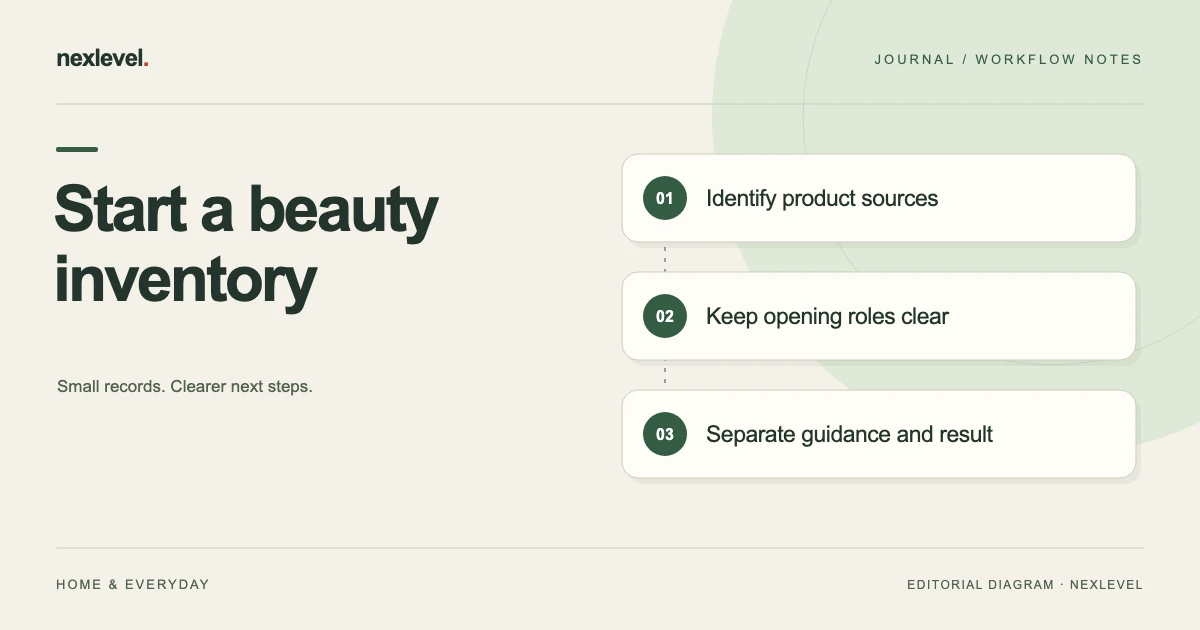
Start a beauty inventory by identifying the physical product and separating purchase information from evidence of when it was opened. Record actual label guidance and any uncertainty. A review date organizes attention; it does not establish expiry or suitability.
Identify the item before assigning an opening date
- Match the product to a reliable identity source and distinguish similar copies.
- Keep the receipt or purchase note in its own role.
- Record the opening-date basis without substituting the purchase date for missing evidence.
- Add label guidance, a review purpose and the next question only where the sources support them.
Working fields:
Product | Identity source | Purchase context | Opening basis | Label guidance | Review purpose | Unresolved detail
Useful next steps: Use the fuller inventory template, Distinguish look-alike containers, Set up use and amount records separately.
Choose the initial recording task
Write a bounded purpose: “Prepare the selected product’s inventory context from the supplied identity and opening sources.” Identify the product, source occasion, intended record use, and next review task.
A useful starting record does not need invented certainty about every date. It needs a clear account of what is supplied, what is reported, and what relationship remains unprovided.
Do not infer identity from a familiar brand alone. Similar products or separate copies can have different source occasions.
Use the advertised product roles
Panmoire advertises name, brand, category, opened date, period-after-opening guidance, price, remaining amount, and an optional photo. Keep the source behind a selected detail understandable.
A product photograph can support recognition without establishing opening date, condition, or a complete label interpretation. The listing does not advertise automatic photo recognition or source-document extraction to claim here.
The initial task is to organize relevant inputs, not to certify every product fact or generate a use recommendation.
Create a controlled fictional source set
For this exercise, P82 identifies the selected product. R2 is purchase-context material, I3 a product-identification source, O4 an opening-information role, and G5 a label-guidance source.
V6 identifies an organizational review-date role, U7 a later use-log role, and N8 the companion setup note. Another product, Q9, appears only in a look-alike case.
No real cosmetic, ingredient, price, opened date, guidance duration, condition, or safety result is supplied. These labels are companion references, not native field names or an import schema.
Keep purchase and opening occasions separate
R2 can describe purchase context without establishing when the product was opened. O4 needs its own relevant basis if the recording task requires an opening date.
If the actual opening relationship is unprovided, retain that limitation instead of using the receipt date by habit. A familiar purchase month is not evidence that first use happened then.
The public description does not document every incomplete-entry state. This worksheet preserves uncertainty independently rather than claiming the app accepts every missing field.
Distinguish reported information from an observed event
An owner note may report an opening occasion. A contemporaneous source may establish another kind of context. Preserve what the actual supplied material supports instead of silently making every remembered date an observed event.
This is an independent source-reading practice, not a promise of native verification flags or a professional authentication feature.
If later actual material clarifies O4, give it its own reference and occasion before preparing another explanation. Do not make the earlier record appear to contain information that arrived later.
Read period-after-opening guidance at its actual scope
Panmoire advertises recording period-after-opening guidance. The official listing explicitly treats such dates as organizational guidance rather than authoritative expiry or safety verdicts.
Keep the selected label source and its relationship to the product visible. This exercise supplies no duration, date calculation, ingredient interpretation, or universal rule about when a cosmetic is usable.
Follow actual product labels and appropriate professional advice when safety is uncertain. The worksheet does not turn a calendar entry into a medical or product-safety conclusion.
Keep review preferences separate from diagnosis
The app advertises a review calendar for revisiting texture, scent, color, and performance. A calendar prompt represents an organizational task, not a diagnosis or assurance that a product is safe.
If V6 is actually supplied, retain its source and purpose. If it is unprovided, do not invent a review date merely to make the initial shelf look complete.
The guide recommends no inspection method, use interval, or treatment. It prepares context for the actual supported record.
Use a copy-ready initial-inventory worksheet
A practical companion worksheet asks for selected product, identity source, purchase context, opening-information basis, label-guidance source, organizational review purpose, entered remaining-amount role, and optional photo context.
Add actual representation inspected, cutoff, missing relationships, later-source references, next task, and any planned project association.
These prompts are an administrative structure. They are not native required fields, an automated safety validator, or an import-ready template.
Fill the source-clear branch
In the first fictional branch, I3 and the supplied O4/G5 context clearly concern P82. N8 can preserve those roles without asserting a real date or product condition.
V6 remains organizational review context, and U7 remains a later use-log role until actual supported entries exist. No inventory item or use event is created here.
The preparation result can be clear while substantive product decisions remain outside its scope.
Fill a look-alike product branch separately
In another branch, an opening note belongs to Q9 rather than P82. Keep that actual association instead of using it because the brand or container looks familiar.
If the relationship is unknown rather than established as Q9, retain an unprovided source question instead of a proven mismatch. Those conclusions need different next tasks.
For broader duplicate reconciliation, use the beauty inventory association guide. This exercise establishes no native app error.
Keep remaining amount and uses in different roles
Panmoire advertises a remaining-amount record and one-tap use logging. A logged use is not automatically an exact measurement of physical product consumed.
Keep the basis for an actual entered amount clear when preparing a companion explanation. Do not invent automatic weighing, photo measurement, or a native formula for every value-used metric.
This initial setup supplies no quantity or use count. It does not claim a product was finished or a financial saving occurred.
Choose project goals without changing source facts
The listing advertises Project Pan projects with selected products, a target, and finish date. A goal is a planned organizational context, not proof that use or completion occurred.
Keep any actual project association separate from P82’s identity and opening sources. A desired finish date should not rewrite the recorded opening occasion.
For a reusable shelf structure, use the beauty inventory template. Inspect the actual supported workflow rather than invent a goal-completion rule.
Read the use-next queue within its advertised role
Panmoire advertises prioritization shaped by opened context, review date, active projects, and recent use. A queue is an organizational aid, not a recommendation that every listed item is safe or suitable.
Do not reconstruct undocumented weighting or assume a particular source always outranks another. The companion worksheet identifies the relevant inputs, not a native sorting algorithm.
A missing source relationship should remain explicit even when the product appears in a familiar position on a shelf.
Keep entered status separate from physical outcome
The app advertises searching and filtering active, empty, and decluttered products. An entered status describes the local record; it does not independently prove a physical use or disposal event.
If an actual later source establishes a change, give it its own occasion before preparing another explanation. Keep earlier source context accurate rather than silently rewriting history.
For historical copies, use the inventory source archive guide. This exercise changes no status and disposes of no product.
Preserve local work and portable-copy limits
Panmoire advertises on-device collection data without an account. Locally supported inventory work should not introduce a mandatory server or remote-analysis requirement.
CSV export is advertised and listed among Pro capabilities. Inspect actual current access and output rather than promise a universal schema or every attachment in every copy.
A readable CSV is not automatically arbitrary import or complete restoration. This worksheet exports nothing, imports nothing, restores nothing, and deletes no collection data.
State current access accurately
The free experience advertises up to fifteen active products and one Project Pan. Pro expands products and projects and includes deeper insights, widgets, and CSV export.
Monthly, annual, and lifetime options are advertised, with Restore Purchases available. Do not invent a trial, localized price, or unlimited capability not established by the selected source.
A purchase cannot establish a missing opened date, physical condition, or safety conclusion. Keep entitlement separate from the source facts behind the inventory.
Run an initial-record reading test
Give an authorized reader N8 and the fictional references without the original folder context. Ask what identifies P82, what R2 establishes, what O4 needs, and why V6 is organizational.
Then introduce Q9’s opening note and a later actual clarification separately. The reader should preserve product identity and source occasions instead of borrowing the most familiar date.
Record any explanation still needed. A useful result can identify the next source task without recommending use or making a health claim.
Write a bounded setup receipt
A compact fictional note can state: “P82 uses I3 for selected identity context. R2 is purchase material, not automatically opening evidence. O4/G5 retain their supplied source roles. V6 is organizational review context, and U7 is unprovided later use context. No safety or expiry verdict is established.”
Add actual sources or corrections only when available. Preserve accurate product context while repairing a companion explanation that used another item’s date.
The result is an understandable inventory basis. It does not establish product suitability, disposal, a completed project, or a financial outcome.
Fill the source-limited initial note
N8 can identify P82 from I3 while keeping R2 as purchase context. If O4 is unprovided, state that the selected packet lacks the actual opening relationship. Do not replace it with a date copied from the receipt.
Keep G5 as the relevant label-guidance source only when its association is established. V6 can describe an organizational review purpose without asserting a safety deadline.
This note is useful because another reader can identify what needs evidence next. It does not pretend that a fully populated-looking inventory is more accurate than one with an explicit source limitation.
Keep separate product copies separate
Two items can share a brand, category, and appearance while representing different opening occasions. A familiar product name does not establish that one opening note applies to both.
If a companion explanation borrowed Q9’s date, correct that association against the actual source. Do not invent an opening event for P82 or claim the app confused the items.
An optional photograph may help recognition, but the relevant date still needs its own source basis. This is an independent reading practice rather than a native image-matching or batch-authentication feature.
Keep setup clarity separate from a use-next decision
Organizing P82’s sources can be a completed administrative task while an actual use choice remains outside the packet. The queue and review calendar do not supply missing product-safety information.
If later material clarifies an opening occasion, give it its own reference before another explanation is prepared. If only a copied label changed, retain that limited correction instead of describing a new physical event.
A reader should be able to distinguish source clarification, record explanation, planned project activity, and actual use. Keeping those stages clear avoids turning an initial shelf entry into an unsupported recommendation or a claim that a product was consumed, finished, or safe.
Use Panmoire for thoughtful inventory context
Keep the selected product reference and cutoff beside the setup result so another reader can identify exactly which source context was inspected.
Panmoire connects product details, opening and review context, Project Pan goals, use logs, shelf organization, and supported local output.
Check the official Panmoire App Store listing for current capabilities and access. Keep source facts, organizational guidance, entered records, and physical outcomes distinguishable.