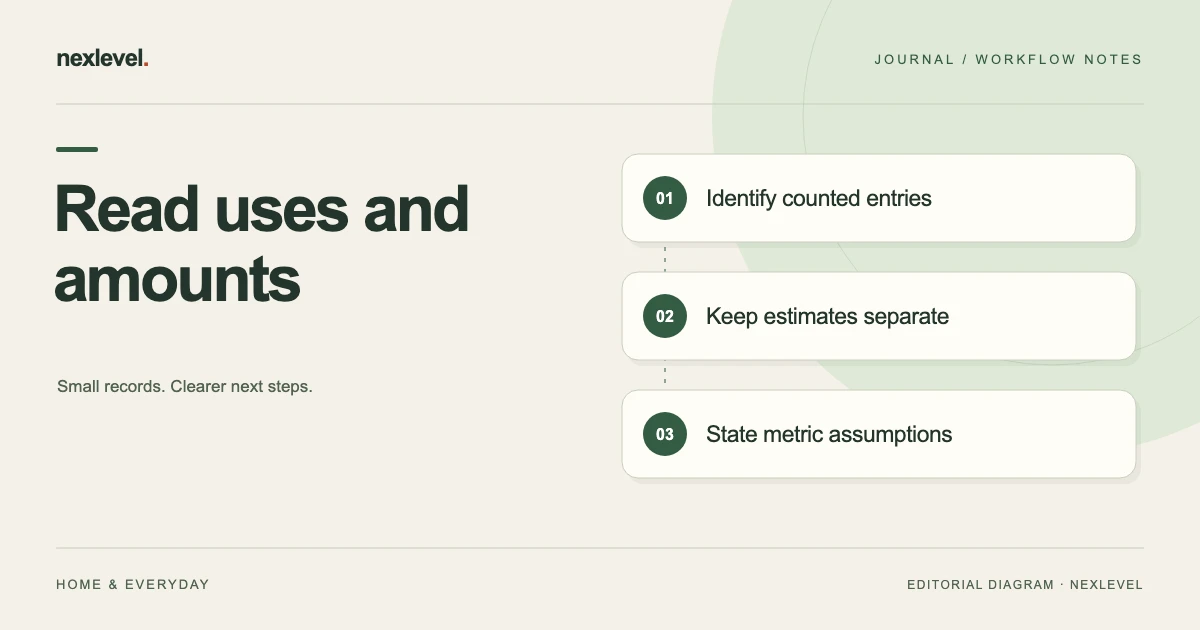
A logged use counts an entered event; a remaining-amount estimate describes a different observation or judgment. Neither automatically establishes the other. Keep the selected entries, estimate source and any cost-per-use denominator visible so a summary does not imply precise consumption.
Keep the count and the amount on separate evidence
- Identify the product, exact use-entry set and count cutoff.
- Record the remaining-amount source and whether its basis is an estimate or measurement.
- Label any independent cost-per-use calculation with its price and counted-entry assumptions.
- Keep goals, status and physical-product conclusions separate from those records.
Working fields:
Product | Counted entries/cutoff | Amount source/basis | Price/model assumptions | Project/status context | Source gap
Useful next steps: Check whether entries belong to separate items, Review the project with a clear period, Hand off goals and recorded events clearly.
Define the record relationship under review
Write a bounded purpose: “Check whether the companion explanation keeps selected use logs separate from the remaining-amount basis.” Identify product context, source occasions, selected entries, amount-reference role, cutoff, and next task.
A clear local record does not automatically prove every physical event. Conversely, an unprovided source in this packet does not prove that no use occurred elsewhere.
Keep the administrative question visible rather than use a tidy chart to imply a product was consumed, finished, or safe.
Use the advertised record roles
Panmoire advertises one-tap use logging, remaining amount, product details, project goals, and insights including uses, empties, declutters, value used, and cost per use.
Those roles are useful when their actual bases remain understandable. The official description does not establish automatic weighing, image measurement, or a formula that converts every logged use into exact physical consumption.
Do not reconstruct an undocumented native algorithm. This worksheet reviews selected source relationships and explicitly independent models.
Create a controlled fictional source set
For this exercise, P74 identifies the product. U2–U5 are four saved-use roles, Q6 is a remaining-amount estimate role, C7 a selected price-source role, and N8 the companion explanation.
The teaching price is 12 in one currency. No real cosmetic, use event, quantity, estimate, price, condition, opened date, or safety result is supplied.
The source labels are independent worksheet references, not native field names, a measurement system, or an import schema.
Keep the counted record set explicit
The fictional count of four comes from the selected U2–U5 roles. It does not establish the quantity used on any occasion or the product’s total lifetime use.
A reader should be able to identify which records were counted and the cutoff they represent. A familiar product title should not silently include another item’s entries.
If the record association is unprovided, retain that exact source question rather than complete the count with an assumption.
Read the amount estimate at its own basis
Q6 represents a selected estimate role, not an automatic consequence of four logs. Preserve what actual source supports it when a relevant source is supplied.
An estimate may be useful organizational context while still differing from a measured physical amount. The public description does not document every native quantity unit or input method.
This example supplies no remaining value and recommends no way to inspect or measure a cosmetic. It gives no product-use or safety advice.
Use a limited independent cost-per-use model
For teaching only, divide the selected price of 12 by the four selected use roles. The independent result is 3 per counted use under that model.
The example excludes all other cost adjustments and supplies no actual charge or financial gain. It is not a claim about Panmoire’s exact native metric formula.
A derived amount does not establish physical contents, product quality, suitability, or savings. Keep the selected denominator beside the result.
Compare a different count without inventing consumption
In a separate illustrative source set, five selected use roles would give 12 divided by 5, or 2.40 per counted use. That difference follows from the model’s denominator.
It does not establish that the container has a particular amount remaining. Nor does it prove that either record set is correct for a real product.
Keep the alternative count source separate rather than merge both results into one story. The exercise performs no native edit or use logging.
Use a copy-ready use/amount worksheet
A practical companion worksheet asks for product identity, selected use-entry references, count cutoff, remaining-amount source, estimate or measurement basis when actually supplied, price role, and independent metric assumptions.
Add project/status context, representation inspected, missing associations, correction source, next task, and any later source occasion.
These prompts are an administrative structure, not native required fields, an automated physical-consumption checker, or an import-ready format.
Fill the source-clear branch
In the first fictional branch, U2–U5 clearly belong to P74 and Q6 retains its own estimate role. N8 can preserve those relationships without making the count into a quantity measurement.
The price-based calculation can be described under its explicit teaching assumptions. It should not become a claim that the product paid for itself or that an actual financial result occurred.
The task can finish with a bounded record explanation while physical product decisions remain outside its scope.
Fill an association-gap branch separately
In another branch, one supplied use note has an unprovided product relationship. The review cannot safely include it in P74’s count merely because the brand looks familiar.
Retain the missing association rather than call it a proven duplicate or native mistake. Different conclusions require different source evidence.
For broader reconciliation, use the inventory association guide. This exercise establishes no application defect.
Keep opening and review context separate
Panmoire advertises opened dates, period-after-opening guidance, and review dates. None of those roles is an exact physical-remaining measurement derived from a use count.
The official listing treats period-after-opening dates as organizational guidance, not authoritative expiry or safety verdicts. Follow actual product labels and appropriate professional advice when safety is uncertain.
For initial source setup, use the product and opening-source guide. This article supplies no duration or medical interpretation.
Read project goals as goals
The app advertises Project Pan projects with selected products, a target, and finish date. A planned goal does not establish an actual use, remaining quantity, or completed product.
Keep the goal’s actual source context separate from the selected use-entry set. Do not change a physical estimate merely to make a project look on track.
The worksheet supplies no native goal algorithm, recommended use schedule, or promise that a particular target is suitable for a real product.
Keep entered statuses at their actual level
Panmoire advertises active, empty, and decluttered product views. An entered status describes a local record, not an independently verified physical disposal or completion event.
If a relevant actual source establishes another stage, give it its own occasion. Do not make an older explanation appear to contain later information automatically.
For retention, use the inventory source archive guide. This exercise changes no status and disposes of no product.
Read the use-next queue without inventing safety meaning
The listing advertises prioritization shaped by opening/review context, active projects, and recent use. A queue is an organizational aid, not a recommendation that every listed product is safe or appropriate.
Do not infer an undocumented weighting rule or exact physical quantity from a familiar position in the queue. Preserve the source roles behind the selected explanation.
A missing association remains a question even when the product appears in an attractive dashboard.
Preserve local work and portable-copy limits
Panmoire advertises on-device collection data without an account. Locally supported logging and review should not acquire a new mandatory server or remote-analysis requirement.
CSV export is advertised and listed among Pro capabilities. Inspect actual current access and representation rather than promise every attachment or editable relationship in each output.
A readable CSV is not automatically arbitrary import or complete restoration. The exercise exports nothing, imports nothing, restores nothing, and deletes no collection data.
State current access accurately
The advertised free experience includes up to fifteen active products and one Project Pan. Pro expands products and projects and includes deeper insights, widgets, and CSV export.
Monthly, annual, and lifetime options are advertised, with Restore Purchases available. Do not invent an introductory trial or localized price.
A purchase cannot establish a physical amount, safety conclusion, or missing use association. Keep entitlement separate from evidence and actual product decisions.
Run a use/amount reading test
Give an authorized reader N8 and the fictional references without the original folder context. Ask which entries make the count of four, what Q6 represents, and why 3 is a limited cost-per-counted-use model.
Then introduce the five-entry alternative and an unassociated note separately. The reader should preserve the selected denominator and product relationship rather than infer contents from a chart.
Record any explanation still needed. A useful result identifies the next source task without recommending use or claiming a physical outcome.
Write a bounded review receipt
A compact fictional note can state: “P74 uses selected U2–U5 count roles. Q6 is a separate amount-estimate role. The independent 12/4 model gives 3 per counted use; the alternative 12/5 gives 2.40. Neither establishes physical contents, safety, a native formula, or actual savings.”
Add actual sources and corrections only when they exist, with their own occasions. Preserve accurate records while repairing an explanation that treated a count as a measurement.
The result is a clearer administrative interpretation. It certifies no product, completed project, use event, or financial outcome.
Fill the use-count and amount note
N8 can identify P74 and the exact selected use-entry roles before showing a count. Keep Q6 beside its own estimate basis rather than present it as the inevitable result of those entries.
If the amount source is unprovided, retain that limitation. It does not mean the product contains nothing or that no estimate exists elsewhere; it describes the material available for this review.
The independent price calculation can remain a teaching model while physical contents and safety stay outside the supplied evidence. A familiar chart should not fill those gaps.
Keep denominator changes within their source branch
The four-entry and five-entry examples are alternative controlled record sets. They should not be combined into one conclusion about a real product’s use history.
If an actual later source clarifies which entries belong to the selected context, give that source its own occasion. Do not infer physical consumption merely because a derived cost figure changes.
Likewise, a corrected companion count does not itself create or remove a native use event. The worksheet claims no undocumented editing mechanism or immutable audit history.
Keep the result separate from a use recommendation
A clearer explanation of count, estimate, and metric roles does not establish that the product should be used, discarded, or kept. Those questions require their actual relevant sources and appropriate review.
If an opened-date or guidance relationship is missing, name that specific gap rather than derive a safety answer from recent activity. A logged use is not a product-condition assessment.
A later reader should be able to identify which entries were counted, what the amount estimate represents, which model was calculated, and which conclusions remain unprovided. This makes the administrative reasoning reproducible without treating a queue, project goal, status, or attractive dashboard as proof of a physical or financial outcome.
The exercise performs no actual use, measurement, record correction, or disposal and promises no particular native calculation.
Use Panmoire for distinct record roles
Retain the selected product, counted-entry set, amount-source role, and cutoff beside the conclusion. This lets another reader distinguish the administrative model from a new use event, a physical measurement, or a product-condition assessment.
Panmoire connects product details, opening/review context, Project Pan goals, use logs, remaining-amount records, and supported local output.
Check the official Panmoire App Store listing for current capabilities and access. Keep source entries, estimates, derived metrics, organizational guidance, and physical outcomes distinguishable.