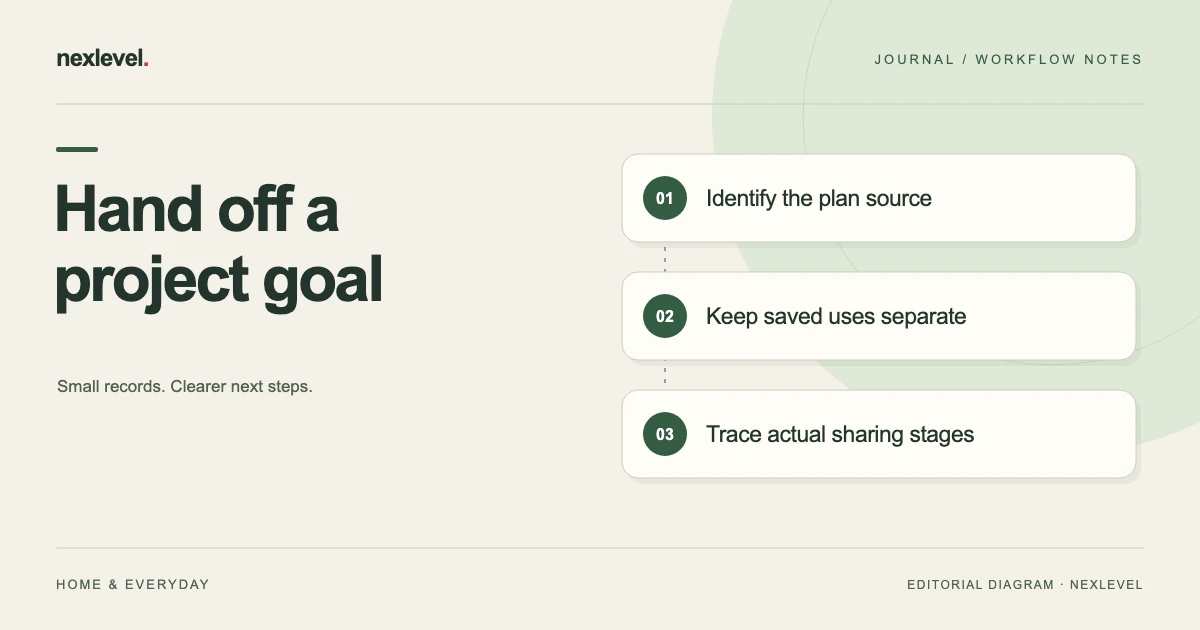
A Project Pan handoff should identify the selected product and project, the goal and the separate evidence for any recorded use. A finish date or target does not establish completion. Include estimate and status sources only within what the packet actually supports.
Tell the next reader what is planned and what is recorded
- Define the product/project scope, recipient task and source cutoff.
- Put goal and planned finish context in a separate lane from saved uses.
- Identify the source of amount estimates and collection status.
- State missing associations, the next source task and the actual sharing stage.
Working fields:
Product/project | Goal/date source | Saved-use source | Amount/status basis | Copy/cutoff | Next question | Sharing stage
Useful next steps: Distinguish use counts and amount estimates, Check product and opening-date sources, Retain a historical project packet.
Define the selected handoff task
Write a bounded purpose: “Explain the selected product/project context and which use evidence is actually supplied.” Identify product, project, source occasions, intended authorized reader, cutoff, and next task.
A handoff for understanding a goal is narrower than advising somebody what to use next. Keep the actual reader question visible instead of transferring an unexplained whole collection.
Preparation remains separate from delivery. A packet can be ready without being shared, received, understood, or adopted as somebody else’s plan.
Keep the advertised project role narrow
Panmoire advertises focused projects with selected products, a target, and finish date. Those are organizational roles, not proof of a physical event.
The public description does not establish every target type, progress formula, or export field. Do not invent a specific native goal algorithm for this worksheet.
A clear handoff preserves which actual source establishes the planned context and which separate source establishes a saved use.
Create a controlled fictional handoff
For this exercise, P46 identifies the product, J2 the selected project, G3 an organizational target role, and F4 a planned finish-date role.
U5 identifies a saved-use role if one is actually supplied, Q6 a remaining-amount estimate role, and H7 the companion handoff note. No actual product, date, use, quantity, condition, or target is supplied.
These references demonstrate companion relationships, not native field names, target units, or an import schema.
Read the goal as a plan
G3/F4 describe selected intended activity. They do not establish that U5 exists or that the product’s physical contents changed.
If a companion note calls the goal completed merely because a target was entered, identify that unsupported expansion before choosing any new wording.
The correction need not claim failure either. An unprovided use source in this packet does not prove that no use happened elsewhere.
Keep saved uses at their actual scope
The app advertises one-tap use logging. A saved entry can record an entered occasion without independently measuring how much product was consumed.
Keep U5 tied to its actual product and source occasion. A familiar project label does not establish that another item’s use belongs to P46.
For that distinction, use the use-log and remaining-amount guide. This exercise performs no logging.
Keep amount estimates separate from project progress
Q6 represents a selected amount-estimate role. It should not become the inevitable physical result of entering a target or saving a use.
The official description advertises remaining amount and insights without establishing an automatic weighing or image-measurement system. Do not invent one.
This fictional handoff supplies no quantity, metric formula, or observation of a container. It prepares a bounded explanation of the source roles.
Use a four-lane companion worksheet
| Independent lane | What the next reader needs |
|---|---|
| Plan | Which selected product/project and actual source establish the target and intended finish context? |
| Entered event | Which supplied saved-use source establishes the product association and occasion? |
| Amount or status | What separate source supports an estimate, active/empty/decluttered role, or later change? |
| Communication | Which representation was prepared, what remains unprovided, and what delivery stage actually exists? |
These lanes are a reading aid, not native interface labels or promised CSV columns. Keep their source relationships separate.
Fill the plan-without-use branch
In the first fictional branch, J2/G3/F4 are supplied but U5 is not. H7 can explain the planned context while retaining the missing saved-use relationship.
Do not call the product completed, empty, unused, or unsafe from that absence alone. The packet supports a limited administrative conclusion.
The next task is to identify the relevant source if a use question matters. No real product is handled or recommended here.
Fill a use-supplied branch separately
In another branch, actual material establishes U5 for P46 at a selected occasion. Give it its own reference before updating the companion explanation.
A saved-use relationship still does not establish that every goal is complete or that a particular physical amount remains. Keep Q6 separate.
This illustrates a source-reading pattern, not an observed native result. The exercise creates no use event or project.
Keep similar products and projects distinct
Two items can share a brand or appearance while having different opening occasions and use records. Two projects can contain a familiar product without representing the same target.
If an association is unprovided, retain that question rather than choose the most familiar label. If an actual source establishes another item, preserve that relationship.
For broader reconciliation, use the inventory association guide. This article identifies no application defect.
Keep opening and guidance sources in their own roles
Panmoire advertises opened date, period-after-opening guidance, review context, and optional product photos. A project finish date is not automatically an opening date or authoritative expiry.
The official listing treats period-after-opening dates as organizational guidance, not a safety verdict. Follow actual labels and appropriate professional advice when safety is uncertain.
For setup context, use the product and opening-source guide. No duration or medical interpretation is supplied here.
Read queue position as organizational context
The use-next queue is advertised as shaped by opening/review context, active projects, and recent use. Its position does not independently establish physical completion or product suitability.
Do not reconstruct an undocumented weighting rule or make a favorable queue position substitute for missing source evidence.
The handoff can explain the selected plan and records while leaving actual product decisions outside its scope.
Keep entered status separate from physical outcome
The app advertises active, empty, and decluttered views. An entered status describes a local record and needs its relevant source context in a companion explanation.
Do not infer physical disposal from a project target or declare a container empty because a planned finish date arrived. The example supplies no such event.
If actual later material establishes a different stage, give it its own occasion before preparing another representation.
Choose a supported portable representation
CSV export is advertised and listed among Pro capabilities. Inspect actual current access and output before saying which product, project, use, or estimate relationships another person receives.
A readable file may need H7 to explain a source gap. The description does not establish automatic household synchronization or a particular shared-data backend.
Do not promise arbitrary import or complete restoration. This exercise exports nothing, imports nothing, restores nothing, and deletes no data.
Preserve local work and deliberate sharing
Panmoire advertises on-device collection data without an account. Locally supported review should not acquire a new mandatory server or remote-analysis requirement.
A copy being prepared does not establish recipient receipt. Supply only authorized material needed for the selected task rather than an unrelated whole collection.
The fictional handoff sends no personal inventory, contacts no person, and changes no record.
State current access accurately
The advertised free experience includes up to fifteen active products and one Project Pan. Pro expands products/projects and includes deeper insights, widgets, and CSV export.
Monthly, annual, and lifetime options are advertised, with Restore Purchases available. Do not invent an introductory trial or localized price.
Expanded access cannot establish a missing use, physical amount, safety conclusion, or completed goal. Keep entitlement separate from evidence.
Use a copy-ready handoff receipt
A practical receipt asks for selected product/project, goal and finish-date sources, saved-use relationship, remaining-amount basis, status context, actual representation inspected, and cutoff.
Add unprovided associations, correction source, next task, intended reader, and actual sharing stage. Keep later events at their own occasions.
These prompts are administrative structure, not native required fields, an automated completion validator, or a file promised to import.
Run a goal/use reading test
Give an authorized reviewer H7 and the fictional references without the original folder context. Ask what G3/F4 establish, what U5 would need to establish, and why Q6 remains separate.
Then introduce a similar product and a later use source separately. The reader should preserve identity and occasion instead of treating every familiar target as completed activity.
Record any explanation still needed. A useful handoff can specify the next source task without recommending use or making a health claim.
Write a bounded handoff result
A compact fictional note can state: “P46/J2 uses selected G3/F4 plan context. U5 is a separate saved-use role, and Q6 a separate amount-estimate role. A target is not completion, a date is not a use event, and a local status is not independent physical observation.”
Add actual later sources only when they exist. For retention, use the inventory source archive guide.
The result is an understandable administrative handoff. It establishes no completed product, safety verdict, disposal, savings, or actual communication event.
Fill the goal-limited handoff note
H7 can identify P46/J2 and the actual G3/F4 plan context before discussing progress. If U5 is unprovided, state that the packet lacks the selected saved-use source rather than call the target completed.
Keep Q6 beside its own amount basis. The note should not require a reader to infer physical contents from a planned finish date, project position, or attractive progress display.
A goal-limited packet can be ready for a bounded handoff while a real use or product decision remains outside its scope. The explanation does not need an invented event to be useful.
Distinguish a partial answer from complete evidence
A later source may establish a saved use while leaving amount or status context unprovided. Preserve the answered relationship and the remaining question instead of treating one new entry as proof that every project goal is complete.
Likewise, a source identifying the product does not establish its opening date or suitability. Each actual claim needs the relevant source relationship, not merely a familiar product name.
The handoff can therefore become clearer without making a health, disposal, completion, or financial claim. A record explanation and a physical outcome are different things.
Keep later source occasions separate
If actual later material clarifies U5 or Q6, give it its own reference before preparing another explanation. Do not make an older handoff appear to contain information that arrived after its cutoff.
If only the companion heading called a goal a completed use, correct that explanation. A wording repair is not itself a native use entry or an actual product event.
Keep the selected representation and correction source visible. The public description does not establish an immutable version history for every possible record change.
Make the recipient’s next task specific
Instead of “check the project,” identify whether the next reader needs a use source, amount basis, product association, or actual output-scope answer. These are different tasks even when they concern the same shelf.
An unprovided relationship in this packet does not prove the event never happened or that no other source exists. State the actual coverage limit rather than a universal negative claim.
This keeps the handoff understandable without reconstructing an old conversation, sharing unrelated collection data, inventing household synchronization, or turning an organizational target into advice to use or discard a cosmetic.
Use Panmoire for clear project handoffs
Panmoire connects product details, opening/review context, Project Pan goals, use logs, remaining-amount records, and supported local output.
Check the official Panmoire App Store listing for current capabilities and access. Keep planned goals, entered uses, estimates, shared copies, and physical outcomes distinguishable.