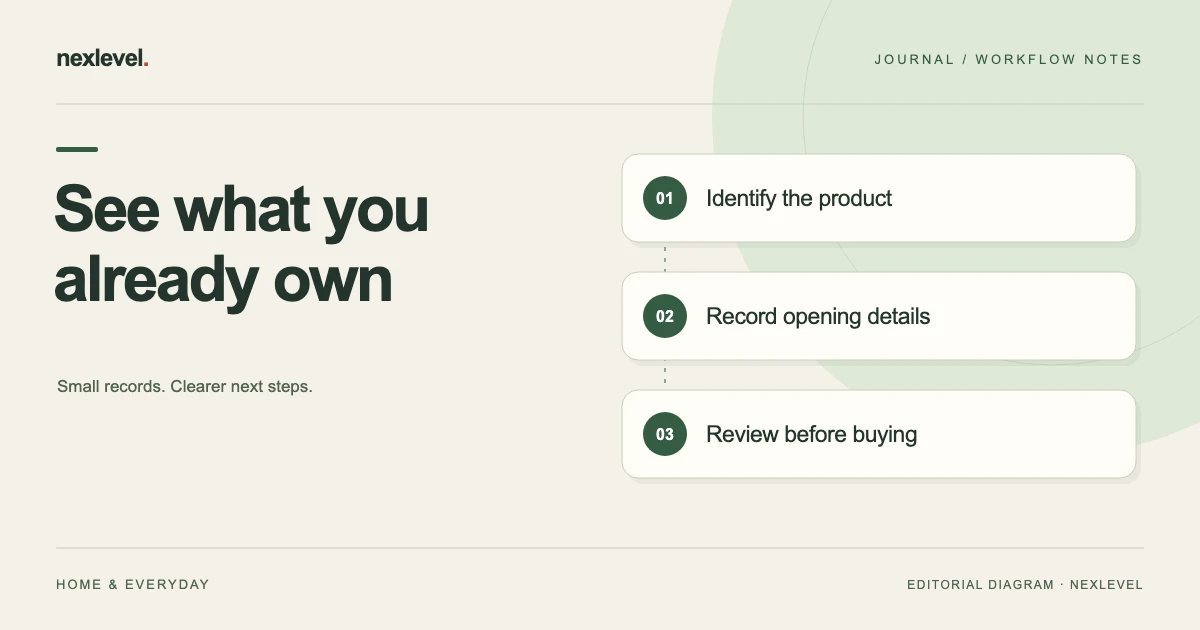
A beauty product inventory should help you find what you own, see what you have opened, and choose a manageable next step. A long shopping list with no use history can make the shelf look organized while doing little to prevent duplicate purchases or forgotten products.
This template creates a practical use-next record with product identity, label information, review dates, and personal use notes. It includes a fictional shelf example and simple cost-per-use arithmetic. It is an organizational method, not an expiry calculator, a product-safety assessment, or a reason to keep using a product when relevant guidance says otherwise.
Start with the shelf you actually use
Choose one area or category first: the daily bag, a drawer, or a small group of products already in rotation. A complete catalog can come later. The first goal is a record that helps with a real decision today.
Give similar products distinct identities. Brand and product name may be insufficient when you have different shades, sizes, or duplicate purchases. Add a readable distinguishing detail rather than relying on a photo alone.
Separate owned products from a wish list. A product you are considering should not appear in active use, spending-to-date, or empty counts as if it had already been purchased.
Record only information you can establish. A partly remembered opened date can be marked approximate. Choosing an exact date simply to satisfy a form makes the record appear more certain than it is.
Copy this beauty inventory template
Use one entry per physical product where separate tracking matters. The fields below are a starting point rather than a requirement to measure every item precisely.
- Identity: name, brand, category, shade or variant, size, and optional photo.
- Purchase: date if known, price, currency, and receipt reference where useful.
- Opening: opened date, whether exact or approximate, and source of the information.
- Label guidance: the actual period-after-opening or other relevant label information, without inventing it.
- Current state: unopened, active, empty, decluttered, or another clearly defined category.
- Use history: recorded uses, notes, and any project association.
- Remaining amount: a labeled estimate or measurement, with its basis.
- Review: personal review date, question to check, and next organizational action.
Keep unknown, not applicable, and zero distinct. An unknown purchase price should not be counted as a free product. An unrecorded use history should not be treated as proof that the item was never used.
Record label information without turning it into a verdict
Copy relevant label guidance faithfully and preserve the product identity it belongs to. Do not apply one item’s information to another merely because they share a category or brand.
Keep the opened date separate from the purchase date. A product can be purchased and remain unopened, or opened before you begin tracking. The inventory should state which event each date describes.
A personal review date is a reminder to reconsider the product’s record and guidance. It is not an authoritative expiry date. If important information is unclear, check the product’s label or appropriate manufacturer guidance rather than deriving certainty from the app’s calendar.
Do not use an inventory goal to override relevant safety instructions or professional advice. The record helps organize information; it cannot assess a product’s condition or suitability from dates, ratings, or a photograph.
A fictional example: three products in rotation
Imagine Riley starts with three products already in use. Product A has an exact opened date from a personal note. Product B has an approximate opened month. Product C was a gift with an unknown purchase price. Each receives a separate entry.
Riley records actual label information where available and creates a personal review question for each item. Product B’s approximate date stays visibly approximate. Product C’s unknown price is excluded from any cost calculation requiring a known amount.
Riley chooses A and B for a small organizational project and records uses during the week. The project does not change their label guidance or make either product automatically appropriate to continue using. It simply focuses the personal queue.
When A is finished, Riley marks it empty and preserves its history. B remains active. C stays outside the project until Riley decides what role it should have. The shelf record reflects actual states rather than treating every owned product as a task to finish.
Build a use-next queue with a reason
Choose a manageable set of active products and record why they are there. You might prioritize an already-open item, a product you want to understand better, or a category where several similar items compete for attention.
Keep the reason visible so the queue does not look like an objective safety or quality ranking. A personal preference, project target, and label-based review question are different forms of information.
Leave room for products outside the queue. The point is to reduce decision clutter, not assign an urgent obligation to every item in a collection. A product can be recorded without being part of the current project.
Revisit the queue when circumstances change. If a product is no longer relevant to the routine, update its state or project association rather than leaving an unrealistic goal active indefinitely.
Log uses consistently enough to interpret them
Define what counts as a use for your personal log. One application event may be enough for your purpose. If you choose a different convention, write it down and keep it consistent within the comparison.
Record the event when practical, but do not invent a precise history later. If the record begins halfway through a product’s life, say that logged uses begin on the tracking date. The number then describes recorded activity, not lifetime consumption.
Keep subjective notes short and attributed to your experience. “I preferred this texture in my current routine” is different from a general product-performance claim. Personal observations need not become public reviews.
Do not infer remaining quantity directly from use count unless you have an appropriate measured basis. Applications can vary. A use log can support reflection without pretending to measure volume.
Calculate cost per recorded use transparently
For a simple personal metric, divide the known recorded purchase price by the recorded use count. A fictional product costing 24 with 12 logged uses gives 24 ÷ 12 = 2 per recorded use.
Label the denominator. If tracking began after earlier uses, this is not the product’s lifetime cost per use. The metric can still be useful if the limitation is clear.
Do not calculate a division by zero for a product with no logged uses. Show that a meaningful ratio is not yet available. Likewise, keep an unknown purchase price out of a precise-looking cost metric.
Use the number as a description of the entered record rather than a judgment about value or a reason to pursue unnecessary use. It does not include every possible acquisition cost or establish how much material was consumed.
Make a small Project Pan plan
Select a limited group and define a personal goal that can be reviewed. It might concern logged uses or a check-in date. Avoid a vague promise to finish an entire drawer with no way to understand progress.
Keep each product’s state and label guidance independent of the project. A finish date is your planning target, not a statement about the product’s safe or useful life.
At review, ask what the record helped you learn. You may decide to continue, pause, replace a goal, or remove an item from the project. Those are legitimate organizational outcomes; completion is not the only useful result.
Preserve the earlier goal when it changes. The history can explain why a project evolved without presenting the new target as though it had been the original plan.
Distinguish empty, decluttered, and inactive
An empty product, a product deliberately removed from the collection, and a temporarily inactive product describe different events. Define the states you use so the archive remains meaningful.
Record a short factual reason where helpful. A declutter decision might reflect personal preference or a change in routine. Do not automatically turn that reason into a general claim about the product.
Preserve useful purchase and use history while keeping inactive items out of the daily queue. An archive should help retrieval rather than make every old product appear to need attention.
If you dispose of or transfer an item, follow the relevant product and local guidance. The inventory can record the outcome without supplying universal disposal or sharing instructions.
Use purchase records to avoid duplicate confusion
When considering a new purchase, check the active and unopened records for similar items. A readable variant and size can prevent a duplicate being mistaken for a replacement.
Keep receipt information connected where it matters, but avoid copying unnecessary account or payment details into the inventory. A private reference to the original document may be sufficient.
Our receipt organization guide provides a general method for identifying purchases and preserving original documents. Apply only the relevant parts to the collection.
If you discover duplicate entries, compare physical identity, purchase information, variant, and use history before merging. Two identical-looking products can be separate items; one product can also have been entered twice.
Keep exports readable and deliberate
Check a sample export outside the original workspace. Product identity, dates, currencies, states, and notes should remain understandable. A list of values without labels loses much of the record’s purpose.
Separate a full private archive from a summary you choose to share. Photos, purchase details, and personal notes may not all belong in a public Project Pan update.
Know what your backup or export contains. A portable table may not preserve every attachment or app relationship. Test retrieval through the supported workflow before assuming the collection can be recovered fully elsewhere.
Use a short periodic review to fix missing identities and stale project states. Improve the fields that affect a decision rather than expanding the template until logging becomes a chore.
Start with a one-week inventory exercise
Choose three products you already use and record only their identity, known opened-date information, actual label guidance, and current state. Photograph them if that helps distinguish variants. Leave uncertain fields marked uncertain instead of trying to reconstruct the whole purchase history on the first day.
For the week, record uses under one consistent personal convention. Add a short note only when it helps the next decision. The exercise should test whether logging is practical, not require a diary entry for every application.
At the end, ask which field you actually used. Product identity may have prevented a duplicate search. A review question may have prompted you to check a label. A use log may have shown that a project target was unrealistic. Keep the fields that supported a useful action.
Then add one improvement before expanding the collection: clarify a variant, verify a price, or remove an inactive item from the queue. Avoid adding many optional fields until the core record works. A small maintained inventory is more helpful than an elaborate spreadsheet abandoned after its first entry.
Preserve the exercise’s start date so later metrics remain interpretable. Twelve logged uses since tracking began are twelve recorded events; they do not rewrite what happened before the log existed.
Use Panmoire for a private use-next shelf
Panmoire organizes product identity, opened dates, label guidance, review dates, use history, and Project Pan goals. Its official listing describes active, empty, and decluttered views, personal cost-per-use insights, and collection export options. Period-after-opening dates remain organizational guidance rather than a safety verdict.
View Panmoire on the App Store for current features and access. Start with a small accurate record, then use it to make the next shelf decision easier.
Sources and example scope
App features were checked against the official Panmoire listing and product page. Riley, the products, price, and use counts are fictional. The guide supplies an original inventory method without product-expiry determinations, medical advice, or safety assurances.