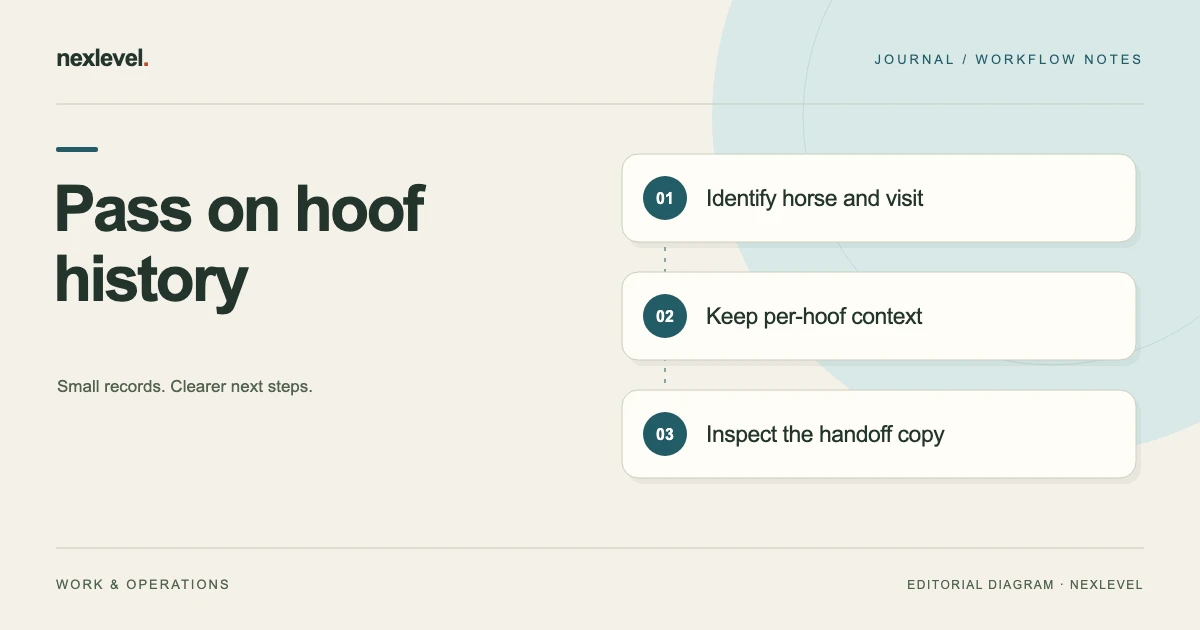
Prepare a new-farrier handoff around the horse's stable identity and selected visit records. Link each hoof-specific statement and photo to its source, keep later notes separate from earlier work, and identify the next professional question without turning the packet into a service prescription.
Give the receiving professional the history and its limits
- Name the horse, selected visits, handoff purpose, recipient and cutoff.
- Open the relevant per-hoof entries and retain their source references.
- Index photos by actual visit occasion and flag uncertain associations.
- Inspect the portable copy and ask the recipient to locate one visit and its open question.
Working fields:
Horse/visit | Date source | Hoof record | Photo occasion | Later context | Open question | Next owner | Cutoff
Useful next steps: Use the farrier visit record template, Retain the handoff history for later retrieval, Check a Watch-origin action before describing it as saved.
Identify the horse and visit
Record the horse reference, relevant owner or yard context, visit identifier, and date source. Similar names can describe different records or occasions.
Keep the physical identity relationship within the actual yard and professional process. A photograph or nickname can help lookup without resolving every identification question.
Use the intended privacy and access arrangement for the packet. The recipient needs the relevant history, not unrelated private records.
State the handoff purpose
Identify whether the reader is reviewing history, preparing for a visit, checking an administrative question, or receiving a deliberate summary.
Keep the outgoing source owner, recipient, and preparation cutoff clear. New information after that point should remain identifiable as later context.
The packet does not establish a technical plan. Use qualified professional judgment and the actual responsible process for the work itself.
Keep hoof-specific records in context
Read the actual per-hoof entries and their visit relationship. A broad full-set or other service summary should not silently replace differing individual records.
Preserve what was recorded as performed versus what was proposed or discussed. The handoff should not make a later plan appear to have occurred at an earlier visit.
This worksheet supplies no technical setting or method. It keeps the source available for a qualified reader.
Use a visit-history worksheet
Useful fields include horse ID, visit ID, date source, per-hoof reference, recorded work, relevant source note, photo context, current question, next event, responsible person, and cutoff.
Keep a readable summary linked to the actual records. A portable sheet should not become a competing history maintained separately without an owner.
Add what was actually checked and what remains uncertain. A completed handoff can retain an explicit source question.
Keep photos with the correct occasion
Record the horse, visit, and role of each selected image. Similar views from separate dates should not be treated as interchangeable evidence.
A photo can show a visible condition under its capture context without establishing every technical conclusion about the horse or work.
Use the actual professional process and appropriate access arrangement for selection and sharing. This article does not interpret images clinically.
Distinguish scheduling from work performed
An entered cycle or next date is a planning record. It is separate from the source event establishing that a visit occurred.
Do not apply a generic interval from this article. The appropriate professional and responsible process determine the plan for the actual horse.
Keep a proposed appointment distinguishable from a confirmed arrangement and from the eventual visit entry.
Walk through a fictional history packet
Imagine horse H24 with completed visit V8 and a later administrative note N9. The packet begins by naming the actual horse and visit references and the source of each date. N9 is later context, not part of V8’s original recorded work.
The preparer opens the per-hoof records rather than relying only on a broad service title. They retain the actual descriptions and relevant source references. If one field is unclear, the summary identifies that question instead of substituting a familiar preset or assumed standard entry.
The next professional can locate the source record for each consequential statement. The packet does not tell them what treatment or adjustment to choose. It gives an administrative route to what the earlier history actually contains.
A selected image is indexed by horse, visit, and role. If its occasion cannot be established, preserve that limitation. A clear image from another visit is not automatically a substitute for missing context at V8.
The preparation receipt says what was checked, which source remains open, and how the recipient can access the relevant material. A packet can be useful without claiming every technical fact or every event in the horse’s history was independently validated.
Check an ambiguous per-hoof summary
A second fictional packet has a broad description that appears inconsistent with one individual entry. The reviewer records the two source statements and their locations before deciding what they mean.
The apparent conflict may concern a different visit, a shortened summary, or a real source error. Keep these as questions until the actual history and responsible professional process establish the relationship.
Do not rewrite the older per-hoof entry merely to make the summary look consistent. Use the tool’s actual supported correction method and retain the explanation required by the professional’s records process.
If clarification establishes a current interpretation, record its source and cutoff. Keep the original event distinguishable from the later explanation. The recipient should be able to understand why the current summary uses its wording.
The result is an administrative clarification, not a clinical or technical recommendation. The handoff should preserve that role when shared with an owner or another professional.
Inspect a queued companion action
A third fictional question concerns a visit action initiated on a companion device. The preparer checks the actual supported workflow and current record rather than assuming an old screen establishes the saved result.
FarrierForge’s current listing describes Watch actions queuing until the iPhone confirms saving. Keep the initiating action and the later established source state distinguishable where that context matters.
Check horse and visit identity as well as the action. A familiar next-horse label should not lead the packet to associate an event with another record.
If the state remains uncertain, retain the question and next check. Do not create a completed visit statement in an independent summary merely because that would make the packet easier to finish.
This review does not guarantee synchronization timing or the outcome of every future device action. It records what the actual source establishes at the handoff cutoff.
Prepare the actual portable copy
Open the CSV or other supported summary intended for the recipient. Check horse and visit references, date labels, recorded work, amount context where relevant, and source notes.
State what it includes versus what remains separately held. A readable export does not automatically recreate the complete editable app or every original photo.
Keep the selected audience and privacy arrangement deliberate. An owner summary and a professional source review may need different levels of detail.
If an output is corrected, identify the current copy and source relationship. A correct working record does not replace an older file already retained elsewhere.
Test one visit relationship
Ask the recipient to locate H24, identify V8’s actual recorded scope, and distinguish N9’s later context. They should be able to do so without the preparer’s memory.
Then ask which source supports one selected per-hoof statement or photo. Keep any limitation visible rather than turning a readable reference into a technical conclusion.
Record unclear identifiers or access gaps found in the test. Correct the relevant field or source route through the actual process.
This checks administrative usability. It does not establish clinical condition, technical adequacy, eligibility for work, or compliance with a professional standard.
Keep a filled handoff receipt
A fictional receipt can state: “H24, visit V8, source date checked. Per-hoof records retained as the work source. Later note N9 identified separately. Selected photo occasion established or explicitly left uncertain. Current scheduling context recorded through the responsible process. No treatment recommendation created by this packet.”
Add actual source locations, cutoff, and next owners in your own record. A visible filename is not the same as a completed content review, and a copied summary is not proof that the recipient received it.
Use recurring retrieval questions to improve future records. A clearer visit reference or photo role can make the next transfer easier without creating a second system competing with the source history.
Check similar horse names in a shared source set
A fourth fictional packet contains H24 and H25 with similar readable names. Both belong to the same broad yard context, and a convenience file refers only to the name. The preparer starts with the actual horse and visit references rather than assuming that the familiar label identifies the intended record.
They compare the source event, relevant date, and retained identification context through the authorized process. If the relationship remains uncertain, the packet records that limitation and the responsible next check. A confident summary should not assign work to the wrong horse merely because the filename looks plausible.
When the source establishes the relationship, update the working reference through the actual supported method. Keep the clarification connected to the earlier question so another professional can understand why the current packet uses its selected identity.
Then inspect the portable output. A corrected app record can still coexist with an older file prepared before the clarification. Identify which copy the recipient should use and retain earlier material appropriately rather than leaving different contents under an unexplained final label.
Keep service amounts within their source role
A service-history summary can include an amount without being a payment-processing or accounting record. Identify what the actual entry means and which visit it concerns. Do not make the recipient infer whether a number is an estimate, recorded service amount, or another source observation.
For a fictional visit amount of 125 currency units, retain the visit reference and the source role. If a separate business process records a payment, keep that event distinguishable. This article does not determine pricing, payment rights, or the correct accounting treatment.
If the number changes after a source correction, record what changed and which current copy uses the result. A source-based explanation is more useful than a vague note saying the record was fixed.
Ask the recipient to reconstruct one consequential amount or date from the packet. They should identify the visit and source without treating every number as a technical conclusion or a completed payment. Keep any remaining business question assigned to the actual responsible process.
Close the selected source check
Read the handoff against the original scope before closing. Confirm which horse, visit, per-hoof record, photo context, and scheduling source were inspected. Keep the cutoff and any open question available in the summary.
A completed administrative transfer can leave a professional decision open when the relevant source and next owner are clear. It should not create the appearance of a new service, technical assessment, or confirmed appointment simply because a portable packet was prepared.
Use recurring source questions to improve the next visit record. A clearer identifier, field label, or evidence role can reduce later reconstruction while preserving the actual professional’s responsibility for the horse and the work.
Before closing the selected handoff, compare the current packet with its original scope. Confirm which identity, visit, source entry, photo relationship, and scheduling context were checked. Keep the cutoff and next question available. A completed administrative transfer can leave a professional decision open without replacing it with an assumed technical answer. The recipient should know what the record actually establishes.
Use FarrierForge within its recordkeeping scope
FarrierForge records horses, visits, individual-hoof work, and scheduling context. Its current listing describes CSV export, queued Watch actions, and before-and-after photos kept with the working record. Sharing individual owner summaries requires a separate Pro purchase.
Use qualified judgment for technical work. Check current capabilities and plan details in the official FarrierForge App Store listing, and keep source history distinct from a proposed future plan.