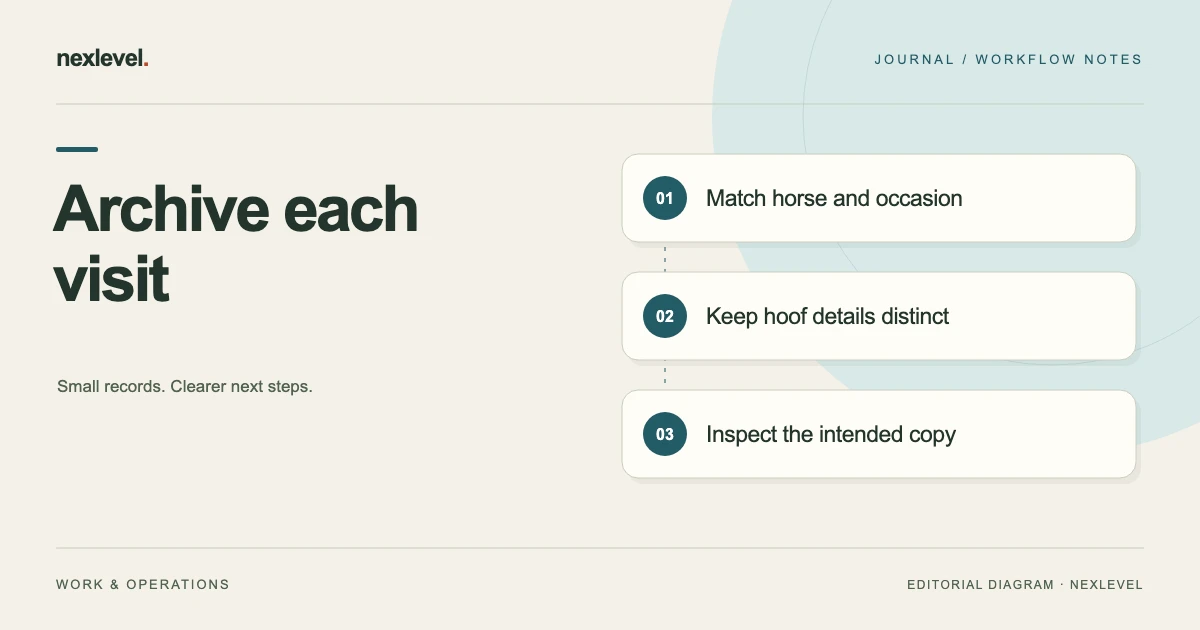
Archive farrier visits around stable horse identity, the service occasion and the actual per-hoof history. Include the relevant photo context and output dependencies so a later reader can distinguish completed work from a preset, reminder or later summary.
Keep the selected visit understandable outside its original message
- Define the horse, visit range, reader, retrieval purpose and cutoff.
- Index the selected hoof records and the source copy supporting them.
- Give each photo an established occasion or an explicit unresolved relationship.
- Open the retained output and test retrieval without the original conversation.
Working fields:
Horse | Visit range/cutoff | Hoof scope | Source copy | Photo occasion | Output/dependency | Open question
Useful next steps: Use a complete farrier visit structure, Separate preset values from service history, Prepare the archive for a receiving professional.
Define the archive question
Choose the later retrieval task before preparing a copy. A business-history question about a selected visit differs from comparing photos or planning the next route. The archive can support a bounded task without claiming to be a complete veterinary or ownership record.
Write the selected horse, visit range, source cutoff, intended reader, and purpose. Avoid a folder name such as “old horses” doing all the identity work. A short index makes the scope readable even after a file is moved outside its original conversation.
This article recommends no legal retention period. Use the actual responsible business arrangement for retention and access. The practical objective is that the chosen source relationships remain intelligible, not that every piece of yard correspondence is copied into one large packet.
Keep horse identity distinct from a familiar name
Two records can share a stable name or nickname. Preserve enough authorized context to identify the actual horse represented by the selected visit, while avoiding unnecessary owner details in a general index. A repeated name alone does not establish that histories should be combined.
If a horse’s display label later changes, the archived visit should still be findable through its actual source relationship. Keep the earlier label understandable rather than silently making every past copy look as though it used the new wording.
FarrierForge’s current listing describes records organized around individual horses and service cycles. That organization helps preserve entered history. It does not independently verify identity, ownership, the physical work performed, or the accuracy of a companion summary.
Use a visit archive index
One index row can describe a selected visit or a clearly bounded group. Include enough information to route the reader to the source without reproducing the whole working record.
| Field | What it explains |
|---|---|
| Horse reference | Which actual record is selected |
| Visit reference | The service occasion represented |
| Hoof scope | Which separately entered hoof details apply |
| Source copy | Where the supporting record can be inspected |
| Photo context | Which horse, visit, and occasion an image describes |
| Limitation | What the archive cannot establish |
These are independent worksheet fields. They do not establish a named archive module, a particular report column, or an automatic link between every exported file and photo.
Preserve the four-hoof structure
FarrierForge’s current description supports separate hoof records for work such as a full set, reset, trim, or pulled status, with shoe details where applicable. Retain what was actually entered for each hoof rather than compressing different entries into one unexplained “done” line.
A summary can be concise while preserving relevant differences. If a particular hoof has an unresolved source question, identify it explicitly. Do not copy another hoof’s details into the gap merely because a preset or an earlier visit looks similar.
The archive review concerns record meaning, not which work should be performed. The professional’s actual source and judgment determine service questions. A complete-looking table cannot establish that a particular shoe or action was appropriate for an animal.
Work through a fictional visit packet
Imagine horse H18 and visit V6. The working record contains separately entered hoof information. A retained owner summary says only “visit complete,” while a companion photo carries an unclear occasion label. The archive task is to preserve the specific source, not infer missing service detail.
The first row links H18/V6 to the selected working record and intended copy. It identifies the source period and the hoof scope that the reader should inspect. A similar horse name elsewhere in the yard does not become another route to the same visit.
The second row notes that the shortened summary omitted differences present in the actual hoof entries. The reviewer prepares a clearer explanation of that source. This administrative action is not another farrier visit and should not be logged as new work merely to document the review.
The third row leaves the photo’s visit relationship unresolved until its actual source is established. The reviewer does not date it from a file modification timestamp or infer treatment progress from its appearance. The packet can preserve a useful limitation without supplying an animal-health conclusion.
The final row states what the reader can reconstruct: H18, V6, the selected hoof entries, the prepared summary, and the remaining image question. No real horse, service specification, charge, or interval is supplied by this example.
Keep presets separate from service history
A reusable shoeing preset describes a saved structure that may be applied through the supported workflow. It is not independent proof that the same setup was used at every past visit. A later preset change should not silently rewrite an earlier service explanation.
The current listing describes shoeing presets kept close to the working record. Check the selected source rather than building an archive around an assumed automatic version history. This guide does not invent a preset-to-visit audit function.
Use the separate preset versus completed-visit guide when that relationship is unclear. The archive can retain its established result or open question without duplicating the actual service event.
Give photos an identifiable occasion
The current listing describes before-and-after photos kept close to the working record. Keep the selected images associated with the correct horse and service context. A before-and-after label is meaningful only when the actual source establishes which occasions those words describe.
A photo may help a professional review a record without proving a diagnosis, service effect, or complete physical condition. The article supplies no visual assessment method. Preserve the original context rather than using a cropped image as a replacement for the service history.
If a report and a photo set travel separately, the companion index should explain their relationship. Inspect the actual intended copies. Do not assume a CSV includes image files or that every owner-ready summary contains all photos automatically.
Separate visit records from reminders and Watch actions
A next-service countdown or reminder is scheduling context. It should not become an earlier service date or proof that work occurred. This guide gives no recommended cycle; retain the actual entered scheduling source without presenting it as animal-health advice.
The current Watch description says actions queue until the iPhone confirms they were saved. A retained glance or queued action can therefore represent a different source moment from the confirmed working visit. Inspect the actual supported result where that distinction matters.
Do not add another visit solely to make an old screenshot agree with the current record. First establish whether the discrepancy concerns a queued action, a retained copy, or the actual source. Correct the appropriate layer through the supported workflow.
Choose the intended portable form
FarrierForge’s current listing includes export of every record as CSV. Sharing individual owner summaries requires Pro. Local reminders, shoeing presets, and before-and-after photos are also described in the current listing. The public description does not establish a general CSV import or arbitrary archive restore feature.
Check the selected output’s purpose. A readable owner summary and portable structured data can support different tasks. Neither should automatically be called the complete editable app, a live synchronized record, or a veterinary certificate.
Open the actual output and inspect horse identity, visit dates, hoof context, relevant notes, and stated limitations. Preparing a file does not prove it reached the intended person or that a later reader will understand a private naming convention.
Test retrieval after separation from the original message
Give an authorized reader the intended packet without the original cover conversation. Ask them to find H18/V6, identify the hoof-specific source, and locate the photo question. They should not need the outgoing writer to explain every abbreviation.
Then ask which part describes history and which part describes a future reminder or reusable preset. If those roles blur, improve the index. Do not make the record appear more certain by hiding the unresolved relationship.
For another professional taking over, use the new-farrier record preparation guide. An archive can support that transfer, while the actual access, responsibility, and professional decisions remain separate.
Prepare a readable horse-and-visit cover sheet
The H18/V6 packet can begin with a cover sheet identifying the selected horse source, visit occasion, hoof-specific record route, and output purpose. Its references should remain understandable without the original yard conversation. A familiar nickname can stay visible while not doing all the identity work.
Next, give each selected hoof relationship its own place in the index. This does not mean inventing an action for every hoof. It means preserving what the actual record establishes, including when a particular source question remains open rather than silently copying another entry.
A compact contents list can distinguish the working-record reference, structured export, owner summary where available, photo material, and independent explanation. Name only the parts actually prepared. A CSV should not be described as carrying image files merely because the index mentions them.
For the fictional photo question, write which relationship is missing: whether the image belongs to V6 or another occasion. That is more useful than “photo issue.” A later reviewer can then seek the selected source without guessing that the question concerns animal condition or comparing appearance.
Keep the review occasion beside that question. If the relationship is clarified later, the correction can identify its new source context. The earlier packet remains interpretable as what was available then, rather than a supposedly complete source that somehow changed without explanation.
Test a copy separated from its cover sheet as well. Can its horse and visit scope still be identified? If a file needs the index to be understood, retain that dependency explicitly. A standalone-looking filename is not a substitute for a source relationship inside the intended packet.
Now ask the reader to distinguish service history from the next due context. A summary may mention both, but the earlier visit should not become a future appointment and a countdown should not become proof of work. Clarify the roles without prescribing an interval.
The same approach helps when a later owner-ready summary is prepared from accurate history. State its selected scope and preparation occasion. It can be a useful new representation without being a new service event, a complete medical history, or evidence that the recipient received it.
A final cover-sheet line can name the intended next reader and unresolved source question. That keeps the archive usable for a later business review while leaving animal-health interpretation, service choices, and actual access arrangements with their appropriate responsible sources.
Keep a short archive receipt
The receipt can identify the horse and visit scope, actual sources opened, intended output inspected, and remaining question. If a later source clarifies the photo, add that clarification with its own occasion rather than making the earlier packet appear to have known it already.
FarrierForge keeps horse-specific and hoof-specific service records usable locally. Check the official FarrierForge App Store listing for current capabilities and Pro access. Preserve enough source context for later readers to reconstruct what was entered without turning the archive into a claim about care outcomes.