A bike fit measurement record is valuable when another professional can understand how each value was measured and which setup it describes. A list of coordinates without reference points, units, equipment identity, or revision history can look precise while remaining difficult to reproduce.
This template focuses on preserving professional inputs and measured outcomes. It separates initial, proposed, and final positions, includes a fictional record, and explains how to keep later adjustments understandable. It does not recommend fitting coordinates, diagnose discomfort, or certify the bicycle or rider’s safety.
Identify the rider, bicycle, and session
Give the session a reference, date, and preparer. Identify the rider and the particular bicycle using the level of detail appropriate to the studio’s work. A rider may have several bicycles with different components and intended uses; measurements should not migrate between them without an explicit reason.
Record relevant equipment identity, including the parts that define the setup being measured. Use readable descriptions alongside internal codes. If components change during the session, preserve the initial configuration and identify the final one.
State the purpose of the appointment in the rider’s words or a faithful attributed summary. A request to document an existing position is different from a request for a professional fitting assessment. The record should preserve that distinction without implying outcomes beyond the work performed.
Keep private studio notes separate from the information intended for a client report. Both may support the professional workflow, but the recipient should receive an appropriate record rather than every working thought.
Copy this bike fit record template
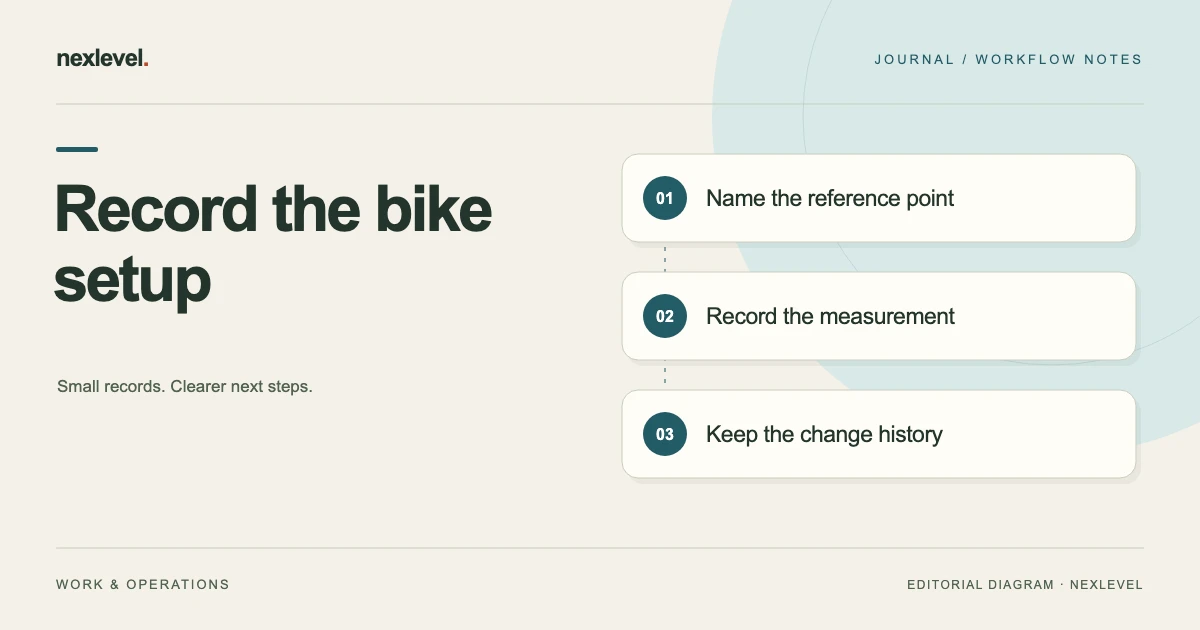
Use a consistent measurement structure for each coordinate. The template should make the value interpretable without relying on the preparer’s memory.
- Session: reference, date, preparer, rider, bicycle, and purpose.
- Equipment: relevant component identity and the configuration measured.
- Measurement: field name, value, unit, side where relevant, and exact reference points.
- Method: measurement approach, tool or convention where useful, and uncertainty or missing information.
- State: initial, proposed, or final, with date and version.
- Reason: professional rationale for a proposed or completed adjustment.
- Observation: rider-reported response or professional observation, with attribution.
- Confirmation: what record was confirmed, by whom, and what remained open.
- Follow-up: next review date or proposed action, without implying a guaranteed outcome.
Leave unknown values explicitly unknown. Zero can be a real coordinate or amount, so it should not stand in for a measurement that was never taken.
Define reference points before entering values
Write down the points and convention behind a measurement. A familiar field name can still be interpreted differently by two studios or tools. The record needs to explain which physical references were used, not merely attach a number to a label.
Record units consistently, and show them beside the value in exports. A conversion may be mathematically straightforward while the measurement method differs. Do not merge values from different methods simply because their units can be converted.
Use diagrams to support the written reference, especially when side or location matters. A marker can show where a measurement was taken, while the text explains the method. Neither should silently substitute for the other.
If the method changes in a later session, label the new method and assess comparability. An apparent difference between values may reflect the measuring convention rather than a physical adjustment. Preserve that possibility instead of presenting every numerical change as a setup change.
Separate initial, proposed, and final coordinates
Initial values describe the configuration recorded at the start. Proposed values describe a plan or professional suggestion. Final values describe the configuration actually recorded after the session’s work. These states answer different questions and should remain visible together.
Do not overwrite the initial position with the proposed position. If the adjustment is not made, the proposal still exists as a proposal. Likewise, a target entered before work does not establish that the final measured result matches it.
Record final measurements from the actual final configuration under the stated method. If a field was not remeasured, say so. Copying the target into the final field can create an apparently verified result without a corresponding observation.
Use a clear current-state marker while preserving history. The next visit should begin from the confirmed record actually in use, with access to earlier proposals when they explain the professional reasoning.
A fictional example: documenting a position change
Imagine a fitter records Session BF-018 for one rider and Bicycle B. The initial record identifies the installed components and the studio’s measurement convention. Several coordinates are recorded, while one unavailable value remains marked unknown.
The fitter proposes an adjustment and records the professional reason separately from the rider’s reported experience. The proposal has its own state. The example deliberately contains no coordinate recommendations or adjustment procedure.
After the session’s work, the fitter records the final configuration and measurements. One proposal was not carried out, so it remains identifiable as a proposal rather than appearing in the final setup. The report states the actual reviewed configuration.
At a later visit, a component has changed. The fitter creates a successor record, identifies the new component, and records why the later measurements differ. The original confirmed session stays available so the history does not suggest the new component was present all along.
Attribute observations and preserve their limits
Separate what the rider reports from what the professional directly observes or measures. “Rider reported a different sensation during the session” is not the same as a diagnosis or a prediction about future riding.
Record the context relevant to the observation. A short in-session report and a report after later use describe different events. Keep the date and source clear rather than combining them into an undated statement that appears to cover every situation.
Avoid turning preference into a universal conclusion. A rider may prefer one setup under the session’s conditions. The record can preserve that response without claiming improved performance or guaranteed comfort.
If an observation needs another professional’s assessment, record the appropriate next step without inventing an assessment yourself. The recordkeeping task is to preserve the information and its source accurately.
Document equipment changes as changes
When a component is replaced or substituted, identify the old and new item and the date of the change. The same coordinate can have a different practical context when equipment differs. A complete record preserves identity as well as numbers.
Keep proposed substitutions distinct from installed components. A product comparison or recommendation should not appear in the final equipment list until it reflects the actual confirmed configuration.
Preserve original attachments where they support the decision, and label working annotations or summaries. A client-facing report can reference the relevant information without including unrelated purchase details or private studio commentary.
Do not treat a recorded component change as evidence that all equipment checks were performed. Use the relevant professional procedures separately, and describe the actual scope of the session rather than a broad certification.
Use confirmation to identify the record, not erase uncertainty
Before confirming a session record, review identity, measurements, methods, units, equipment, observations, and unresolved fields. The purpose is to preserve an understandable state, not to make unknown information disappear.
State which version was confirmed and by whom. If the rider reviewed a client report, record that event accurately. Acknowledgment of a report should not silently imply a technical assessment or a guarantee of future results.
Keep limitations visible in the confirmed record. An unavailable measurement, a proposed later review, or a component still awaiting confirmation can be recorded honestly. A polished report does not need to imply perfect completeness.
If a correction is needed after confirmation, preserve the earlier version and issue an identifiable successor or correction. The next reader should understand what changed and why.
Prepare a readable before-and-after report
Present initial and final values with the same labels and units, adding method notes where they affect comparison. Show proposals separately so the reader does not confuse an intended value with a delivered measurement.
Include the equipment identity and session date in the report. A table detached from the bicycle and component configuration can become difficult to interpret after several visits or equipment changes.
Keep the explanation concise. State the professional reasons recorded, rider-reported observations, and the actual follow-up arrangement. Avoid adding a broad claim of success merely because numerical differences are visible.
Open the exported report outside the editing workspace. Check that labels, diagrams, units, and notes remain readable and that private studio notes are excluded from the client copy.
Make the next visit start from a reliable history
Before a later appointment, identify the latest confirmed configuration and any subsequent reported changes. Ask whether components or relevant circumstances differ rather than assuming the bicycle matches the last report.
Use a stable relationship between predecessor and successor records. This lets a professional trace the sequence without comparing a folder of files whose names all contain “final.” Keep the reason for each meaningful change alongside its measurements.
Record the next review date as agreed or proposed. A reminder can help the studio recall that date, but it does not mean the appointment has been booked or attended. Keep those states separate.
For a broader service handoff, the work completion report template offers a structure for scope, observations, exceptions, and follow-up. Use only the parts relevant to the actual fitting service.
Keep the archive recoverable
A client PDF and a working backup serve different purposes. The PDF presents a selected confirmed record; the backup should preserve what your chosen system needs for recovery. Verify what is included before relying on an export as a complete archive.
Test a sample restore or retrieval through the supported process. Check that equipment identity, revisions, measurements, and attachments remain connected. A file existing in a backup folder does not establish that its contents can be recovered correctly.
Use deliberate sharing and appropriate access controls for rider and studio records. A handoff should provide the information needed by the recipient without making the entire client archive public.
Compare inherited records before interpreting a difference
When a rider brings an earlier report, first identify the bicycle, component configuration, measurement convention, and units. The report may be useful context without being directly comparable to the studio’s current method. Keep it as a source rather than copying its numbers into the initial measured fields.
A unit conversion can resolve one kind of difference while leaving another untouched. For a purely illustrative quantity, 10 cm and 100 mm represent the same length. They do not establish that two people measured between the same physical points. Confirm the reference before describing the records as equivalent or contradictory.
If an inherited field cannot be interpreted, label it as an unverified historical value and record the question. The current session can still preserve its own clearly measured values. Avoid manufacturing continuity by guessing what the earlier preparer intended.
In the client report, distinguish a comparison of documented records from a comparison of measurements taken under the same method. State any important limit in readable language. This lets the rider and a later professional understand why the current record differs without suggesting that one set of numbers alone proves an error or an improvement.
Use GearTune for professional setup records
GearTune keeps Golf and Bike Fit workspaces distinct. Its official listing describes initial, proposed, and final bike coordinates, reference points, methods, units, diagrams, rider observations, successor revisions, and client reports. Core capture, retrieval, and report creation work offline.
View GearTune on the App Store for current access and compatibility. It records professional inputs and measured outcomes; it does not infer coordinates from photos or diagnose discomfort. Use the template to preserve the meaning behind the measurements.
Sources and example scope
App features were checked against the official GearTune listing and product page. Session BF-018 and its history are fictional. The guide provides an original documentation method without fitting recommendations, medical claims, equipment certification, or guaranteed sporting outcomes.