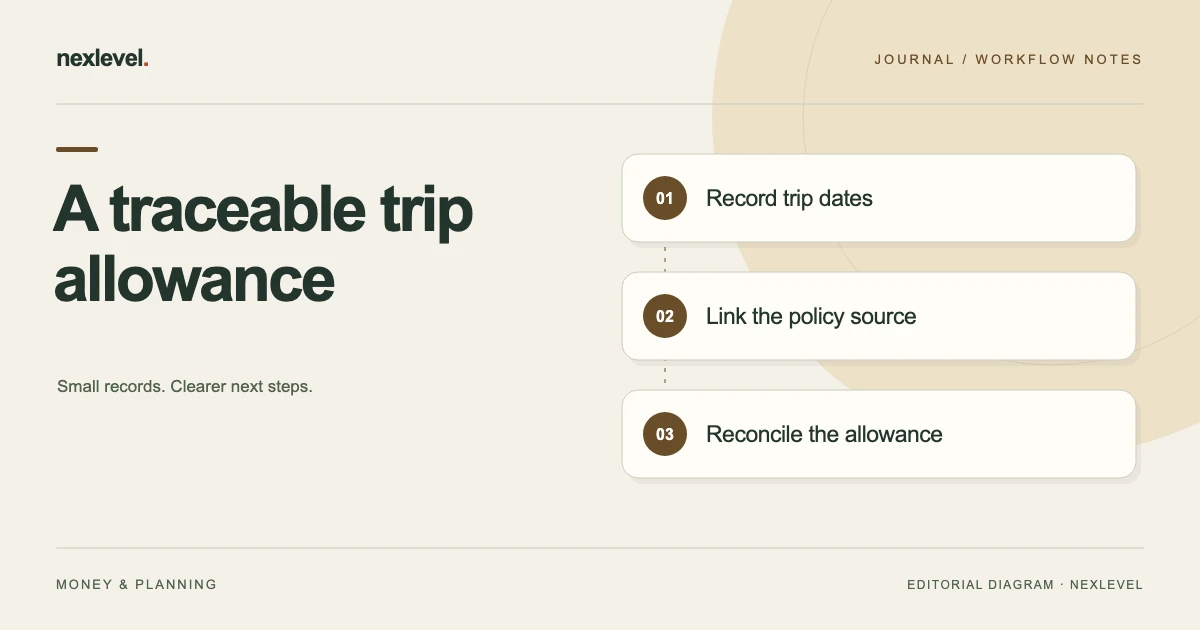
A business-trip allowance record should explain the policy used for planning, which days it covers, what expenses were actually recorded, and which decisions remain with the employer. A daily-rate total alone cannot explain mixed personal spending, missing receipts, or costs governed by another rule.
This template connects an employer-entered policy to the itinerary, expense events, and reconciliation. Every amount in the example is fictional. The guide does not supply government rates, tax rules, reimbursement entitlement, or a universal method for counting travel days.
Record the policy before calculating the trip
Identify the employer policy, version or source date, covered categories, currency, and responsible contact. A saved rate without its source can remain in a spreadsheet after the relevant policy changes.
State what the allowance represents in this case. A meal allowance and a complete-trip budget are different scopes. Do not assume a daily amount includes lodging, transport, or every expense.
Keep policy questions visible. If the treatment of a travel day, provided meal, or exception is unclear, record the question rather than applying a familiar rule from another employer.
Use the actual authoritative route for policy interpretation and approval. The tracker organizes entered values without deciding what the traveler is legally or contractually owed.
Copy this trip allowance template
Use linked sections for the plan, actual expenses, evidence, and review. Keep the original source and later decisions identifiable.
- Trip: reference, traveler, purpose, itinerary, dates, and relevant time zones.
- Policy: source, version, covered categories, daily values, and open questions.
- Day record: date, entered eligibility or treatment, source basis, and planned amount.
- Expense: date, category, gross amount, currency, business portion, and personal portion.
- Evidence: receipt reference, availability, note, and review state.
- Other flows: employer-paid items or advances, identified separately where relevant.
- Reconciliation: like-for-like comparison, exception, decision owner, and outcome.
- Report: snapshot date, policy version, totals, and unresolved limitations.
Unknown is not zero. A missing receipt, unverified rate, or pending category decision should remain distinguishable from a confirmed amount of none.
Define the days under the actual policy
A trip’s departure and arrival dates do not automatically establish how many allowance days apply. Record the employer’s actual method and the itinerary facts needed to use it.
Keep local dates and time-zone context where relevant. Crossing midnight or changing zones can make a simple date subtraction misleading if it is not the policy’s intended basis.
For the fictional example below, the policy explicitly treats four recorded days as eligible at the same entered meal allowance. That is an assumption of the example, not a general travel rule.
If the itinerary changes, review the affected day entries and policy questions. Moving a return date should not silently preserve an outdated allowance calculation.
A fictional allowance plan
Imagine Trip TP-016 has four eligible days under a fictional employer policy. The entered allowance is 90 per day for meals only, so the planned meal allowance is 4 × 90 = 360.
The policy source and date are saved with the plan. Lodging and transport are recorded under separate categories and require their own policy treatment.
The traveler does not treat the 360 plan as a confirmed payment or add it automatically to every actual expense. Its role is a policy-based planning value under the stated example.
A later policy clarification should be preserved with the relevant version and decision. The record should not make it appear that the new information was known when the initial plan was created.
Capture expenses without losing the original total
Record the actual transaction amount, currency, date, category, and receipt reference. A short note while details are fresh can help explain a mixed purchase or a missing document.
Keep the original gross amount even when only part belongs in the business record. Replacing the total with the business portion can make the receipt difficult to reconcile.
Distinguish the traveler’s payment from an item paid directly by the employer where relevant. The same expense should not enter reimbursement calculations twice.
Do not infer an amount from a blank field or a vague memory. Preserve the open question and identify how it will be checked.
Separate personal portions visibly
Suppose a fictional mixed meal transaction totals 80, with 20 recorded as personal. The entered business portion is 80 − 20 = 60. Keep all three values linked to the source.
The allocation should follow the actual employer process and evidence. The arithmetic does not decide which items qualify or whether the resulting portion will be approved.
Record an adjustment’s source if the split changes during review. Do not overwrite the initial allocation without explaining the correction.
A personal portion is not a missing receipt or a rejected business expense. Those states describe different information and should not share one ambiguous checkbox.
Use a scoped expense summary
The fictional trip records the following amounts in one currency. The table describes entered business portions, not approved reimbursement.
| Entry | Gross | Personal | Business |
|---|---|---|---|
| Meals | 120 | 0 | 120 |
| Mixed meal | 80 | 20 | 60 |
| Lodging | 240 | 0 | 240 |
| Transport | 50 | 0 | 50 |
| Total | 490 | 20 | 470 |
The entered meal business amount is 180. The other 290 belongs to lodging and transport categories. Comparing all 470 with the meal-only allowance of 360 would mix different scopes.
The report keeps the 360 allowance plan, 180 entered meal amount, and 290 other business amount distinct. It does not conclude which payment method or final reimbursement the employer should apply.
Compare like with like
Before interpreting a difference, check the categories, period, currency, and basis on both sides. A planned allowance and actual receipts can be relevant without being interchangeable.
A difference can be a review question rather than an amount automatically owed or returned. The applicable policy and approval process determine the treatment.
Keep employer-paid items, advances, and later reimbursements in their own fields when relevant. A transaction’s existence does not establish that it should be added to the allowance total.
For a prospective whole-trip budget, our door-to-door comparison guide addresses a different question: the complete modeled cost of booking options before travel.
Make receipt states actionable
A receipt can be available, missing, unreadable, pending review, or not required under a stated policy. Those states need different next actions.
Record the reference and where the source can be found. A filename alone may be insufficient when several similar transactions occurred on the trip.
Keep the original and label any annotated or redacted copy. A shared report should not expose unrelated personal purchases or payment details unnecessarily.
If evidence is missing, record the actual explanation and follow the employer’s process. The tracker should not invent a replacement document or assume an exception will be granted.
Preserve exceptions and decisions
For each exception, identify the affected expense or day, the policy question, supporting evidence, decision owner, and current state.
Keep requested approval separate from actual approval. A report sent for review has not automatically completed the employer’s decision process.
Record the answer and its scope. A decision about one expense should not silently become a general rule for every future trip.
If the policy changes, preserve which version governed each report or entered decision. A convenient template update should not rewrite a historical reconciliation.
Review the report before sharing
Check trip identity, dates, policy source, daily amounts, category coverage, personal portions, receipts, and unresolved items. A clean total should not hide an open policy question.
Open the actual exported report and verify labels, currency, and arithmetic. Make sure a reader can distinguish planned values from recorded transactions and decisions.
Share through the employer’s appropriate route with only the information needed. A private working archive can contain more context than a report sent to one reviewer.
The handoff checklist offers the general pattern of a current version, source references, open questions, and a receiving check.
Close the trip without erasing follow-up
A trip can be over while a receipt, decision, or payment remains pending. Keep those tasks visible rather than marking everything resolved because travel ended.
Record actual reimbursement or other settlement through the appropriate business records. The tracker can preserve the event without replacing payroll, banking, or accounting systems.
Keep the final report version and source set. If a later correction matters, identify it clearly and preserve the earlier issue.
Use the completed trip to improve the next preparation checklist, such as verifying a policy version or capturing receipt references earlier. One trip does not establish a universal entitlement rule.
Review a changed policy or itinerary as a new version
Suppose a fictional later policy source enters 95 per eligible day rather than 90. Four days at 95 produce a planned 380, compared with the earlier 360. The 20 difference is arithmetic; it does not establish which policy applies to the actual trip.
Record the source, effective scope, and responsible decision before changing the trip’s policy version. A newly downloaded document should not silently rewrite a report already issued under an earlier basis.
In a separate scenario, if the applicable source establishes only three eligible days at the original 90, the plan becomes 270. Keep this distinct from the rate-change scenario. Combining selected pieces from two different assumptions would produce a total with no clear policy basis.
When the itinerary changes, review day treatment, categories, employer-paid items, and open questions. A changed return date can affect more than one row. Preserve the current version and the actual decision rather than letting a reminder edit stand in for policy review.
Trace a corrected personal portion through the report
Return to the fictional mixed meal of 80. If the reviewed personal portion changes from 20 to 25, the business portion changes from 60 to 55. The entered meal business total becomes 175 rather than 180, and the overall entered business total becomes 465 rather than 470.
Preserve the gross transaction of 80 and the source of the correction. The receipt did not become a different purchase merely because its allocation changed. Keep the earlier report identifiable if it was already shared.
Before sending the revised summary, check the affected category subtotal, overall business total, and exception note. A corrected row can leave a stale headline total if the document was edited manually.
Ask the receiving reviewer to identify the policy version, day basis, gross total, personal portion, and unresolved decision. They should be able to distinguish the 360 planning allowance from the actual expense entries without adding them together automatically.
Finally, record what the employer actually decides and any subsequent settlement through the appropriate business process. The corrected arithmetic supports that review but does not determine entitlement, approval, or payment timing. This keeps the report useful even when the final administrative outcome differs from the original plan.
If a later source confirms that the fictional 240 lodging amount was paid directly by the employer, preserve that payer information separately. It can remain part of the trip’s recorded business cost while not representing money the traveler personally advanced. The actual settlement treatment still follows the employer’s process.
Do not delete the lodging evidence or silently reduce the trip’s business-cost history to force a reimbursement total. Instead, distinguish gross business records, payer, advances, approvals, and any amount actually settled. The receiving reviewer should be able to explain each total’s meaning before using it in another system.
Use TravelPerDiem for policy-based records
TravelPerDiem records entered employer allowances, policy source dates, itinerary plans, expenses, personal portions, receipt status, and reconciliation. Its official listing describes offline trip records and organized summaries with calculations and exceptions.
View TravelPerDiem on the App Store for current features and access. Use it to preserve the evidence and questions, with actual policy interpretation and approval handled by the responsible employer process.
Sources and example scope
App features were checked against the official TravelPerDiem listing and product page. TP-016, policy, days, and amounts are fictional. No government rate, tax treatment, eligible-day rule, or reimbursement entitlement is supplied.