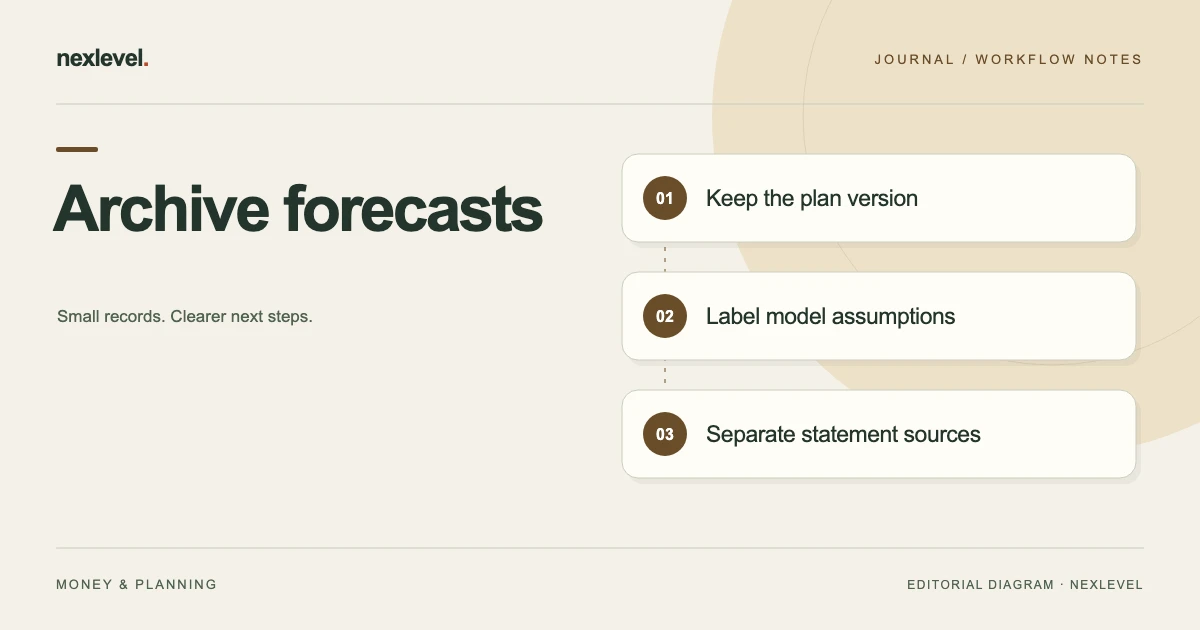
Archive a commission forecast around the historical question it needs to answer. Keep the entered plan version, scenario and calculation inputs connected to the statement source, while labeling later terms or clarifications as later information.
Retain the calculation and comparison context
- Choose the selected deal, scenario, historical question and cutoff.
- Index the entered plan and enough inputs to reproduce its expected amount.
- Retain the statement scope, currency and explicit variance convention.
- Open the retained packet and retrieve the model from the statement reference, then reverse the route.
Working fields:
Deal | Plan/version | Scenario | Inputs/result | Statement/source | Difference convention | Copy/cutoff | Open question
Useful next steps: Explain an input or plan change, Prepare a current variance handoff.
Choose the historical question
A later reader may need to reconstruct one estimate, understand a variance, or identify which plan version applied to a selected deal. These tasks can require different sources. State the selected purpose before collecting files.
Write the deal scope, plan version, source cutoff, scenario, preparation occasion, and intended reader. A packet for one comparison should not appear to represent the complete employer plan or every payment in a period.
Keep access proportional. A companion index can use authorized aliases and source routes without copying unrelated customer, payroll, or account material into a broad shared folder.
Preserve the calculation’s actual inputs
PayoutVerity’s current description includes credited share, rate, quota accelerator, tier, clawback, payout cap, plan version, and expected total in a readable trail. The relevant inputs depend on the selected entered plan.
A retained total should identify the source version and assumptions that produced it. A current plan label cannot explain an older estimate if its terms have changed.
Do not invent a missing rule to make the arithmetic look complete. The archive can preserve a precise source question while retaining the entered values that are actually established.
Use a forecast archive index
One row can identify a selected calculation relationship. Separate rows can describe a statement or supporting document where their source roles differ.
| Field | What to preserve |
|---|---|
| Deal reference | The selected eligible-deal context |
| Plan version | The actual rules entered for the estimate |
| Scenario | Which selected forecast the packet represents |
| Calculation | The stated input basis and resulting amount |
| Statement comparison | The source amount and comparison convention |
| Evidence question | What remains unresolved outside the model |
| Output | The chosen copy and its source cutoff |
These are independent companion prompts. They do not establish a dedicated archive screen or guarantee that every explanatory field appears automatically in a PDF or CSV.
Work through a simplified fictional comparison
Imagine deal alias D9 and entered plan version V2. For this deliberately simplified example, eligible amount is 1,000 units in one invented currency, credited share is one half, and the selected rate is one tenth.
Under the explicit assumption that no other rule changes this calculation, the modeled amount is 1,000 multiplied by one half multiplied by one tenth: fifty units. This does not describe a real employer plan or imply that actual plans use this formula.
Statement source S4 records forty-five units for the selected comparison. Using the stated convention of statement amount minus forecast, the difference is negative five. That arithmetic identifies a question; it does not establish an underpayment or entitlement.
Retained packet R6 identifies D9/V2, the selected scenario, S4’s source occasion, the calculation assumptions, and the open question about the difference. No real transaction or payment outcome is supplied.
Keep the scenario visible
The current app describes base, likely, and stretch scenarios across expected payout dates. A selected scenario is an entered planning view, not a promise that a deal will close or a payment will arrive.
For R6, name the actual scenario used. A shortened cover summary should not silently combine totals from different scenarios or present a stretch estimate as an established statement amount.
If the source scenario is unclear, preserve that question. Do not infer it from the largest figure or the most recent dashboard view merely to make the archive easier to summarize.
Keep plan changes tied to their own occasion
PayoutVerity currently describes creating a new version when plan terms change without rewriting closed deals. The archive should identify which version belongs to the selected calculation.
Suppose a later working context uses V3. Its existence does not establish that D9’s older V2 estimate should be recomputed under the new version. The actual source relationship determines the appropriate historical interpretation.
For changed inputs, use the plan-input review guide. The archive can preserve that review’s actual result or limitation without treating the current plan as an automatic substitute for older context.
Separate statement records from actual payment evidence
A statement amount, an expected amount, and evidence of actual payment may answer different questions. Keep each source in its actual role rather than allowing one amount to stand in for every stage.
The app currently supports recording a statement amount, surfacing variance, attaching supporting evidence, and marking issues resolved. An administrative resolved label does not independently establish a bank transaction or a legal outcome.
Use the forecast-versus-payment guide when the source roles need closer review. Preserve what the actual sources establish and leave the precise external question visible.
Give the difference its stated sign convention
In the fictional example, statement minus forecast means forty-five minus fifty, or negative five. Another worksheet could use the reverse convention, but the retained packet must say which relationship the displayed sign represents.
A correct subtraction cannot explain the cause of a difference. The source may require further review of scope, timing, entered rules, or statement context. The guide does not choose among those possibilities for a real case.
Keep the invented currency basis with the numbers. No exchange conversion, expected saving, annualization, payroll conclusion, or recommendation follows from this simplified administrative example.
Inspect the intended evidence export
PayoutVerity Pro currently includes evidence exports and focused PDF or CSV packs, alongside expanded plans, deals, accelerators, and advanced scenarios. Check actual feature access and open the selected output.
Inspect deal identity, plan version, scenario, entered calculation basis, statement context, and limitations. A companion explanation may be needed where the chosen output does not represent every source relationship automatically.
The public description does not establish a general payroll integration, arbitrary spreadsheet import, or full-system restoration process. A useful portable packet can remain bounded to its actual supported purpose.
Prepare a cover note for R6
The first line can identify D9/V2, the selected scenario, and R6’s source cutoff. A calculation line can state the simplified assumptions and fifty-unit model result.
A comparison line can identify S4 and its forty-five-unit source amount, followed by the explicit statement-minus-forecast convention. A separate line names the next evidence question without calling the difference an established employer error.
The contents line should list only what was prepared. A PDF, a CSV, an original supporting source, and a companion note can have different roles. A filename called complete is not proof that all of them are included.
Test retrieval from the statement and model
Ask an authorized reader to begin with S4 and locate the selected D9/V2 estimate. Then ask them to start with the fifty-unit model result and identify the actual statement comparison.
The reader should reproduce the simplified arithmetic while keeping its assumptions visible. They should distinguish the difference from a conclusion about what is actually owed or paid.
If a retained copy omits the scenario or currency basis that the working record preserves, repair the copy. Do not change accurate source values to match a shortened summary.
Handle later clarification as later evidence
A later statement or supporting source may clarify the comparison. Retain its own source occasion and relationship to R6. Do not make the original packet appear to have contained later information from the start.
A correction to the companion explanation is distinct from changing the entered plan or recording another statement occasion. Keeping those purposes separate helps preserve the historical question the archive was built to answer.
For a responsibility transfer, use the commission variance handoff guide. An archive does not itself authorize another person to access employer records or make compensation decisions.
Finish with a source-and-assumption check
Check deal identity, selected plan version, scenario, entered inputs, statement source, difference convention, output contents, and source cutoff. Each required relationship should have an actual route or an explicit limitation.
Keep the important explanations inside the packet, not only in a filename. A later reader should not have to infer the calculation’s period or source role from a file’s modification date.
The reusable method is the index and comparison structure. Keep the fictional D9/V2 figures out of real commission history and use actual authorized sources for genuine records.
Complete a source-and-calculation cover sheet
The fictional R6 cover sheet can separate model arithmetic from external evidence in a few explicit rows. Use the actual selected source routes alongside the short labels when preparing a genuine packet.
| Selected relationship | Meaning retained | Boundary |
|---|---|---|
| D9 and V2 | The chosen deal context uses the entered plan version | A later V3 is not automatically substituted |
| 1,000 × one half | The simplified credited basis is five hundred units | No other plan rule is assumed |
| Five hundred × one tenth | The simplified modeled result is fifty units | This is not actual payment evidence |
| S4 | The selected statement source amount is forty-five units | The amount’s real-world cause remains unproven |
| Forty-five minus fifty | The stated comparison produces negative five | A variance is not an entitlement conclusion |
| R6 | The output represents the chosen cutoff | Later sources retain their own occasion |
The first calculation step matters because a shortened fifty-unit total can hide the credited-share assumption. Keeping that intermediate basis visible lets the reader reconstruct the stated model without borrowing an unstated rule.
Likewise, the statement-minus-forecast label matters because a bare negative number can be interpreted in the opposite direction. Preserve the convention inside the copy, not only in the original explanation.
Use a second-reader exception test
Ask a reader to identify the first source they would need if the statement comparison cannot be explained. The answer should be a bounded source question about the selected packet, not a conclusion that an employer made an error.
Now introduce another fictional statement S5 from a later occasion. Its existence should not silently replace S4 or change R6’s cutoff. The reader should identify whether the later source belongs to a new comparison or clarifies the original one.
If the retained copy labels S5 as though it was available when R6 was prepared, repair the source chronology. If the working record already has accurate occasions, change the explanatory copy rather than rewriting correct historical inputs.
A practical completion note can state which model inputs were checked, which statement source was inspected, which sign convention was used, and what question remained. That is a useful administrative result without a claim about compensation rights or payment recovery.
The fictional numbers remain calculation examples. Reuse the source-and-assumption structure with actual authorized records, preserving their currency, period, scope, and applicable plan context rather than adopting the example as a real formula.
For one final check, remove the cover conversation and ask the reader to identify the fifty-unit model, the forty-five-unit statement source, and the selected sign convention from R6 alone. If they need an unstated assumption to explain the difference, add that precise source question to the packet. The goal is reproducible administrative context, not a more confident conclusion about an external payment.
Use PayoutVerity for traceable entered forecasts
PayoutVerity organizes entered plan rules, deal scenarios, calculation trails, statement comparisons, and supporting evidence without requiring an account.
Check the official PayoutVerity App Store listing for current capabilities and Pro exports. Employer plan documents and statements govern actual payment; the archive preserves the administrative context of what was entered.