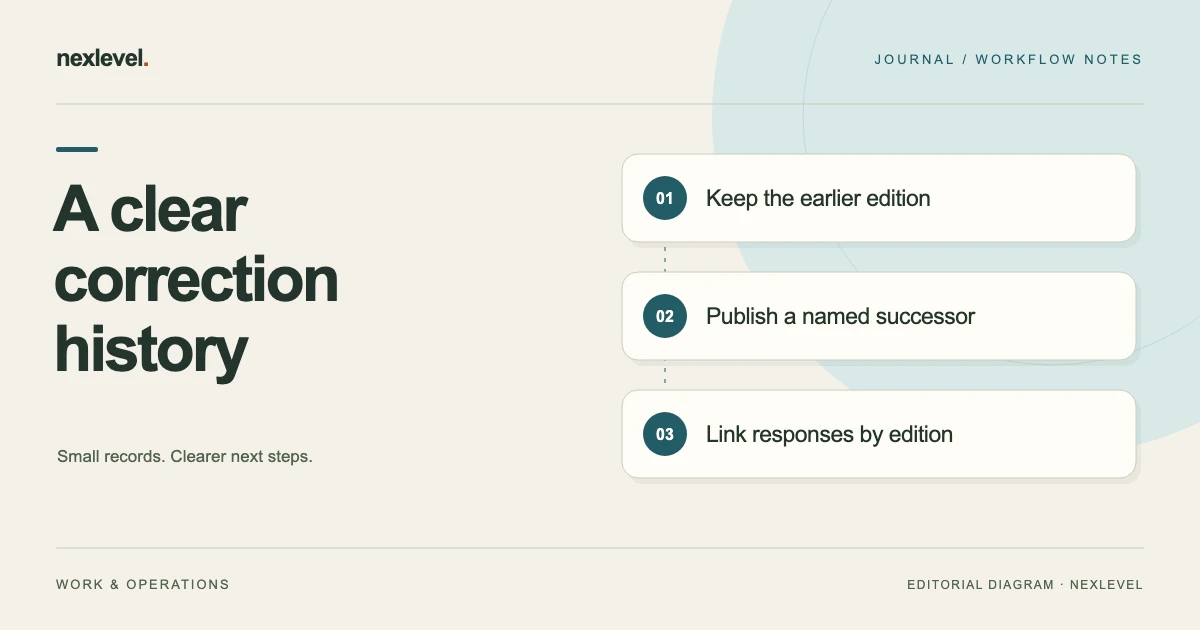
Corrected meeting minutes should make the current record easier to find without making the earlier published edition disappear. If a secretary simply replaces a file called “final minutes,” readers may not know what changed or which version they previously reviewed.
Use a successor edition, a concise correction record, and an index that points to the current publication. Keep acknowledgments and comments associated with the edition they actually concern. That gives the committee a readable history while allowing an error to be corrected.
This guide describes a recordkeeping method and an original fictional example. Follow the committee’s established correction and publication procedures; the workflow does not determine the legal validity of a meeting or decision. For the material prepared before discussion, see the committee decision packet guide.
Separate a correction from a later change of mind
A correction addresses an error or omission in the record of what happened. A later decision to take a different action is a different event. Keeping that distinction visible prevents a new decision from being written back into the minutes of an earlier meeting.
Record the question being investigated: for example, whether the published paragraph contains the wrong spending limit or whether the committee now wants a different limit. The evidence and process required to address those situations may differ under the committee’s own arrangements.
If the distinction is uncertain, preserve the request and refer it to the responsible person or process. Do not turn a disputed recollection into a routine typographical correction merely because replacing one number would be technically easy.
Identify the exact published edition
Record the meeting identifier, meeting date, edition identifier, publication date, and file or record location. A correction request should identify the paragraph, item, or decision concerned. “The minutes are wrong” does not give a reviewer enough information to establish the issue.
Keep the published edition unchanged while the correction is considered. Work in a separate draft or proposal so the original remains distinguishable. If the source file is continually edited, a later reader cannot reconstruct what members actually received.
Include the circulation reference if available. Some people may hold downloaded or printed copies, while others use a shared link. The archive should explain which edition was circulated rather than assuming that every recipient always sees the newest file.
Capture the correction request as its own record
A useful request contains the requester, date received, affected edition, location of the issue, existing wording, proposed correction, supporting evidence, and current review status. Keep the request separate from the eventual decision about how to correct the minutes.
Preserve the wording of the request accurately. If the requester supplies a recollection rather than a contemporaneous record, label it accordingly. Different sources can contribute to the review without being presented as equally conclusive.
Assign a person to coordinate the next step. That person can gather the relevant material and follow the committee’s established process. Receiving the request does not mean the proposed correction has been accepted or that a replacement edition is ready to publish.
Check evidence against the recorded item
Locate the relevant agenda item, proposed wording, amendments, participation record, notes, and other material retained through the committee’s process. Compare what each source establishes. The pre-meeting proposal may differ from the wording considered during discussion.
Keep source references with the correction review. A later reader should be able to understand why the existing paragraph was questioned and what supported the resulting change. Avoid relying on an unexplained note saying “confirmed with everyone.”
If evidence conflicts or remains incomplete, record that uncertainty. The secretary’s recordkeeping task is to make the issue inspectable and follow the appropriate procedure, rather than deciding that the most convenient source must be correct.
Work through a fictional spending-limit error
Imagine a volunteer group’s meeting M07. Its packet proposed replacing a cabinet within a $500 limit. During discussion, the wording was amended to a $450 limit. The published minutes, edition 1, accidentally retained the original $500 figure.
A member requests a correction and identifies the paragraph. The secretary gathers the recorded amendment and the associated meeting notes, then follows the group’s correction process. The successor draft changes the paragraph to reflect the recorded $450 wording and describes the difference in a correction note.
The example concerns the accuracy of the record. It does not establish whether the decision was validly adopted. If the group later wants to increase the limit to $600, that would be a new proposed decision to handle through its normal process, not a reason to rewrite what M07 originally recorded.
Create a successor instead of overwriting publication
Give the corrected edition a new identifier and an explicit predecessor reference. For example: “M07 minutes, edition 2, corrects edition 1.” Include the date of the successor publication and the location of the correction explanation.
Keep the earlier published file in the archive with a clear superseded label or index status. Avoid changing its contents to add the corrected paragraph while leaving its edition number unchanged. That would make two different files appear to represent the same published edition.
Maintain a clear relationship between the draft correction and the published successor. A working file can change during review, but the archive should identify which version was actually issued. Keep abandoned draft filenames from looking like additional published editions.
Write a concise correction note
The note should identify the affected item, summarize the change, reference the earlier edition, and identify the successor. Where useful, include the existing and corrected wording. Keep the explanation factual and within the scope of the recorded correction.
For fictional M07, a note could say: “Edition 2 corrects the spending limit in item D04 from $500 to $450, reflecting the recorded amended wording. It succeeds edition 1.” The archive can then link the supporting correction record and the applicable review outcome.
Do not use the note to erase the fact that edition 1 was circulated. Nor should it imply that unrelated paragraphs were reexamined unless that actually happened. State the correction’s scope so a reader knows what changed and what the note does not establish.
Keep acknowledgments attached to their editions
An acknowledgment of edition 1 remains an acknowledgment of edition 1. Do not transfer it to edition 2 merely because the successor is now current. The person may not have seen the changed wording or the new file.
If the committee’s process calls for acknowledgment of the successor, request and record it for that edition. Distinguish the request, delivery, acknowledgment, and any correction response. They are separate observations, not interchangeable indicators of agreement.
When preparing a summary, say which edition it concerns. “Five responses received for edition 1” is more precise than a general statement that “the minutes were acknowledged” when the archive now contains a corrected successor. An acknowledgment is not a legal signature or a determination about the recorded outcome.
Build an archive index that points to the current record
Use an index row for each published edition. Helpful fields include meeting ID, edition, publication date, status, predecessor, successor, correction summary, file reference, and circulation reference. Add the person responsible for archive maintenance if that is useful to your group.
Make the current edition easy to identify. Earlier editions should remain findable where your process requires them, but should not look like equally current choices. Use text labels such as “current” and “superseded,” rather than relying only on a color or a file’s position in a folder.
Keep the index linked to the actual files. A correct spreadsheet row does not help if its link opens an obsolete duplicate with a similar name. Test the references after moving files or reorganizing folders.
Use filenames that preserve the sequence
Choose a consistent filename pattern such as meeting identifier, document type, and edition. “M07-minutes-ed02.pdf” communicates more than “minutes-final-fixed.pdf.” Include dates where they help retrieval, using a consistent format within the archive.
Keep the filename and the document’s visible edition information aligned. A PDF named edition 2 that still displays edition 1 on its cover creates unnecessary ambiguity. Check both before circulation, including any footer or internal reference to the publication edition.
Do not prescribe a universal retention period from a generic archive template. Use the group’s actual records requirements and applicable process. The method here is about keeping editions distinguishable and retrievable while they are retained.
Handle circulation without assuming old copies update
Prepare a circulation note that names the successor, identifies the corrected item, and points to the current file or record. Use the committee’s normal communication route. A changed link in the archive does not update printed copies or files already downloaded by members.
Keep a reference to the actual circulation event. Record the edition sent and any relevant recipient group under your established process. Avoid marking distribution complete merely because a PDF was exported or placed in a folder.
If an old link remains accessible, consider how its surrounding index or entry can clearly identify its superseded status. Preserve the historical edition itself while helping readers find the current publication. Do not quietly serve different content under an indistinguishable old edition label.
Inspect the final successor package
Open the actual file intended for publication. Check the meeting identity, edition, corrected wording, correction note, navigation, and action references. Compare the changed item with the reviewed correction record rather than relying on memory of the draft.
Check related vote or outcome records when wording is affected. A paragraph and its associated record should describe the same wording considered by the committee. If that relationship is unclear, keep the issue under review rather than treating a text edit as the whole correction.
Inspect the remainder for accidental changes introduced during the update. Formatting can move a heading or break a reference even when the intended correction is narrow. Record the publication check and keep the final successor distinguishable from the working draft.
Test retrieval from an old reference
Ask a colleague to start with the edition 1 reference and find the current record. They should be able to identify edition 2, understand the correction, and locate edition 1 as the earlier publication where retained. This is a practical test of the archive’s navigation.
Then ask which edition a particular acknowledgment concerns. If the answer requires guessing from its date, improve the edition link. A response received after the correction request could still refer to edition 1 if that was the file the member reviewed.
Record and fix broken links, ambiguous status labels, and mismatched filenames. The test does not certify the entire archive, but it shows whether a person outside the correction work can reconstruct this publication sequence without relying on the secretary’s memory.
If another correction request arrives while the successor is being prepared, identify it separately. For example, a member may flag an attendance entry as well as the spending-limit paragraph. Record both requests and their review outcomes. If edition 2 eventually includes both corrections, its note should identify both. If edition 2 is already published before the second issue is resolved, keep that boundary clear and follow the normal process for a further successor. Do not add the second change to an already published file while continuing to call it the same edition. A clear publication boundary keeps the index, circulation record, and member responses understandable.
Use versioned minutes software within its limits
DecisionSession describes published editions that remain unchanged, corrections that create successors, and acknowledgments associated with the exact edition reviewed. It also supports local drafts, participation and action records, and readable PDF sharing. Those capabilities match the distinction between a working correction and a published successor.
The app records outcomes supplied by the user; it does not determine whether a motion was lawfully adopted. Check current features and plan details in the official DecisionSession App Store listing. Keep the current minutes easy to locate while preserving an understandable record of earlier publication and correction.