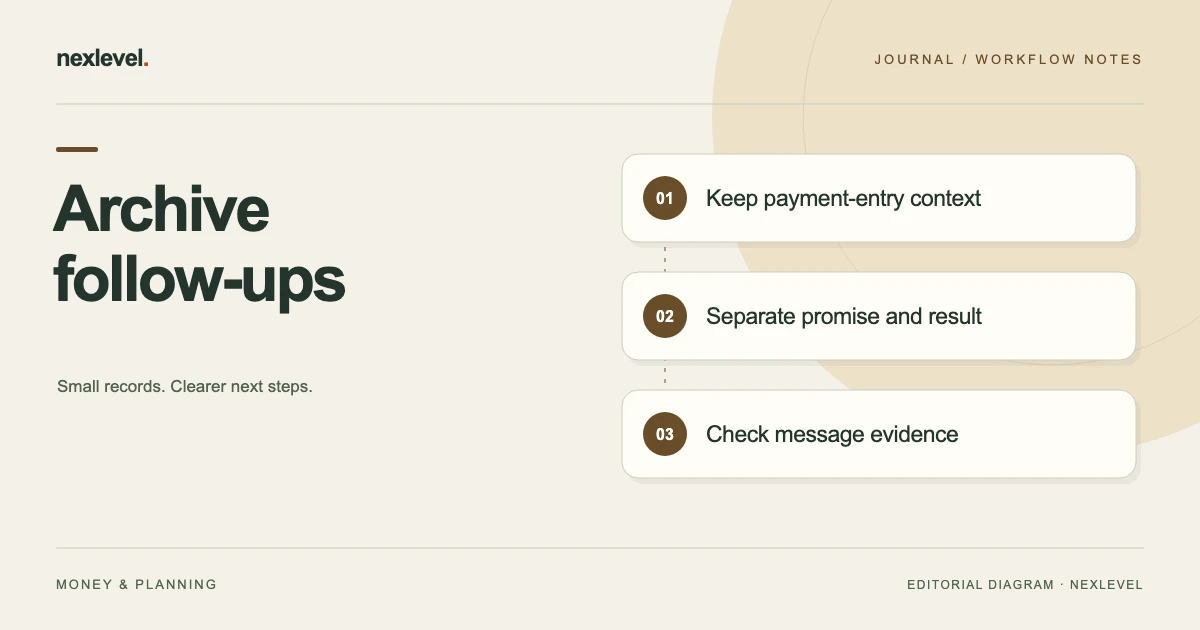
An invoice follow-up archive should connect the invoice and payment entries to their sources, preserve promises separately, and identify whether a message was prepared or actually sent. Record the cutoff and any unresolved outcome question so a later reader can reconstruct the history.
Preserve what happened and what was only planned
- State which invoice, period and retrieval question the packet covers.
- Index the original amount, payment events and any remaining-balance assumptions.
- Label promises and message states according to the evidence available.
- Open the retained copy and test that a reader can find the sources without assuming a later outcome.
Working fields:
Invoice/period | Amount basis | Payment sources | Promise source | Message state/source | Copy cutoff | Outcome question
Useful next steps: Check partial-payment history, Keep a promise separate from its outcome, Transfer the next follow-up action.
Choose the archive question
A reader may need to understand an entered remaining amount, locate a recorded promise, or identify what a prepared reminder actually said. Those questions can need different sources. State the purpose before collecting files.
Write the selected invoice reference, source period, preparation occasion, intended reader, and cutoff. A packet about one invoice should not appear to describe a client’s complete account or all later payment activity.
Keep access proportional. A companion index can preserve source relationships without copying unrelated client records, credentials, or private correspondence into a broad shared folder.
Keep invoice identity and source context clear
A customer name may recur across several invoices. Retain enough authorized reference context to distinguish the selected record and its source. A familiar title or similar amount should not be the sole identity key.
PaidCue’s current description includes invoice and client records, a priority queue, payment promises, partial or full payments, follow-up history, reports, and CSV output with plan-dependent access.
The app organizes entered information. It does not independently establish that an invoice is valid, that a bank transaction occurred, or that a particular message has a legal effect.
Use an invoice archive index
One row can identify a selected source relationship. Separate rows can preserve payment, promise, message, and output context where those roles differ.
| Field | Question to preserve |
|---|---|
| Invoice | Which selected record and source period? |
| Payment entries | Which entered amounts and supporting sources? |
| Promise | What was recorded, and at which occasion? |
| Message | Was it prepared, shared, or established as sent? |
| Outcome | Which actual source resolves the follow-up question? |
| Output | What copy exists, with what cutoff and limitation? |
These are independent companion prompts, not a claim that PaidCue provides a separate archive module or automatically includes every explanatory relationship in a CSV.
Work through a fictional invoice packet
Imagine invoice I21 with an entered amount of 240 units in one invented currency. Payment entries P1 and P2 record sixty and forty units. Under this simplified entered-record scenario, payments sum to one hundred and the remaining amount is 140.
Promise note N3 records a selected promised-payment occasion. Message M4 is a prepared reminder. Retained copy C6 represents the source cutoff chosen for the archive.
The index identifies I21/P1/P2 and the source roles of N3, M4, and C6. A separate question asks what evidence, if any, establishes the external payment outcome after the cutoff.
No real invoice, charge, currency conversion, transaction, client commitment, or message delivery is supplied. The example demonstrates record arithmetic and retrieval without recommending an actual collection action.
Preserve payment-entry context
For the fictional inputs, sixty plus forty equals one hundred; 240 minus one hundred equals 140. These calculations describe the selected entered records under the stated assumptions.
The result does not independently establish a bank receipt or total account balance. A real review must use the actual authorized source scope and distinguish payments, adjustments, and other items rather than borrowing the example’s simplified model.
Use the partial-payment record guide if a remaining-amount question needs closer review. Preserve that review’s actual result or limitation.
Keep a promise separate from its outcome
A recorded promise identifies what was entered about a future action. It does not prove that payment happened. Keep N3’s source occasion and any later outcome evidence distinguishable.
PaidCue currently describes pausing the normal sequence for a recorded payment promise and resuming after the promise date. That is workflow behavior based on entered information, not independent verification of the client’s circumstances.
This guide supplies no reminder lead time or escalation recommendation. If the outcome remains unresolved, preserve the exact source question rather than marking the packet paid merely because the promise date has passed.
Distinguish prepared and sent messages
PaidCue currently lets the user preview stage-shaped follow-up text before copying or sharing. The listing explicitly says it never contacts a client automatically.
For M4, identify whether the source establishes preparation, a share action, or actual sending through the chosen external channel. Those events may need different evidence. A draft-looking message should not become a delivery receipt by implication.
Keep the selected text’s source occasion and purpose. A later edited draft can coexist with an earlier retained copy without making the old packet wrong as history. Actual accuracy, tone, terms, and local requirements need their appropriate review before real sending.
Give queue and notification states their actual role
An overdue or priority label helps organize attention. It is not a legal determination or independent transaction record. Preserve the entered date and source context that explain the selected queue state.
The current app describes optional local warnings for follow-ups and promises, with full payment, archive, or deletion canceling the warning. A configured prompt does not prove another person received it or that a payment occurred.
When preparing C6, distinguish the historical context from the present working queue. A later archive action should not erase the explanation of what the selected record represented at its cutoff.
Inspect the intended CSV and report scope
PaidCue’s current listing keeps existing CSV and PDF exports with the PaidCue Free footer available without ads. An optional completed video can provide a clean PDF for selected frozen report content, while Pro adds unlimited active invoices, complete sequences, and clean CSV and PDF exports without videos. Check actual access and open the selected representation.
Inspect invoice identity, entered payment context, promise reference, message role, source cutoff, and limitations. The actual output may need a companion explanation where it does not represent every independent source relationship automatically.
The public description does not establish arbitrary CSV import, bank synchronization, or a universal full-system restoration workflow. A useful portable copy can remain bounded to the administrative purpose it actually supports.
Prepare a cover note for C6
The first line can identify I21 and the selected source cutoff. The arithmetic line can name the simplified entered amount, payment-entry sum, and remaining figure with the stated currency basis.
A promise line identifies N3 and its actual role. A message line identifies M4 and the event the available source establishes. An outcome line names the next question without treating the planning record as independent proof.
A contents line should list only what the packet includes. An invoice source, a CSV, a message representation, and a companion index can have different roles. A file called complete does not establish their presence.
Test retrieval from the balance and message
Ask an authorized reader to begin with the 140-unit fictional remaining figure and locate I21/P1/P2. They should reproduce the arithmetic while recognizing that it concerns entered records, not verified banking activity.
Then start with M4 and ask which source establishes its actual status. The reader should distinguish a prepared text from a sent message and a promise from payment evidence.
If the intended copy omits a relationship preserved in the working record, repair the copy. If the original source remains uncertain, retain that question instead of changing accurate data to match a shortened summary.
Keep later outcomes at their own occasion
A later authorized source may establish another payment or clarify a message event. Retain its own occasion and relationship to C6. Do not make the historical packet appear to have known later information from the start.
A correction to an explanatory index is different from entering another payment or closing a follow-up. Keeping those purposes distinguishable helps prevent a documentation repair from becoming invented account history.
A concise receipt names sources inspected, established relationships, the actual output opened, and the next question. It records an administrative review without claiming a legal, collection, or financial outcome.
Separate an archive from a responsibility transfer
An archive can support the original user’s later retrieval. Another person taking over the work also needs a clear source arrangement, current unresolved questions, and responsibility for the next authorized action.
For that task, use the follow-up handoff guide. A retained packet does not itself authorize someone to contact a client or access private account material.
For a method choice, use the invoice tracker comparison. Selecting a tool and making one historical invoice understandable are related but different tasks.
Complete the fictional amount-and-event cover sheet
The C6 cover sheet can preserve each source role on its own line. This is an independent explanatory worksheet rather than a claim that every row appears automatically in the app’s CSV output.
| Reference | Meaning preserved | Boundary |
|---|---|---|
| I21 | The entered invoice amount is 240 units | Identity and source period still matter |
| P1 and P2 | Entered payments of sixty and forty sum to one hundred | Banking evidence remains a separate source role |
| Remaining figure | The simplified model gives 240 minus one hundred, or 140 | No adjustment or conversion is assumed |
| N3 | The selected promise record | A promise is not payment |
| M4 | The message event established by the actual source | Preparation is distinct from delivery |
| C6 | The chosen representation at its cutoff | Later outcomes retain their own occasion |
Keep the invented currency basis beside the amounts. A copied remaining figure should not lose the assumptions that make the arithmetic interpretable, and the retained packet should not imply that every real account uses this simplified model.
A source question can remain open even when the subtraction is correct. For example, a reader may still need to establish the actual role of an external payment source. The correct calculation should not make that question disappear.
Use an event-status exception test
Ask a reader to begin with M4 and name the strongest event its available source establishes. If the source supports only a prepared draft, the reader should not infer that the client received or acknowledged it.
Then introduce another fictional note N4 from a later occasion. It should not silently replace N3 or change C6’s cutoff. Identify whether it supplies new information, clarifies an earlier source, or belongs to a separate follow-up record.
If the companion summary calls the invoice settled while the source only contains a promise, repair that explanation. Do not create a payment entry merely to make the historical packet agree with an unsupported label.
A concise completion note can identify the entered amounts checked, source relationships established, actual message status, output inspected, and next authorized question. It records a useful administrative result without claiming payment recovery or prescribing a real collection message.
Keep the fictional figures and client-event references out of genuine invoice history. Reuse the source-and-event structure with actual authorized records while preserving their currency, period, and external evidence boundaries.
Keep the actual cutoff inside the packet as well as in any filename. A later reader should not infer the selected account period from a file modification date. If an established payment-entry relationship is missing from the copy, repair that representation; if the source remains uncertain, keep the precise next question. A documentation correction should not create a transaction or claim that a message was delivered.
Use PaidCue for clear local follow-up records
PaidCue organizes entered invoice priorities, promises, payment history, prepared messages, and plan-dependent reports without requiring an account or automatically contacting clients.
Check the official PaidCue App Store listing for current capabilities and access. A useful archive preserves what was recorded while keeping actual payment evidence and external communication outcomes in their appropriate roles.