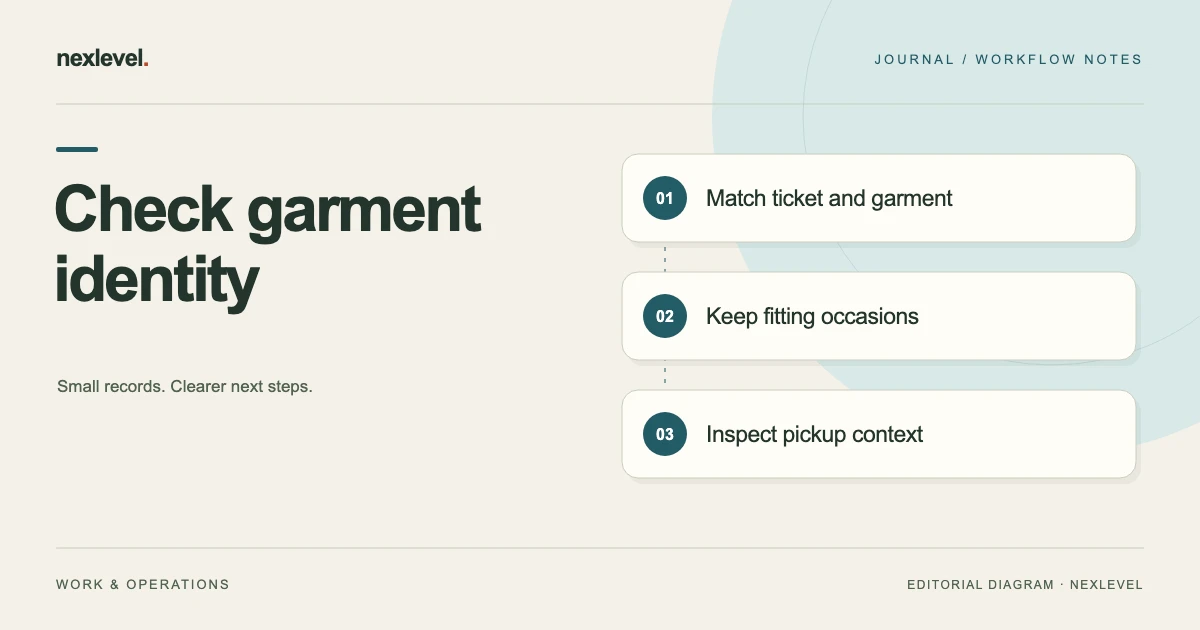
To check garment identity, compare the ticket and garment references across fitting notes, the selected visual map, the approval version and the pickup copy. Start with the mismatch you need to resolve; a familiar customer name or garment description may describe more than one item.
Resolve one identity mismatch at a time
- Write the ticket, garment and fitting occasion the check concerns.
- Locate the actual source for each note, image and retained copy.
- Classify a copied-label error separately from an unresolved garment relationship.
- Correct only the relationship supported by the source and retain the check result.
Working fields:
Source | Ticket ID | Garment ID | Fitting occasion | Version | Match or open question
Useful next steps: Hand off the checked garment record, Retain the archive with its context.
Choose the selected identity question
Write the ticket and garment scope, source cutoff, intended reader, and exact discrepancy. A check concerning one photo or receipt should not appear to verify every item for the customer.
Examples of bounded questions include which garment a fitting image represents, which approval version a pickup copy cites, or whether an abbreviated label lost a ticket reference.
Use fictional records for the exercise. There is no need to inspect a real garment or expose private customer information merely to test the worksheet.
Separate customer, garment, and ticket references
A customer may have multiple garments. A garment description can recur across orders. A ticket reference and source occasion help distinguish the selected relationship.
AlterationTicket’s current description connects customer, garment, visual alteration map, measurements, fitting history, balance, approval, and pickup receipt in a local workspace.
This guide’s references are independent document conventions. They do not establish a barcode module, automatic identity matching, or particular native ticket-number format.
Set up a fictional mismatch
Imagine customer alias C12 with ticket T93 for garment G1 and another ticket T94 for garment G2. Fitting reference F2 belongs to the selected T93 source context.
Approval snapshot A4 and pickup representation P6 are retained for review. One shortened cover note labels a photo only as garment, leaving its G1/G2 relationship uncertain.
No real customer, garment, measurement, fitting, approval, or collection event is supplied. The exercise tests identity context without creating genuine studio history.
Use a garment-source check table
| Source | Relationship to establish | Result to record |
|---|---|---|
| T93/G1 | The selected ticket/item identity | Established reference or exact question |
| F2 | The fitting occasion and garment context | Source route and limitation |
| Selected image/map | The actual ticket/garment relationship | Matched source or unresolved label |
| A4 | The selected approval-version context | Scope and source occasion |
| P6 | The retained pickup representation | Actual contents and cutoff |
The table is an independent companion worksheet. It is not a claim that the app automatically audits all these relationships or resolves a source mismatch.
Collect the minimum actual source set
Start with the selected working ticket, relevant fitting reference, actual image/map context, approval snapshot, and intended pickup representation. Include only what the bounded question needs.
Keep the actual authorized route beside each short reference. A filename in a worksheet does not automatically make the underlying source available to another reader.
If one source is missing, preserve that limitation. Do not borrow a similar image from T94 merely to make the T93 packet look complete.
Compare identity before interpreting details
First establish which ticket and garment each source concerns. Only then inspect the relationship among fitting, approval, and pickup context.
A familiar color, nickname, or image title may help the writer remember an item without being sufficient evidence for another reader. The check should preserve actual selected references.
This guide performs no visual garment assessment or measurement review. The administrative task is to connect records without inventing physical facts.
Keep fitting occasions distinguishable
An earlier fitting image and a later note can both concern G1 while representing different occasions. Their coexistence should not automatically be treated as a duplicate or contradiction.
For F2, identify which source establishes its selected occasion and relationship to T93/G1. A report preparation date should not silently become the fitting date.
If the source establishes limited precision, retain that limit. Do not infer a missing occasion from a file modification timestamp or an approximate memory.
Keep the visual map’s source role clear
The current app describes pinning alteration points on garment imagery and recording notes/measurements. A copied image may lose part of that working-record context.
Open the actual retained representation and inspect what remains visible. A companion index may need to connect the selected image to T93/F2 where the source establishes the relationship.
Do not invent a particular export format or promise that every annotation appears in every shared copy. The check should state what was actually inspected.
Separate approved scope from identity matching
A4 can preserve a selected approval-version relationship without independently resolving which image belongs to G1. Scope review and identity matching can require different sources.
Use the estimate-versus-approved-work guide for that narrower scope question. Preserve the actual result or precise limitation.
A matched ticket reference should not become a workmanship guarantee or a legal conclusion about approval. Keep the administrative roles bounded.
Inspect the pickup representation independently
P6 should identify the actual selected ticket/garment context and source cutoff. A ready status, prepared receipt, and recorded pickup can have different meanings.
AlterationTicket currently describes a shareable pickup receipt and local pickup reminder. A configured prompt or prepared copy should not automatically establish physical collection.
Open the actual output rather than relying on its filename. If it loses a reference preserved in the working ticket, repair the selected representation.
Classify the discrepancy before changing anything
Distinguish a shortened-label problem, an unclear source route, a wrong copied reference, and genuinely conflicting source context. Those findings may need different next steps.
If the working source is accurate but the cover note is wrong, correct the note. If the original relationship is uncertain, preserve the question rather than changing the ticket to match a guess.
A documentation correction is different from recording another fitting, approval, payment, or pickup. Keep those purposes distinguishable.
Run a reverse retrieval test
Begin with P6 and ask a reader to locate T93/G1/F2/A4. Then begin with the selected image and ask which ticket and occasion it actually represents.
Introduce T94/G2 as the similar alternative. The reader should use actual references rather than choose whichever garment looks most familiar.
If one route fails, identify the missing relationship precisely. More files are useful only when they supply that actual source context.
Write a bounded check receipt
Name the ticket/garment selected, sources inspected, relationship established, copy corrected if applicable, and exact remaining question. Avoid a generic verified label that hides what the check covered.
A later source clarification should retain its own occasion. It should not make the historical pickup packet appear to have known later information.
The receipt documents an administrative identity review without certifying technical work, customer satisfaction, or external collection.
Connect the result to handoff or retention
For a responsibility transfer, use the fitting-to-pickup handoff guide. The result should state which identity relationships are established and which question continues.
For a historical packet, use the alteration archive guide. Its contents/cutoff task differs from this selected mismatch check.
The fictional references remain teaching inputs. Reuse the worksheet structure with actual authorized records rather than importing invented fitting or pickup events into genuine studio history.
Work through four identity findings
The selected worksheet can classify different source situations without declaring the whole order correct or incorrect. Each finding should name the actual relationship and bounded next task.
| Fictional finding | Source situation | Bounded result |
|---|---|---|
| Wrong copied label | The working source clearly identifies T93/G1, but the cover says G2 | Repair the cover reference |
| Unresolved image match | The selected source does not distinguish G1 from G2 | Retain the exact source question |
| Different fitting occasion | Two established references describe separate fittings for G1 | Keep both occasions distinguishable |
| Later requested change | A new source concerns work after A4 | Keep the later scope separate from the old approval context |
These are independent teaching cases. They do not claim an automatic app audit, native merge feature, or universal rule about how every retained receipt represents fitting history.
Continue the selected mismatch without inventing events
In the wrong-label case, the useful repair is specific: correct the companion reference using the established working source. There is no need to change an accurate ticket, create another fitting, or record another pickup.
In the unresolved-match case, more confidence is not a substitute for evidence. Name the source that would distinguish the selected image relationship, or state that the relationship remains unavailable.
In the different-occasion case, an earlier and later fitting can both be relevant. Do not delete one as a duplicate simply because the garment reference repeats.
In the later-change case, preserve the new source occasion. A4 should not appear to have authorized information that was unavailable when the selected snapshot was prepared.
Now remove the original comparison conversation. Ask a reader to begin with P6 and identify T93/G1/F2/A4, then begin with the selected image and locate its actual source context.
Introduce T94/G2 as the similar alternative. The reader should use established references rather than familiarity with the customer or garment description. If one route fails, preserve that exact missing relationship.
Keep identity, fitting occasion, approval scope, pickup role, and cutoff inside the check receipt as well as in filenames. A copied image or PDF can lose its original folder path.
The receipt can name which case applied, sources inspected, copy corrected if any, established relationships, and next question. It documents an administrative identity check without a tailoring, legal, or collection-outcome conclusion.
The fictional references remain teaching inputs. Reuse the classification structure with actual authorized studio records while preserving technical-work and external-event boundaries.
Prepare a check receipt for the selected garment
In one fictional branch, the working source establishes T93/G1 and F2, while P6’s copied cover label says G2. The supported correction is to repair that cover reference. It should not create another fitting, approval, or pickup event. The receipt can name the source inspected and the exact explanatory copy changed.
In another branch, the selected source does not establish whether the image concerns G1 or G2. The correct administrative result is an unresolved identity question. A more confident garment nickname or additional unsourced image would not resolve it.
A third branch has two established fitting occasions for G1. Keep both occasions distinguishable rather than deleting one as a duplicate. The selected task may need F2 while the earlier record remains useful history for another question.
The receipt can identify the selected ticket/garment, actual sources opened, relationship established, correction made if any, and precise next source check. Keep approval scope and pickup role separate from the identity conclusion.
For a final check, give another authorized reader only the selected packet and receipt. Ask them to start from P6, then from the image/map, and locate T93/G1/F2/A4. Introduce T94/G2 as the similar alternative. The reader should use established source references rather than visual familiarity or memory of the customer.
Record any manual explanation needed and the authorized source route that remains unavailable. A useful identity review can make the next administrative task specific without a sewing instruction, legal acceptance conclusion, or claim that physical collection occurred.
Use AlterationTicket for connected garment context
AlterationTicket connects entered customer/garment details, fitting history, visual maps, approval versions, balances, and pickup representations without requiring an account.
Check the official AlterationTicket App Store listing for current capabilities and Pro access. Keep record identity, source meaning, technical work, and physical collection in their appropriate roles.