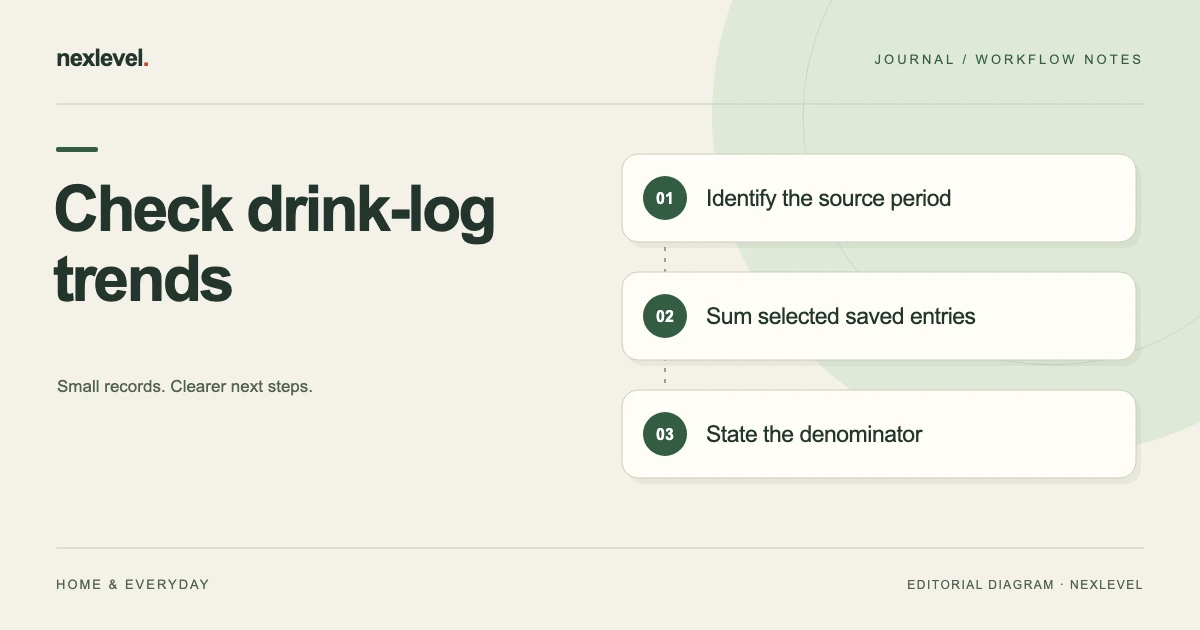
Check a drink-log trend by identifying the history period and saved entries it represents before comparing totals or averages. Keep units and any independent average denominator explicit. A period with no saved entries describes a recording gap in that source; it cannot establish what was physically consumed.
Reconstruct the selected entries before interpreting the chart
- Identify the selected history source, period and available access window.
- Include only matching saved entries and retain their quantity units.
- If calculating an average, state whether the denominator includes empty periods.
- Check period-selection or label errors before changing accurate source entries or inferring an undocumented chart rule.
Working fields:
Source/period | Included entries | Excluded entries/settings | Unit | Total | Average denominator if used | Correction/question
Useful next steps: Separate settings and reminders from entries, Carry the period and calculation into a shared summary.
Define the selected period before reading the shape
Write which history view or supported output you are inspecting and which period it actually represents. A longer history window can contain more entries without establishing that a shorter window lost data.
A source-period label should be understandable without relying on a screenshot’s surrounding conversation. Record the selected occasion and any relevant scope visible in the actual source.
Do not invent day-boundary or time-zone behavior that the current public description does not establish. If the selected source does not make a boundary clear, keep that precise question open.
Set up a fictional three-day worksheet
Imagine selected periods D20, D21, and D22. D20 has saved entries E1 of 100 ml and E2 of 200 ml. D21 has no saved entry in the selected exercise. D22 has E3 of 150 ml and E4 of 200 ml.
An earlier D19 entry E0 of 50 ml is outside the chosen period. R5 identifies reminder configuration, T6 a personal setting, and C8 the prepared companion worksheet.
These are invented teaching inputs. They do not describe a real routine, recommended amount, native CSV schema, or exact chart implementation. No claim is made about unrecorded physical consumption.
Reconstruct only the selected saved entries
| Fictional period | Selected saved entries | Independent total |
|---|---|---|
| D20 | E1 100 ml plus E2 200 ml | 300 ml |
| D21 | No saved entry in this exercise | 0 ml recorded in the selected set |
| D22 | E3 150 ml plus E4 200 ml | 350 ml |
| Selected three-period set | E1, E2, E3, E4 | 650 ml |
| Outside the selected set | D19/E0 50 ml | Excluded from the 650 ml |
The table is an independent worksheet. It does not claim QuenchPop displays these rows, uses these labels, or computes a particular native trend from them.
Distinguish no saved entry from no physical drink
D21’s zero is a statement about this selected saved-entry set. It is not evidence that the fictional person consumed nothing, forgot a reminder, or met or missed a health requirement.
A missing record can remain a missing record. Do not create a guessed pour to make a chart smoother or to fill a blank day in a teaching example.
If a later actual source establishes another saved entry, give that source its own occasion and relationship to the worksheet. A later correction should not make an older retained copy appear to have known more than it did.
Keep the calculation basis visible
The selected sum is 100 plus 200 plus 150 plus 200, giving 650 ml. D22’s recorded total exceeds D20’s by 50 ml under this fictional worksheet convention.
Those calculations compare entered quantities in the selected source set. They do not establish improved hydration, a physical behavioral change, or a recommended increase.
Use the same stated unit throughout the calculation. If a real supported source uses another unit or representation, establish its actual meaning before comparing numbers. This exercise performs no mass-to-volume or physiological conversion.
Explain averages only with an explicit denominator
An independent average across all three selected periods is 650 divided by three, approximately 216.67 ml per selected period when rounded to two decimal places. Across only the two nonempty periods, 650 divided by two is 325 ml.
Both calculations use the same saved entries but answer different worksheet questions. Neither is claimed to be QuenchPop’s native average or trend algorithm.
Keep the denominator beside the result. A bare average can look inconsistent when two readers choose different source periods or count empty periods differently. Resolve that convention before treating their arithmetic as a data error.
Check window differences before searching for missing records
QuenchPop’s current listing describes seven-day history in Free and thirty-day history in Pro. A plan-dependent visible window is different from an independently prepared archive or another retained copy.
Identify the actual available source and selected period. Do not assume an older entry is currently visible merely because a previous file contains it.
Likewise, do not infer deletion from the absence of an entry in one selected view. Establish what that view represents before deciding that the underlying history needs correction.
Separate reminders from entries
R5 describes configuration, not another saved drink. A scheduled prompt should not be added to the entry sum merely because it appears near the log in a working view.
The reminders-versus-recorded-drinks guide covers that narrower distinction. Keep its result separate from the current arithmetic check.
A reminder can be saved while notification permission is off. The current app explicitly supports retaining the schedule in that state. Saved configuration therefore does not independently establish delivered notification, user attention, or physical consumption.
Keep targets and quick-log settings separate
T6 can identify a personal target or main quick-log setting under the actual source arrangement. Those settings are not additional entries unless an actual saved action establishes the record.
Do not calculate the fictional three-period total by multiplying a target by the number of periods. That would replace saved-entry evidence with an intention or configuration.
This administrative check does not evaluate an individual’s target or recommend one. It preserves the distinction between what was configured, what was saved, and what occurred physically.
Treat the visual trend and streak as their advertised roles
The current listing advertises recent logs, a visual trend, and the current streak. It does not establish every aggregation boundary, rounding choice, or streak definition.
Inspect the actual selected source without assigning undocumented formulas to those displays. A companion worksheet can show its own explicit arithmetic while leaving native implementation questions unresolved.
If the source period cannot be established from the available representation, record that limitation. A more precise-looking independent number should not become proof that the app’s differently scoped display is wrong.
Work through a period-selection error
In the first fictional branch, C8 mistakenly includes E0 from D19. Its total becomes 700 ml, which is a correct sum for that larger set but the wrong result for the selected D20–D22 question.
Repair the worksheet’s selected set and explanation using the actual source. Do not alter an accurate D19 entry merely to make C8’s title appear consistent.
The useful result identifies the error as period selection, not native data loss or a physical drinking event. Keeping that distinction makes the correction reproducible.
Work through a settings-versus-history error
In the second branch, a reviewer treats R5 as another drink because a reminder time appears in a prepared summary. Remove that unsupported role assignment from the worksheet.
The schedule itself can remain accurate. There is no need to delete a valid reminder to repair an independent arithmetic explanation.
The permission-off setup guide covers saved schedule and permission context. This exercise changes no actual notification setting or routine.
Work through an average-label error
In the third branch, C8 shows 325 ml but labels it the average across all three selected periods. The arithmetic used only the two nonempty periods.
Correct the stated basis or calculate the explicitly intended three-period model. Preserve the original saved quantities. The mismatch concerns the summary convention rather than the entry records.
Do not use either result as a target, norm, or health assessment. The exercise demonstrates why a denominator belongs beside a derived number, especially when a source period includes an empty saved-entry interval.
Inspect the supported output before comparing copies
QuenchPop Pro currently adds CSV export. Inspect the actual selected output for entry quantities, units, period context, and the cutoff represented. The companion table is not a promised native CSV layout.
The public description does not establish arbitrary CSV import or complete restoration. A readable file should not be described as the whole editable app or as proof that every historical setting can be recovered.
Keep an older retained copy separate from current visible history. A later saved entry or settings change does not automatically update a file already retained elsewhere.
Give another reader a reproducible calculation
Give an authorized reader C8 and the fictional selected entries. Ask them to reconstruct D20’s 300 ml, D22’s 350 ml, and the selected 650 ml sum without adding E0, R5, or T6.
Then ask them to reproduce both averages and explain why their denominators differ. They should be able to do so without guessing QuenchPop’s chart implementation.
Finally, ask what D21’s zero establishes. The answer should remain limited to saved records in the exercise. Record any manual explanation needed; it identifies a label or source boundary the copy still lacks.
Write a source-period check receipt
A manual receipt can state the selected source representation, periods, included entry references, excluded settings/outside-period references, unit basis, calculation convention, actual correction, and precise remaining question.
For the fictional case, the receipt can identify D20–D22 and E1–E4, show the 650 ml sum, distinguish the two average models, and explain that E0/R5/T6 are outside the selected entry calculation.
That result is useful without a claim about physical consumption or native trend internals. Keep the evidence limit inside the receipt so a future reader does not interpret a copied total more broadly than its source supports.
Connect the check to sharing and retention
For a recipient-facing packet, use the source-period sharing guide. Its purpose note should retain the calculation basis established here.
For historical retrieval, use the drink-entry archive guide. For a settings change, use the routine-change review guide.
Keep those tasks distinct. An understandable archive is not a notification-delivery test, and a reminder review is not evidence that a drink was saved or consumed.
Keep the denominator in a copy-ready note
A concise companion note can read: selected saved-entry set D20–D22; E1/E2/E3/E4 included; E0 outside period; R5/T6 configuration only; unit basis milliliters; independent total 650; three-period mean approximately 216.67; nonempty-period mean 325. Native trend and streak calculations are not established by this worksheet.
If only one average is needed for the selected task, label that model clearly instead of placing two unexplained numbers beside the same chart. The reader should understand the denominator without reverse-engineering it from the total.
When the purpose is only to verify the entry sum, omit the average interpretation entirely. A bounded calculation can answer a useful question without adding another derived measure or pretending that every available display must agree numerically.
Before retaining C8, read the note apart from the original screenshot. It should still identify the periods, entries, units, convention, and evidence boundary. If the selected source cannot establish a period relationship, preserve that question beside the affected reference rather than silently choose the most convenient interval.
Use QuenchPop for clear saved-entry context
QuenchPop connects saved pours, chosen local reminders, visible history, and plan-dependent outputs without requiring a NexLevel account. Use the actual supported records as the basis for a bounded review.
Check the official QuenchPop App Store listing for current capabilities and access. Keep source periods, saved entries, settings, independent calculations, and health interpretation in their appropriate roles.