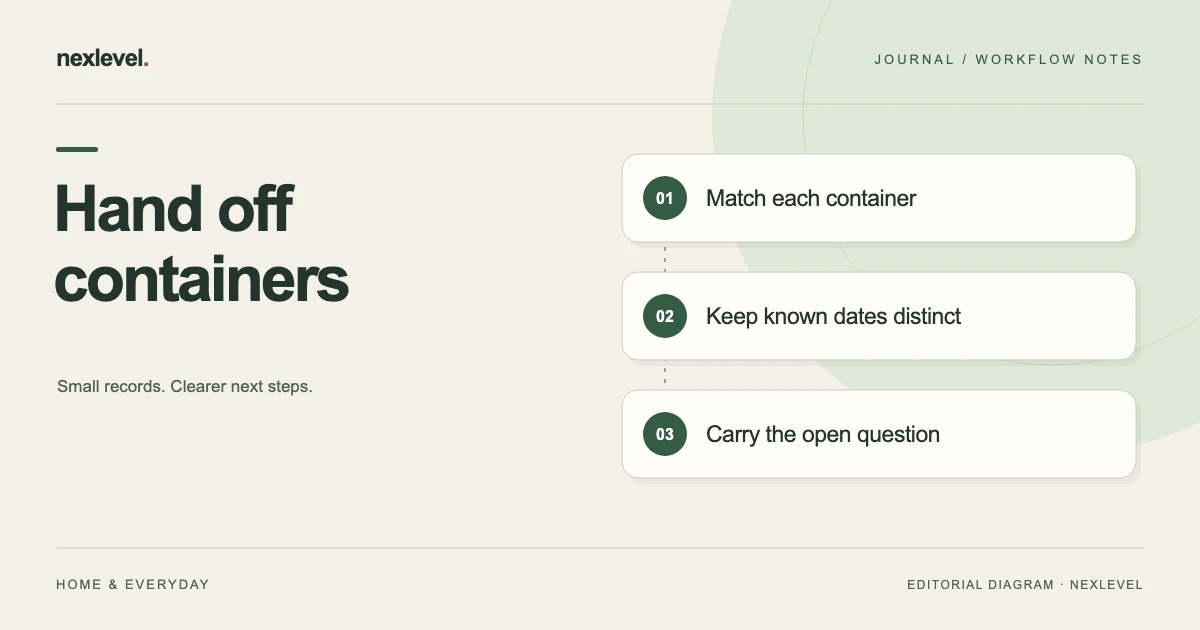
Hand over prepared-food records by identifying the selected containers, their known dates and locations, current recorded states and next questions. State who maintains the working record and which copy the receiver should use. A private device sync or queue screenshot does not by itself provide that household arrangement.
Make the container and next question easy to find
- Define the recipient's task, selected containers and handoff cutoff.
- Match each row to its physical container and keep known and uncertain dates distinct.
- Explain reminder and disposition roles and identify the next source check.
- Open the intended copy and ask the receiver to distinguish the containers without your explanation.
Working fields:
Container/label | Known date/source | Location | Reminder role | Recorded disposition | Open question | Copy/cutoff | Next person/action
Useful next steps: Use the core container inventory, Resolve an actual record mismatch, Explain reminders versus disposition.
Define the recipient’s actual task
Reading a selected inventory copy is different from maintaining the working app or deciding a meal. Name the actual handoff responsibility before sharing a large history.
Identify the selected records and preparation cutoff. A bounded copy can be accurate without representing every later change or all household food.
LeftoverFirst’s current listing describes a local core workflow and optional private iCloud features for the user’s own devices. Do not infer an automatic multiuser household service from those capabilities.
Match the container rather than the dish name alone
Two containers can share a dish label while having different known dates or locations. Use enough source context to distinguish the physical item.
An independent reference such as C21 can help the packet remain readable. It is a companion convention, not a claim about a mandatory app field.
Keep private household details proportional to the task. A useful identity reference does not require distributing unrelated purchase or personal history.
Use a container-handoff worksheet
Suggested fields are container reference, actual label context, known prepared date, recorded location, reminder role, entered disposition, source limitation, intended copy, and next reviewer.
| Role | What the recipient needs |
|---|---|
| Identity | Which physical container the record describes |
| Date | Which event and source the date represents |
| Reminder | A chosen prompt rather than a safety verdict |
| Disposition | The actual recorded state and its source context |
These are independent review fields, not a native household-assignment module. Use the current supported controls for the working record.
Work through a fictional two-container packet
Imagine C21 and C22 with similar dish names. C21 has a source-established preparation date. C22’s preparation date remains uncertain in the available record.
The outgoing person prepares different rows. C21 retains its known source context. C22 keeps the uncertainty explicit rather than copying C21’s date because the labels match.
The recipient can then identify which source question remains. The packet does not tell them whether either food should be consumed, stored, reheated, or discarded.
Keep date roles separate
A preparation date, record-entry time, review occasion, and known location change describe different events. Do not flatten them into one generic deadline.
If only a day is known, preserve that precision. Do not invent a clock time or use the handoff preparation date as a substitute for an unknown earlier event.
The current app description connects containers, location, prepared dates, and reminders. The actual source must still establish what each selected entry means.
Review captured suggestions before treating them as facts
LeftoverFirst’s current listing supports photo, text, or voice capture and on-device label reading with editable field suggestions.
A suggestion is a starting point. Compare it with the actual label or source before describing it as an established field. A neat recognized date cannot resolve an unknown preparation event by itself.
This guide does not claim the app determines freshness or safety from a photograph. The listing explicitly gives dates and queue order an organizational role.
Separate queue position from a food decision
A use-first queue reflects entered dates and rules. It is not an independent assessment of the food’s condition or a guarantee that its source history is complete.
FoodSafety.gov’s guidance addresses handling, cooking, and chilling. Keep appropriate actual instructions available rather than presenting an inventory prompt as a replacement.
The handoff can accurately preserve a record and still leave a food question outside its scope. It should not invent a safe-use period to make the packet look complete.
Keep dispositions attached to the right container
The current description supports eaten, frozen, shared, discarded, and archived states, along with Undo and disposition-history search.
A recorded state should remain attached to the selected item and occasion. Do not apply it to every similarly named container merely because one source is known.
If an actual mistaken update is established, use the supported workflow and inspect its result. An administrative correction does not automatically establish a new physical event.
Choose the actual source arrangement
A screenshot, supported export, and current working view have different scopes. Identify which one the recipient will use and what remains elsewhere.
The current listing includes export in the core loop and full history and optional iCloud features under Pro. Check actual access and output rather than assuming every plan has identical history.
Do not invent a particular file format, general import capability, or automatic household invitation. The actual supported workflow should establish what the handoff can provide.
Inspect the intended copy
Open the actual output and check C21/C22 identity, date roles, locations, entered states, and unresolved questions.
Do not assume every companion worksheet field appears automatically. Provide an appropriate private explanation where the recipient needs a source limitation not included in the file.
A static copy is a representation at an occasion. Preparing it is separate from delivery, understanding, and later record changes.
Correct the appropriate layer
If the working records are accurate but the packet swaps C21 and C22, repair the packet. Do not alter good dates to match an incorrect summary.
If an actual record issue is established, use the supported workflow and inspect the result. Keep later clarification distinguishable from the earlier source occasion.
For a post-meal discrepancy, use the separate container-record reconciliation guide. A handoff should carry its actual outcome or open question.
Review the household arrangement separately from tool choice
The chosen system needs a clear source rule: who maintains the working record, which copy is intended now, and where a later correction will be explained.
For a broader selection, use the prepared-food tool comparison. A local app, label, and sheet can support different tasks without becoming automatically synchronized.
The handoff should preserve the actual arrangement rather than promising capabilities that were not demonstrated.
Test the recipient’s reconstruction
Ask the intended reader to identify C21 and C22, distinguish their known and unknown date context, and locate the actual source route.
If they infer a safety verdict from a reminder or a physical disposition from a vague label, improve the explanation. If they cannot distinguish the containers, improve identity context.
A short receipt identifies the selected scope, actual copy inspected, source limitation, and next question. It does not certify food condition or handling history.
Prepare the fictional household packet
The first row identifies C21 and C22 as separate physical-container references. A shared dish name does not establish shared preparation history. Use actual appropriate source context in real work rather than asking another person to infer identity from the order of rows.
The second row retains C21’s established preparation context. The third records C22’s unresolved date question. Do not make them look equally certain merely because a uniform table is easier to format. The distinction is information the recipient needs.
The location row identifies the entered fridge or freezer context. It should not silently change the original preparation date or establish every condition the food experienced. This guide does not provide storage or reheating instructions.
The reminder row identifies a chosen review prompt. A notification or queue position is not an independent food assessment. The recipient should know where actual labels and appropriate guidance remain available for questions outside the inventory’s organizational role.
The disposition row records only what the actual source establishes. A shared state in the app is an entered record, not automatic proof that another person received the food or understood its source context. Keep any actual communication source separate.
The copy row identifies the current view, supported output, or companion summary being used. Check actual contents. If the independent C22 question is not included, provide an appropriate explanation rather than claiming the export contains information that exists only elsewhere.
The final row names the next source check and responsible household role. A precise question can be handed over without a fabricated answer. The packet is administratively useful when the recipient can continue from established facts and explicit limits.
Check the handoff after a record changes
Suppose the actual source later clarifies C22’s date context. Use the supported workflow for any intended record action and inspect the result. Keep the later clarification distinguishable from the original source occasion rather than making the older copy appear complete all along.
If the working record was already right but the handoff swapped container references, repair the packet. There is no reason to alter accurate dates to match an incorrect cover note. Identify which layer actually needs correction before changing anything.
Now imagine a new similarly named container arrives. It needs its own source relationship. Do not treat an older record’s history as the new item’s facts merely to save typing. Reusing structure should preserve the difference between a template and an actual observation.
Keep optional private device synchronization separate from household access. The current listing describes the user’s own devices, not an automatic invitation system for every household member. A readable static handoff can still serve a bounded task when its preparation scope is clear.
At the next review, ask the recipient to identify the physical container, known date role, actual recorded state, and next question. They should not need the original writer’s memory or infer a safety verdict from a chosen reminder.
Keep the retained copy private according to the actual purpose. The handoff does not require distributing unrelated household history. A concise source route can provide continuity without turning every record into a broadly shared document.
A final receipt identifies selected scope, sources inspected, actual output checked, later clarification if any, and remaining limitation. It does not establish edibility, a safe-use period, or complete handling history. That bounded result is enough to make the administrative handoff clear.
Keep the selected active view distinct from the full disposition history. A container absent from the active queue may have another recorded state, a different selected period, or an unresolved identity question. The actual source should establish which explanation applies.
The current product distinguishes a bounded active-food allowance and expanded full history under Pro. Check the actual view used for the handoff rather than promising every recipient the same scope. A portable copy should identify what it contains and what remains elsewhere.
If a later household review changes the intended source arrangement, preserve the original packet’s preparation context. A new copy can be identified as current without pretending the earlier one never existed. That gives the recipient a usable source rule and avoids turning a record-organization change into an invented preparation date, food disposition, or safety judgment.
Use a short cover note for the two-container example: “C21 has the stated preparation source; C22 still needs its own source check. This copy was prepared for identifying records, not deciding edibility.” Keep that note beside the selected copy where the recipient will actually read it. A general household message can lose the container distinction when forwarded separately.
Use LeftoverFirst for clear local organization
LeftoverFirst connects container identity, labels, dates, location, reminders, queue context, and disposition history. Its current Pro description expands active capacity, history, templates, and optional device features.
Check the official LeftoverFirst App Store listing for current features and plan details. Use a bounded handoff to preserve known facts while leaving actual food decisions with appropriate labels, guidance, and the responsible household process.