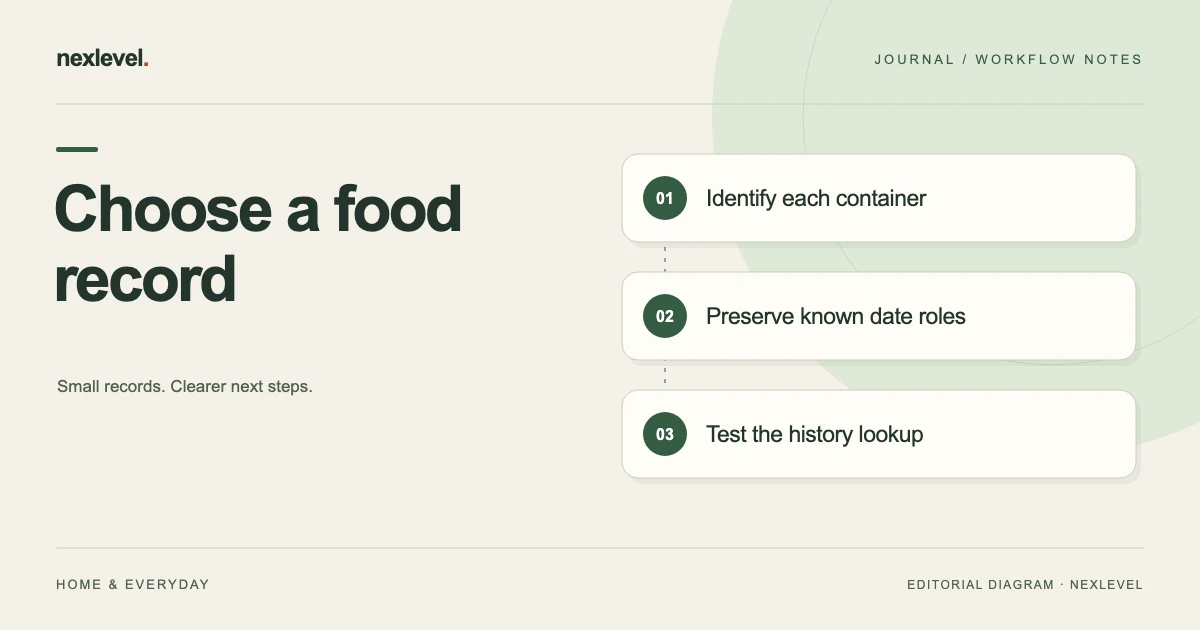
Choose a prepared-food record method by testing how it identifies a container, preserves known and unknown dates, records a change and retrieves history. Use the same fictional containers for labels, a sheet and an app, then include the manual updates each approach needs in your decision.
Test one container through its record lifecycle
- Name the identification or history problem the method needs to solve.
- Use two similar containers, with one known preparation date and one unresolved date.
- Record a location change and disposition, then find the earlier event again.
- Inspect the intended copy and compare maintenance, feature access and unresolved limitations.
Working fields:
Method | Container identity | Known/unknown dates | Update convention | History lookup | Portable copy | Manual work | Remaining issue
Useful next steps: Define the inventory fields first, Test post-meal reconciliation, Check later record retrieval.
Start with the question you want to answer
A useful question is “Which record belongs to this container, and what does its latest entered state mean?” That is different from asking a tool to decide what is safe to consume.
Write the practical problem your current arrangement leaves unresolved. Perhaps containers have similar names, a shared note lacks dates, or an old row remains active after someone records a disposition.
Test that problem directly. A tool’s attractive queue or larger field count does not establish that the household can identify the correct physical container.
The selection should fit the records people will actually maintain. An elaborate inventory that nobody updates can create more ambiguity than a simple well-understood arrangement.
Compare the whole record lifecycle
Use the same fictional container in every candidate system. Check identity, known preparation date, location, review prompt, current recorded state, and later history lookup.
| Task | Question to test |
|---|---|
| Identify | Can someone match the record to the container? |
| Review | Are known dates separate from reminders? |
| Update | Can a recorded change remain understandable? |
| Find history | Can the household locate an earlier disposition? |
Record what you demonstrated and what depends on a manual convention. “Works if everyone writes the reference” is a real assumption worth retaining.
This worksheet does not compare food-safety authority. None of these organizational methods independently establishes every condition the food experienced.
Test a physical label
A readable label can keep identity context near the container. Test whether its wording distinguishes two similar containers and whether known dates retain their meanings.
Do not label an unknown preparation date as though it were observed. A date written when the record was created may describe data entry rather than preparation.
Consider the history question separately. Once a container leaves the active set, a physical label alone may not provide the household’s desired history unless the actual process preserves it.
A label is useful context. It is not an independent safety verdict, and this guide does not prescribe wording that replaces manufacturer instructions or appropriate official guidance.
Test a paper or spreadsheet list
A shared sheet can organize several containers when its row identity and update conventions are clear. Decide what each row represents before adding quantities and dates.
Check whether similar dish names remain distinguishable. If one row represents several containers, explain that scope rather than allowing another reader to assume it refers to one physical item.
Then test a recorded location change and disposition. The reader should know whether a row is current, historical, or awaiting clarification. A crossed-out line without context can leave several interpretations.
A spreadsheet’s filter or a paper list’s active section can help retrieval, but the actual source state matters. Do not assume a blank row means food was eaten or discarded.
Test a dedicated queue against its actual description
LeftoverFirst’s current listing describes prepared-food capture using a photo, text, or voice label; container and location context; prepared dates; reminders; an explainable queue; and disposition history.
Use the fictional lifecycle to test those capabilities. The source says the queue uses dates and rules the user chooses. It should not be described as independently verifying food freshness or expiration.
Check current feature access. The listing describes a bounded active-food allowance in Free, with expanded capacity, full history, templates, and other workflow features under Pro.
Do not infer a general household collaboration service or automatic physical inventory sensing from the existence of an app queue.
Run a fictional two-container exercise
Imagine containers C12 and C13 holding similarly named prepared dishes in a fictional household. C12 has an established preparation date. C13’s preparation date is not established in the available source.
The test is whether the chosen system preserves that difference. It should not copy C12’s date into C13 merely because the names match or the containers were entered together.
Next, record a known location change for C12 through the candidate’s actual workflow. Check whether the reader can still identify the container and distinguish that event from the original preparation date.
Finally, record a fictional disposition and locate it later. The exercise tests administrative continuity, not whether either dish should be eaten, stored, or reheated.
Keep suggestions editable and source-based
The app’s current description includes on-device label reading and editable field suggestions. A recognized phrase or suggested date is a draft input until the user reviews it against the actual source.
Do not describe OCR as a safety assessment or assume a neat field establishes the printed label’s full meaning. Check the container identity and date role before accepting a suggestion.
For C13, the correct organizational result may be an explicit source question. Filling a date from a similar record would produce certainty the household does not actually have.
The same principle applies to copied spreadsheet rows or preprinted forms. Reusing structure should not copy another container’s facts into a completed-looking record.
Separate a reminder from a food decision
A reminder is a chosen prompt to review a record. A queue position organizes entered information. Neither establishes that a particular food is safe or unsafe.
LeftoverFirst’s listing explicitly gives dates, queue order, and reminders an organizational role. Keep actual labels, storage and reheating instructions, and appropriate official guidance available for food questions.
FoodSafety.gov’s food-safety guidance addresses handling, cooking, and chilling as separate practical subjects. A household inventory record should not be presented as replacing that guidance.
This comparison supplies no universal timer or safe-use period. The tool-selection task is to preserve known context and prompts without converting them into an unsupported judgment.
Review dispositions without rewriting identity
The current listing describes eaten, frozen, shared, discarded, and archived records, along with Undo and disposition-history search. These states help explain what was entered in the working record.
A recorded disposition should remain attached to the correct container. A similar name is not enough to decide that C12 and C13 both changed state.
If a mistaken update is established, use the actual supported correction or Undo workflow and inspect the result. Do not assume a correction updates every retained household sheet or screenshot.
For a particular post-meal discrepancy, use the separate prepared-food record reconciliation guide. Choosing a tool and repairing one record are different tasks.
Compare local use and optional device features
LeftoverFirst’s core records and photos stay on device, with no account required for the core workflow. Its current listing describes optional private iCloud synchronization and plan-dependent widgets and Watch actions.
Keep those capabilities distinct from a shared household account. Optional private device synchronization should not be described as automatic collaboration among every person in the kitchen.
Test the actual devices and workflow you intend to use. A retained companion view or screenshot may represent a different source moment from the current working record.
The important question is whether the household can find and update the intended record through its actual arrangement, not whether every possible device feature is enabled.
Inspect a portable copy before relying on it
The current description includes export and deletion as part of the core loop. Prepare the actual supported output and inspect what it retains for the selected task.
Do not invent a particular file format or a general import capability from a broad export statement. Check the actual workflow before planning a move from another system.
A readable copy, an editable working inventory, and a restorable backup are different requirements. State which one you tested rather than calling every file a complete backup.
If the intended recipient needs C13’s unresolved source question, verify that the copy communicates it or supply an appropriate companion explanation. A filename alone does not establish its contents.
Make a small transition with retained originals
Choose a representative sample and preserve the earlier records. Match each container reference to the new structure before expanding the move.
Do not refresh old dates to the transition day. Entry time and preparation time should remain distinguishable where their actual sources differ.
Repeat the two-container exercise in the destination. Can another person distinguish C12’s known date from C13’s unresolved date and find the selected disposition history?
If the answer depends on memory, improve the identity convention before adding more containers. A small clear transition is more useful than copying many ambiguous rows quickly.
Choose a maintainable arrangement
A label may meet a household’s immediate identity needs. A sheet may help organize several records when people maintain it consistently. A dedicated queue may help when its capture, reminder, and history features match the tasks you tested.
Write the decision with its assumptions: active-record scope, identity convention, known-date handling, update responsibility, and portable-copy limitation. Revisit it when the household’s routine changes.
There is no need to declare a permanent winner. The useful outcome is a record arrangement that the actual people can understand and keep current without inventing food-safety certainty.
Ask another intended user to reconstruct C12 and C13 from the chosen system. Their explanation is a practical test of the record’s clarity.
Write a comparison result for the two-container exercise
A useful result can say which method preserved the difference between C12 and C13. For the label candidate, check whether the physical references remain distinguishable after a retained photo is separated from the container. For the sheet candidate, check whether one row really represents one item or an explicitly defined group.
For the app candidate, inspect the actual accepted fields after reviewing any suggestions. A recognized date should not become C13’s preparation date unless the source establishes that role. The record can remain useful with an explicit companion question.
Then test the later disposition lookup. If the chosen history scope does not show the earlier occasion, record that limitation instead of assuming the event never existed. LeftoverFirst’s current listing distinguishes complete history under Pro, so available scope belongs in the comparison result.
The decision note might read: “Selected arrangement distinguishes both containers, retains C12’s established date, preserves C13’s unresolved date role, and allows the intended disposition review within the tested scope.” Replace that wording with what you actually demonstrated.
This is a conditional organizational conclusion. It does not tell the household which food to consume, establish a safe storage period, or prove that a reminder was followed. Keep the food-safety question with the appropriate actual sources. The point of the comparison is that a future reader can recover the known facts and limitations without inventing context from a familiar dish name.
Choose an identity convention that survives a shortened view. If the household’s sheet uses only dish names, test how two similarly named containers remain distinguishable after a row is copied. The actual source reference should still point to the intended item. Do not make the reader infer identity from the order in which rows happen to appear.
Evaluate LeftoverFirst with a fictional kitchen record
LeftoverFirst organizes prepared-food identity, location, dates, reminders, queue context, and disposition history. Its current listing describes a local core workflow with optional expanded features under Pro.
Check the official LeftoverFirst App Store listing for current capabilities and plan details. Choose the tool for clear organization while keeping actual food decisions with labels, appropriate guidance, and the responsible household process.