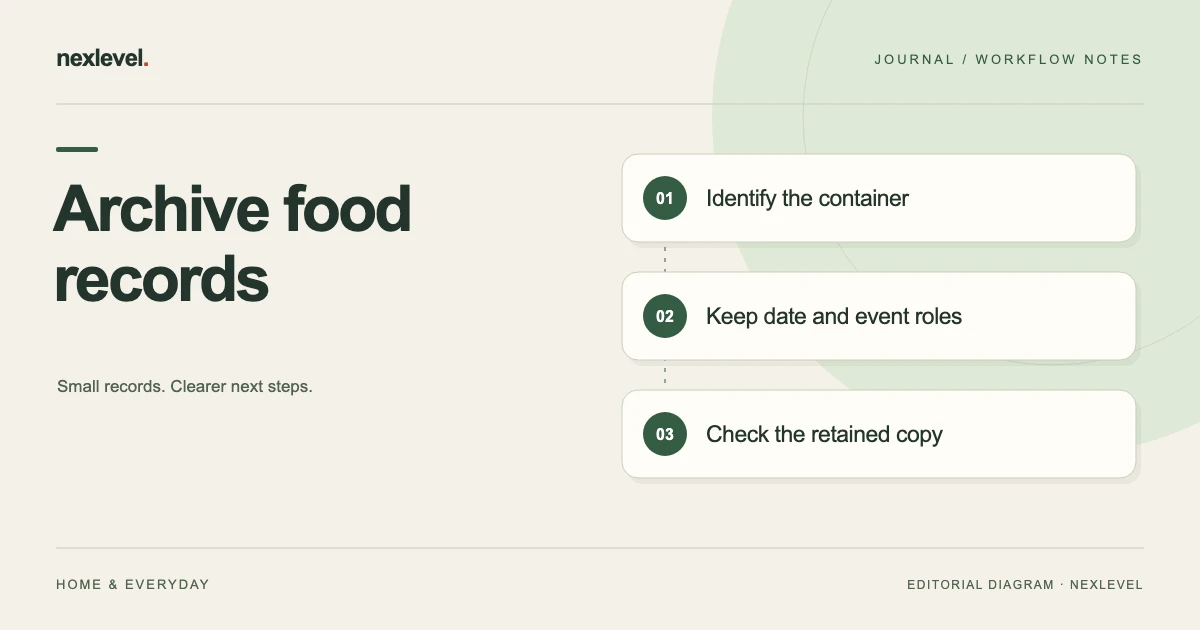
Archive a prepared-food record by identifying the container, label source, date meanings and selected disposition history at a stated cutoff. Keep the reminder and export date in their own roles. Inspect the output and add a source index where it needs context for later retrieval.
Retain the source behind each date and event
- Choose the container and historical question the archive must explain.
- Index the label, entered dates, location, reminder and disposition by source occasion.
- Open the actual output and list its contents, access dependencies and missing relationships.
- Test lookup from the label and disposition back to the right container.
Working fields:
Container | Label source | Entered date/location occasion | Reminder role | Disposition source | Output/cutoff | Limitation | Retrieval result
Useful next steps: Reconcile source and current container records, Prepare a current household handoff.
Choose the historical question
A later reader may need to identify one container, reconstruct an entered disposition, or understand which label source supported a selected record. Those tasks can need different sources.
Write the selected item scope, source cutoff, preparation occasion, intended reader, and actual output. A packet about one container should not appear to represent every household item or all later changes.
Keep the material proportional and private. A companion index can preserve source relationships without retaining unrelated household photos or exposing account information.
Preserve container identity and source wording
A familiar dish name may recur across containers and occasions. Retain enough authorized context to distinguish the selected item and its entered source relationship.
LeftoverFirst’s current description includes photo, text, or voice labels, on-device label reading, editable field suggestions, container context, location, prepared date, and reminders. A suggested field should not silently replace the actual source wording.
If the source cannot establish which container a label belongs to, preserve that question. Do not assign a source merely because the filename or display name looks similar.
Use a prepared-food archive index
One row can identify each selected source relationship. Separate rows can preserve date, location, reminder, and disposition context where their roles differ.
| Field | What to preserve |
|---|---|
| Container | The selected item and actual identifying context |
| Label source | The wording or source route behind the entry |
| Date context | Which entered occasion the packet represents |
| Location | The selected recorded storage context |
| Disposition | The actual entered change and source occasion |
| Output | The retained representation, cutoff, and limitation |
These are independent companion prompts, not a named archive module or a guarantee that every explanatory field appears automatically in an export.
Work through a fictional container packet
Imagine container C14, label source L3, and entered record E2. Reminder R4 belongs to the selected planning context. Disposition D6 and retained copy A8 concern their own occasions.
The first index row identifies C14 and its actual route to L3. Another preserves the entered date and location context. A separate row identifies what D6 actually records.
A8 represents the selected cutoff, not every later working change. A limitation row asks whether a shortened label in the copy can be traced to the original source.
No real food, date, storage action, consumption, disposal, or household outcome is supplied. The fictional references demonstrate administrative relationships without creating genuine inventory history.
Keep date and reminder roles distinct
A prepared date, a chosen check reminder, a recorded disposition occasion, and an export preparation time describe different roles. The archive should preserve their actual meanings.
The current app explains its queue using the dates and rules the user chooses. A prompt can organize attention without determining expiration, edibility, or a safe handling period.
This guide recommends no date rule or reminder lead time. If the selected source is unclear, retain the limitation rather than inferring a preparation date from a file timestamp.
Preserve entered location without claiming physical verification
A selected fridge or freezer field records the user’s entered context. It does not independently establish a container’s physical location or storage conditions at every later occasion.
For C14, identify which source occasion the retained location represents. A later working change can coexist with A8’s earlier context without making the archive wrong as history.
Use the container-record reconciliation guide if the relationship is unclear. Preserve the actual result or next source question.
Keep disposition history in its actual role
The current LeftoverFirst description includes eaten, frozen, shared, discarded, and archived states, with undo and disposition-history search. Those entered records organize a household workflow.
A recorded state should not be expanded into independent proof of physical consumption, delivery to another person, or a food-safety outcome. Keep the selected source and occasion readable.
For D6, state what the actual source establishes. If the outcome remains uncertain, preserve that question instead of filling a plausible event to make the packet look closed.
Separate optional sync from a retained archive
LeftoverFirst’s current description includes optional private iCloud features for the user’s own devices, alongside a core local workflow that does not require an account.
A synchronized working view, an exported copy, and a historical packet have different purposes. Do not assume that sharing a file creates live multiuser inventory or that every old copy automatically receives later updates.
The public description does not establish a universal cross-person database, arbitrary spreadsheet import, or complete restore process. Keep the retention plan within actual supported capabilities.
Inspect the actual export representation
The current listing says users can export their data, with the Free plan including the core export loop and Pro expanding history and other tools. It does not promise a particular universal CSV or PDF format.
Open the selected supported output and inspect container identity, label context, entered date roles, location, disposition, and source cutoff. A companion note may be needed for relationships not represented automatically.
A file’s existence does not prove that the intended reader can interpret it. Output preparation, authorized access, and useful retrieval are separate results.
Prepare a cover note for A8
The first line can identify C14, the selected source cutoff, and the archive purpose. A label line names L3 and the actual source route. Date and location lines preserve their entered roles.
A disposition line identifies D6 and the event the available source establishes. A reminder line keeps R4’s planning role separate from preparation, consumption, or disposal.
A contents line should name only what is retained. A supported export, selected source representation, and companion index can serve different purposes. A filename called complete does not establish their actual contents.
Test retrieval in both directions
Ask a reader to start with A8 and identify C14/L3/E2 and D6’s role. Then start with L3 and locate the selected container relationship.
Introduce another fictional container C15 with a similar display name. The reader should use actual source references rather than assign the label to the first familiar item.
If the selected copy loses a relationship preserved in the working record, repair the copy. If the original source remains uncertain, retain that question instead of choosing a plausible date or disposition.
Keep later clarification visibly later
A later source may clarify a shortened label or disposition relationship. Retain its own occasion and relationship to A8. Do not make the older packet appear to have contained later information from the start.
A correction to the companion explanation is different from recording a new disposition or changing a reminder. Keeping those purposes distinguishable prevents an archive repair from creating fictional household activity.
A concise receipt can name sources inspected, relationships established, actual output opened, and next question. It documents an administrative review without making a food-quality or safety claim.
Keep practical food handling with appropriate guidance
The official FoodSafety.gov handling guidance addresses practical food-safety actions. An archived inventory record does not replace that guidance or determine edibility from a date or queue position.
No temperatures, storage durations, reheating instructions, or physical assessment methods are supplied here. The archive exercise can be completed entirely with fictional references.
The app’s current description likewise presents dates, queue order, and reminders as organizational aids. Preserve that boundary when summarizing the retained record.
Separate an archive from a household handoff
An archive can support later retrieval by the original user. Another household member taking over the records adds questions about source access, current context, and responsibility for the next check.
Use the prepared-food handoff guide for that task. A retained file does not itself make every recipient’s working copy current.
For method selection, use the prepared-food inventory comparison. Choosing a tool and preparing a historical packet have related but distinct requirements.
Complete the container source-and-event table
The A8 cover note can use separate lines for label, entry, reminder, disposition, and output. This is an independent explanatory worksheet rather than a guarantee that every line is a native export field.
| Reference | Role in the packet | Question to preserve |
|---|---|---|
| C14 | The selected container identity | What distinguishes another similarly named item? |
| L3 | The original label-source route | Which wording does the source actually establish? |
| E2 | The entered date and location context | Which occasion does the retained record represent? |
| R4 | A chosen check reminder | What was configured rather than physically observed? |
| D6 | The selected disposition record | Which source establishes its actual role? |
| A8 | The chosen output at its cutoff | What later information remains outside the packet? |
Ask the reader to begin with L3 and identify C14/E2. Then begin with D6 and locate the selected container context. The routes should converge where the actual sources establish the relationship, without relying on the original writer’s memory.
If a shortened label loses an established distinction between C14 and C15, repair the companion explanation. If the original source cannot establish the match, retain the exact question rather than assigning the label to a plausible container.
Compare two possible retained copies
Imagine packet P1 contains only a container image. Packet P2 contains the selected supported output plus a companion source index. Neither is automatically sufficient; compare them with the actual retrieval purpose.
If the task is to find one source label, P1 may supply a useful route once identity is established. If the task is to reconstruct entered date, location, and disposition context, the additional relationships in P2 matter. More files help when they answer the selected question.
Now suppose P2 assigns D6 to the wrong container. Its extra detail does not make it accurate. Repair the source relationship rather than creating a new disposition event to make the packet agree with its summary.
A bounded completion note can identify which representation was opened, which sources were inspected, which relationships were established, and what remained uncertain. It should not claim that food was eaten, shared, or safely stored solely because the archive is readable.
Keep the actual cutoff and important explanations inside the packet too. Files can be renamed or moved, and a later reader should not have to infer source meaning from a folder path or modification time.
The reusable artifact is the source-role table and retrieval exercise. Actual labels, dates, locations, events, and limitations should come from authorized household records. The fictional references supply no handling rule or food-safety result and should remain outside genuine inventory history.
For a final check, give the reader only the selected packet and ask them to identify C14/L3/E2/R4/D6 and the actual cutoff. They should distinguish an entered date, a reminder, a recorded disposition, and a prepared output. If they need the original writer to explain one relationship, preserve that dependency before relying on the archive. A useful packet can make the next source question specific while leaving actual food handling, physical outcomes, and safety judgments outside its administrative conclusion.
Use LeftoverFirst for clear local container records
LeftoverFirst organizes entered container labels, locations, selected dates, reminders, and disposition history in a local workspace with optional plan-dependent online features.
Check the official LeftoverFirst App Store listing for current capabilities. A useful archive preserves what was recorded while keeping actual labels, storage instructions, and official food-safety guidance in their appropriate roles.